‘The main constraint on AI adoption will not be tools or investment — but the availability of skilled professionals’

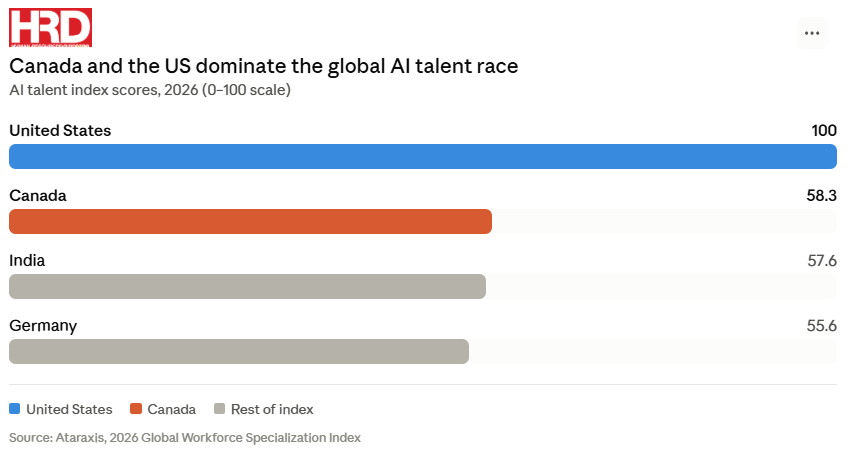
North America holds a commanding lead over the rest of the world in artificial intelligence (AI) talent, with the United States scoring a perfect 100 and Canada climbing to second place globally with a score of 58.345 — more than 20 points clear of any European economy — according to a new international index.
Every other country, including established technology powers – such as Germany, the United Kingdom and Australia – trails well behind.
The 2026 Global Workforce Specialization Index – produced by analytics firm Ataraxis – covers 32 countries and six professional fields. India is the only country that comes close to Canada, scoring 57.57, but it is edged out on the density and international readiness measures that matter most to employers hiring at scale. Germany, the next major contender, scores significantly lower still — underlining just how wide the gap is between North America and the rest of the world.
The US operates in a tier of its own. Canada leads every other country, but its score of 58.345 against the US perfect 100 reflects a gap that shapes hiring competition, compensation benchmarks and talent retention pressure for Canadian organisations daily.
How Canada earned second place
The Ataraxis index constructs its composite score from three weighted dimensions: absolute workforce capacity at 40%, capacity density relative to population at 35%, and service-delivery readiness at 25%. Those weightings explain why India, despite recording a higher absolute AI capacity score of 81.9 compared with Canada’s 54.7, does not hold second place. Canada’s capacity-density score of 39.9 substantially outpaces India’s 6.6, and both countries receive equivalent service-delivery readiness scores of 90.
Separate data from CBRE’s 2026 Scoring Tech Talent report reinforces the picture. The number of AI-skilled tech talent workers across the US and Canada increased by 45% year-over-year to 751,000 as of mid-2026, with AI-specialty talent clustered at 37% of the US total, while Toronto, Montreal and Vancouver contain 60% of Canada’s. Canada’s tech wage premium sits at just 8% above the national average, compared with 15% in the US, according to CBRE — a disparity that creates persistent pressure on Canadian employers competing for the same specialist pool as American firms.
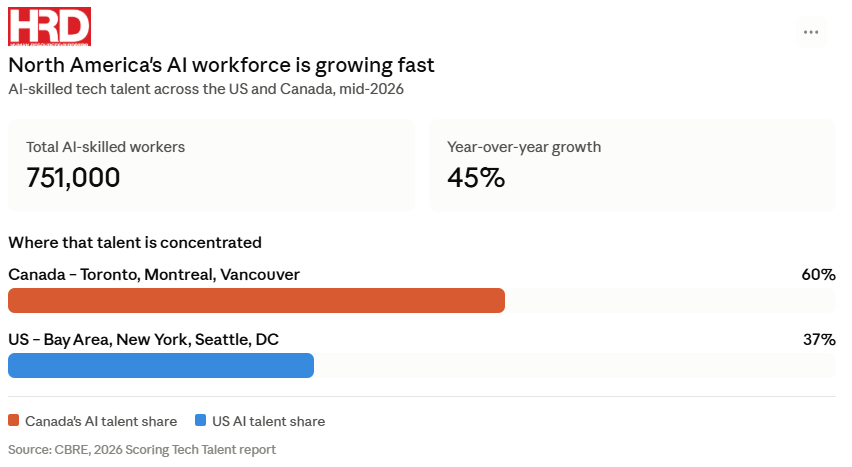
Canada’s position builds on long-term investment in foundational research through institutions including Mila, the Vector Institute and the Alberta Machine Intelligence Institute (Amii), which received a C$50 million, five-year provincial commitment in July 2026. The concentration of 60 per cent of Canada’s AI-specialty talent in three cities is a sign of depth, but it also means the country’s workforce advantage is geographically narrow, making those markets intensely competitive for recruiters.
For HR leaders tracking Canada’s widening AI skills gap and the confidence levels of workers using these tools, the ranking underscores that talent density and talent retention are two separate problems.
What the ranking means for HR leaders
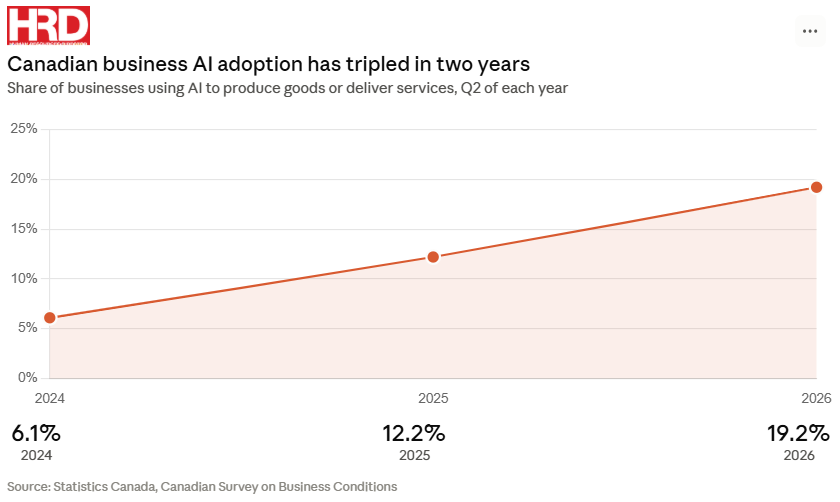
Workforce concentration does not automatically translate into broad commercial deployment. Statistics Canada’s Canadian Survey on Business Conditions, conducted from April to May 2026, found that 19.2% of businesses had used AI to produce goods or deliver services during the preceding 12 months — up from 6.1% in 2024, but still leaving most Canadian enterprises outside active adoption.
Patrick Poulin, President and Managing Director of Randstad Canada in Montreal, has identified the specialist shortage as the central constraint. “In 2026, the main constraint on AI adoption will not be tools or investment — but the availability of skilled professionals who can implement these systems at scale,” he said. Rob Wilmot, General Manager of IBM Consulting Canada in Toronto, echoed that view in February 2026, noting that Canadian organisations are entering 2026 “not because the economy is predictable, but because leaders are betting on AI as a long-term growth engine.”
HRD Canada’s reporting on how HR functions are excluded from AI strategy decisions at 37% of Canadian firms, according to an IBM study with Oxford Economics, suggests many organisations still lack the internal alignment needed to deploy that talent effectively.
For those that do, HR leaders tracking the five workforce transformation priorities outlined in Canada’s national AI strategy will find the Ataraxis results both affirming and cautionary — Canada has the specialist depth to compete globally, but converting that into business-wide productivity gains requires deliberate action now.