Canadian HR teams expected to lead AI implementation, but IBM finds AI literacy and change management capabilities lagging
More than a third of Canadian organizations leave their CHRO out of artificial intelligence (AI) strategy, even as HR is expected to lead AI transformation, according to an IBM study.
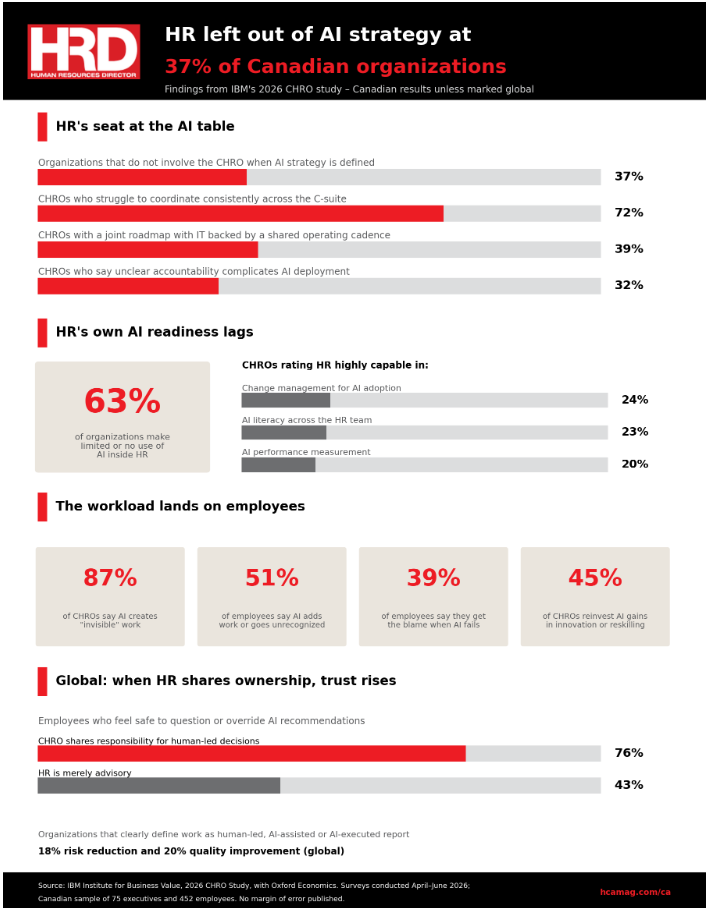
The IBM Institute for Business Value found 37% of Canadian organizations do not involve the CHRO when AI strategy is being defined. Among Canadian CHROs, 72% say they struggle to coordinate consistently across the C-suite, and 39% report a joint roadmap with information technology (IT) backed by a shared operating cadence.
The study – conducted with Oxford Economics from April to June 2026 – surveyed 1,500 CHROs and senior workforce executives, including 75 in Canada, and 8,800 full-time employees, including 452 in Canada.
HR readiness lags AI adoption
IBM found 63% of Canadian organizations make limited or no use of AI inside the HR function. Canadian CHROs rate HR low in AI literacy (23%), AI performance measurement (20%) and change management for AI adoption (24%). A separate 2026 TD report on Canada's widening AI skills gap found 32% of Canadians polled say they have overstated their AI abilities at work.
Globally, organizations with mature HR AI capability, including governance, architecture and measurement, are nearly twice as likely to report a higher number of positive business key performance indicators, IBM found.
Statistics Canada data shows AI adoption plans growing, with 25.2% of businesses in the third quarter of 2026 planning to use AI within 12 months.
"AI is transforming jobs rather than replacing workers," Dr. Anne-Lore Fraikin, associate director of economic research at Ottawa-based Signal49 Research, formerly the Conference Board of Canada, said at a June 2026 Future Skills Centre webinar. She noted employers increasingly value AI literacy paired with skills such as judgement and problem-solving.
AI oversight creates invisible work
IBM reports that globally, organizations that clearly define workflows as human-led, AI-assisted or AI-executed achieve 18% risk reduction and 20% quality improvement.
IBM also found 87% of Canadian CHROs believe AI adoption creates "invisible" work, including validating recommendations, fixing mistakes, providing context and managing exceptions. Among Canadian employees, 51% say AI increases their work or leaves it unrecognized.
According to the study, 39% of Canadian employees say the blame falls on them when something goes wrong with AI, and 32% of Canadian CHROs say unclear accountability complicates deployment.
Globally – where the CHRO at least shares responsibility for which decisions remain human-led – 76% of employees feel safe to question or override AI recommendations, according to IBM. That falls to 43% where HR is merely advisory.
Among Canadian CHROs, 45% say AI productivity gains are primarily reinvested in innovation or reskilling.
In the report, Bich adds: "If the reinvestment is you've saved 10 minutes per person per day and it goes into doing one more email, that's not a good use of anyone's time."