Poll shows two-thirds of Canadians support building our economy as relationship with U.S. deteriorates

Two in three Canadians no longer believe the country’s economic relationship with the United States will go back to what it was — and HR leaders are being handed a clear signal to stop planning around a rebound and start building for a fundamentally different trade reality.
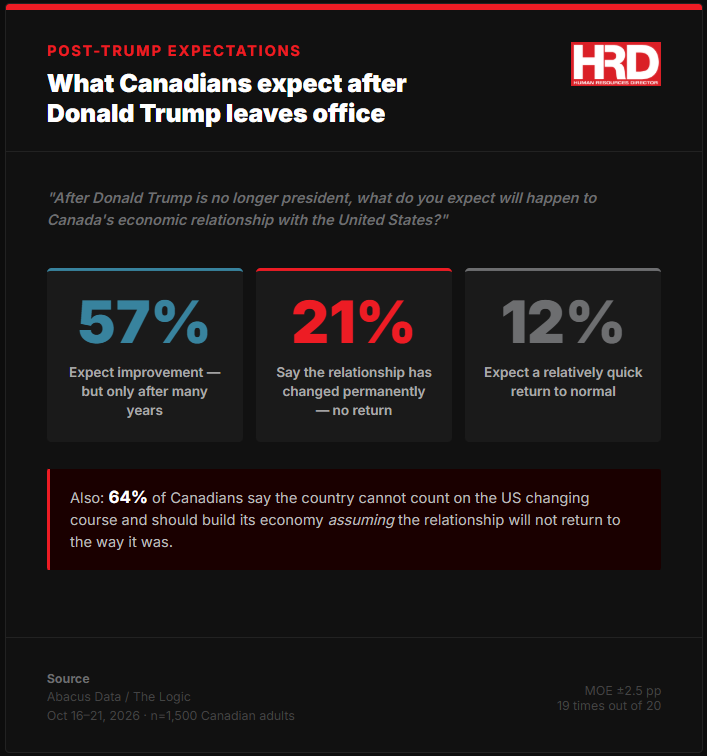
A new survey from Abacus Data, conducted between October 16 and 21, 2026, polled 1,500 Canadian adults and found that 64% support building Canada’s economy on the assumption that the US relationship will not revert to its pre-tariff form.
Only 26% believe the disruption is temporary and that waiting for American politics to shift is the right call. The margin of error is plus or minus 2.5 percentage points, 19 times out of 20.
A slow road back
Even Canadians who expect an improvement are not expecting it quickly. The survey found that 57% believe the relationship will eventually get better after Donald Trump leaves the White House, but only after many years. Another 21% think the change is permanent, and just 12% anticipate a relatively swift return to normal.
That timeline distinction matters for HR. Workforce plans calibrated to a quick political fix will look very different from those designed around a multi-year structural adjustment — and the Abacus Data data suggests the latter is the more widely held expectation. HRD Canada’s coverage of how Canada’s trade storm with the US is affecting hiring and investment decisions has found employers in tariff-exposed sectors are already operating in that mode.
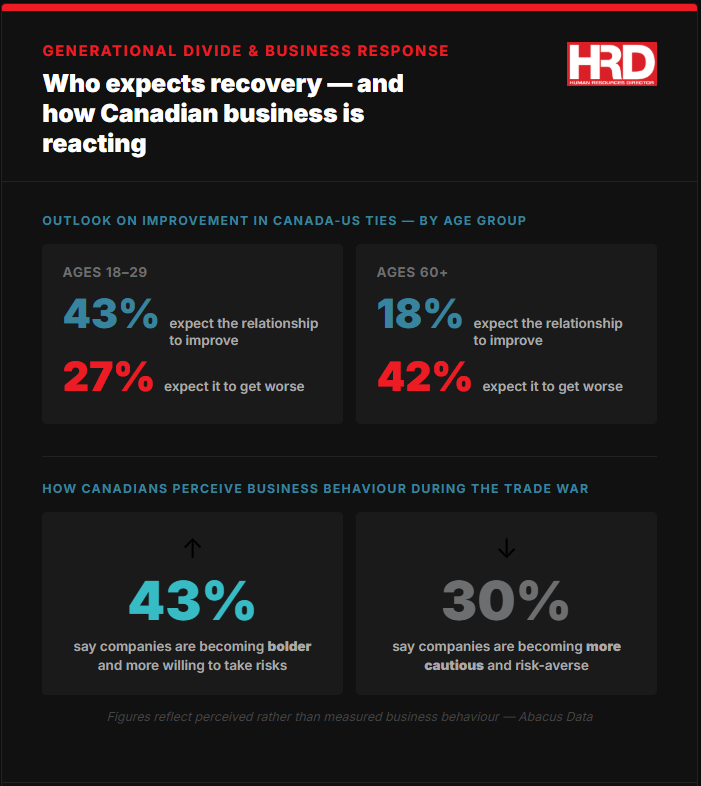
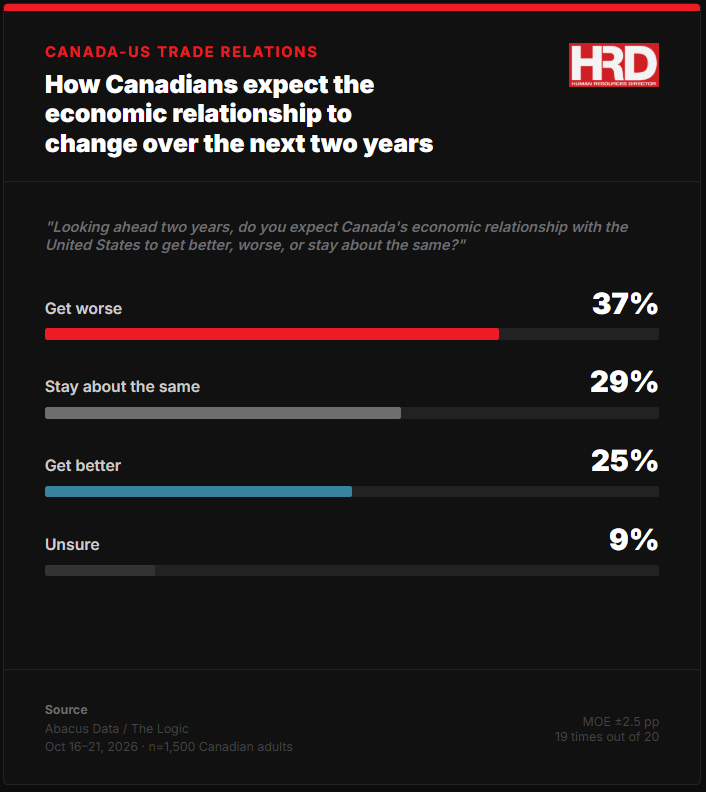
Looking ahead two years, 37% of Canadians expect the economic relationship to worsen, compared with 25% who expect improvement and 29% who see little change. The pessimism is sharpest among Canadians aged 60 and older, of whom 42% expect things to deteriorate. For HR teams managing early-career pipelines, a generational divide is also evident: 43% of those aged 18 to 29 expect improvement — an optimism gap that may be worth addressing directly in recruitment and retention messaging for trade-exposed sectors.
Talks resume, but caution remains
The poll’s findings land against a fast-moving diplomatic backdrop. Prime Minister Mark Carney posted on X on November 1, 2026, that he had a “good conversation” with US President Donald Trump on the future of Canada-US trade, adding that any agreement “will create jobs for our workers, boost affordability for families, and fully respect Canada’s languages, culture, and sovereignty.” The announcement came two days before Tuesday’s US midterm elections.
Sources on the Canadian side of negotiations, however, told CTV News they remain skeptical of the president’s willingness to compromise, even as US Commerce Secretary Howard Lutnick has emerged as the behind-the-scenes driving force pushing both countries to re-engage.
Dennis Darby, president and CEO of Canadian Manufacturers & Exporters (CME), told CTV News Channel that the renewed contact was welcome, if cautious: “The talks broke off pretty abruptly back in August... and so I think that’s encouraging for manufacturers across Canada who’ve been bearing the brunt of the tariffs.”
He added: “It’s good news to understand that they’re back at the table... this is now the beginning or the rebeginning of a process. And if so, that would be good for Canadians and good for Americans too.”
Darby warned that the extended standoff has already left real damage. He said the tariffs imposed on a wide range of goods after August’s breakdown had been “really devastating” to small- and medium-sized businesses. The levies hurt both sides of the border, he said, because they’re “inflationary” — disrupting supply chains in both Canada and the US.
When trade talks collapsed in August 2026, Darby told The Canadian Press the outcome was “not sustainable for many manufacturers, especially SMEs, which are the lifeblood of Canada’s economy.”
The labour market has registered those strains plainly: Canada lost 68,000 jobs in September 2026, a second consecutive monthly decline that pushed the unemployment rate to 6.5%, according to Statistics Canada’s Labour Force Survey.
Is trade disruption making Canadian companies bolder?
Despite the deteriorating jobs picture, the Abacus Data survey finds more respondents — 43% — say the trade disruption is making Canadian companies bolder and more willing to take risks, compared with 30% who see growing caution. Abacus Data notes these figures reflect perceived rather than measured business behaviour.
If that boldness is translating into market pivots, domestic investment, or supply chain restructuring, HR teams will need to keep pace — assessing skills gaps, managing retraining timelines, and communicating change across organizations in transition. How Canadian HR leaders can access federal retraining support for tariff-affected workers through the national Workforce Tariff Response program is one practical starting point.
Canadian HR Reporter’s reporting on how people leaders are rebuilding HR strategy amid the tariff storm has captured the same fundamental shift: the people agenda cannot be separated from the business strategy. Most Canadians, it seems, have already accepted that. The question now is whether HR plans have caught up.