Future Skills Centre recommends defining skills required for role rather than relying on degrees or job titles

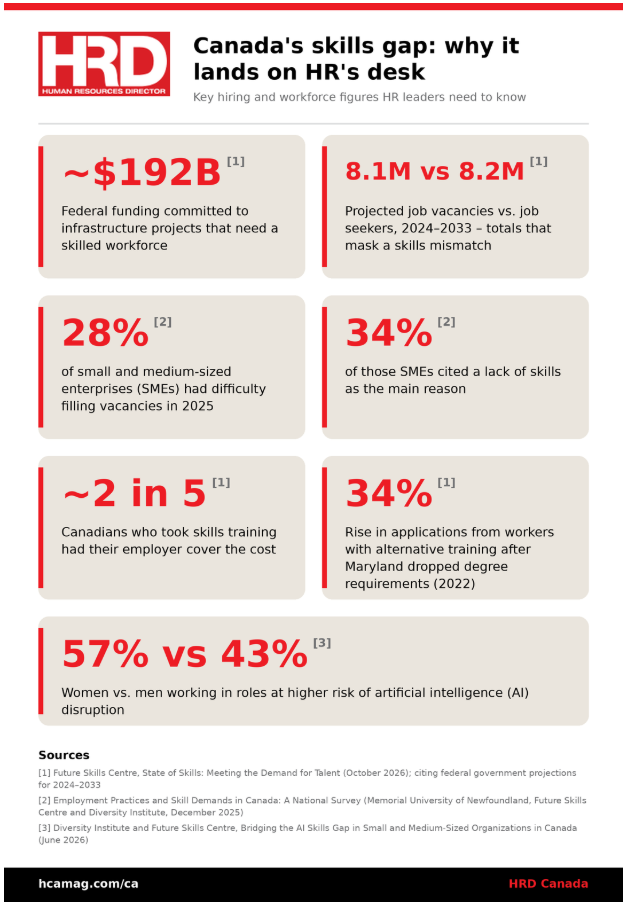
Employers’ hiring and training practices are critical to staffing approximately $192 billion in federal infrastructure projects, the Toronto-based Future Skills Centre (FSC) says, urging employers to close Canada’s skills gap through skills-first hiring and more training.
The State of Skills report, Meeting the Demand for Talent, also urges removing barriers to advancement for equity-deserving groups. Its contributors include Tricia Williams, director of research, evaluation and knowledge mobilization at the FSC in Toronto.
The FSC cites federal projections of 8.1 million job vacancies between 2024 and 2033 and 8.2 million job seekers, but says the totals mask a mismatch between the skills employers need and those workers have.
Construction, health care and manufacturing employers report the most difficulty hiring. Separately, Statistics Canada data showed Canada’s job vacancies held steady in the second quarter of 2026.
Only about two in five Canadians who took skills training had employers cover the cost, the FSC says.
Skills-first hiring widens the talent pool
The report recommends defining the skills a role requires rather than relying on degrees or job titles.
After Maryland dropped degree requirements for many state jobs in 2022, applications from workers with alternative training rose 34% in six months, the report says. In Canada, large employers such as Royal Bank of Canada (RBC) and Shopify lead adoption.
In a national survey of 1,700 small and medium-sized enterprises (SMEs) conducted in 2025 for Memorial University of Newfoundland, the FSC and the Diversity Institute at Toronto Metropolitan University, 28% had difficulty filling vacancies, and 34% of those cited a lack of skills.
For employers weighing artificial intelligence (AI) screening tools, HRD Canada has reported on why skills-based hiring needs data science, not AI guesswork.
Training investment: the return employers are missing
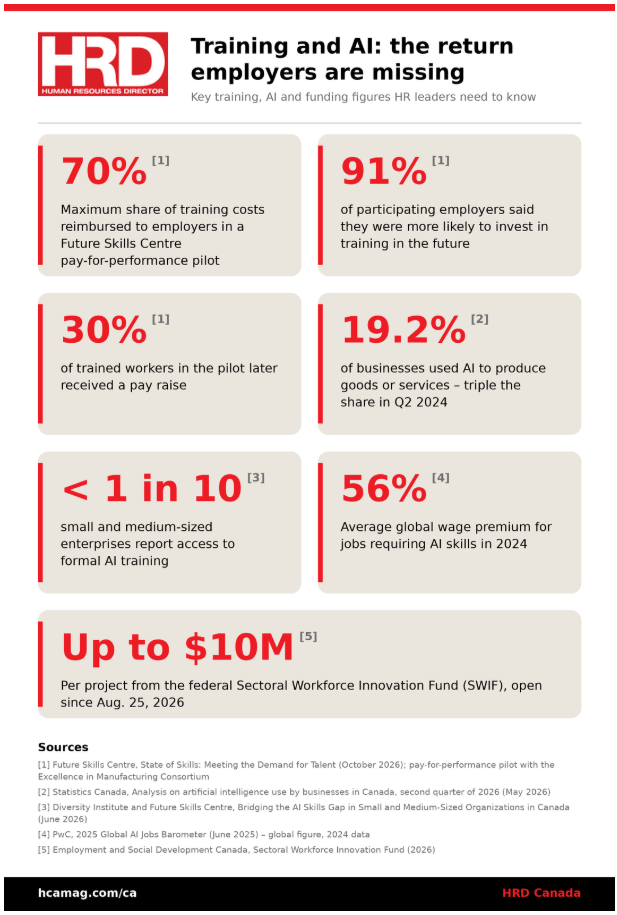
An FSC-funded pay-for-performance pilot with the Excellence in Manufacturing Consortium reimbursed employers for up to 70% of training costs. Of participating employers, 91% said they were more likely to invest in training in the future, and 30% of trained workers got a raise.
Statistics Canada found 19.2% of businesses used AI to produce goods or deliver services in the 12 months before its April–May 2026 survey, triple the share in the second quarter of 2024.
Yet fewer than one in 10 SMEs report access to formal AI training, according to a June 2026 FSC project report led by Wendy Cukier, founder and academic director of the Diversity Institute at Toronto Metropolitan University in Toronto.
Globally, jobs requiring AI skills paid an average wage premium of 56% in 2024, according to PwC’s 2025 Global AI Jobs Barometer, cited in the report.
Support varies by province, according to an HRD Canada analysis of how much provinces are spending on AI workforce training.
Cukier told a May 2026 conference that the most sought-after AI skills are not specialized technical ones. “Those skills are important, but those are not the skills that are in demand,” she said, according to the Toronto Metropolitan University.
What should HR leaders do now?
Employment and Social Development Canada’s (ESDC) Sectoral Workforce Innovation Fund (SWIF) began continuous intake on Aug. 25, 2026, offering up to $10 million per project for partnerships between employers and training providers that include private sector investment, according to ESDC.
The June report found 57% of women work in roles at higher risk of AI disruption, compared with 43% of men.
To close the gap, the FSC recommends that employers co-design training with providers and sector intermediaries, set defined promotion criteria, open mentorship and leadership programs to all qualified staff, and train managers to lead inclusively.