Which sectors, regions saw biggest gains?

Canada's job vacancies barely moved in the second quarter of 2026, holding at 510,200 positions after a 2.7% increase in the first quarter, according to Statistics Canada (StatCan).
The national job vacancy rate sat at 2.8%, unchanged from both the previous quarter and the same period in 2025, per the agency's Job Vacancy and Wage Survey (JVWS).
Part-time vacancies rose by 3,600 positions (2.8%), while full-time, permanent and temporary postings were little changed. Year over year, temporary position vacancies climbed 4.4%, with other categories holding steady, StatCan reported.
Total labour demand rose by 58,100 positions (0.3%) in the quarter, tracking a matching gain in payroll employment. Year over year, total labour demand was up 181,100 positions (1.0%), driven mainly by payroll employment growth of 178,000 positions. There were 3.0 unemployed people per vacancy in the quarter, unchanged from the previous quarter and down slightly from 3.1 a year prior.
Canadian HR professionals weighing these numbers against broader hiring conditions can review HRD Canada's outlook on hiring conditions through 2026 for further context.
Long-term openings and occupations shift
One of the sharper movements involves long-term vacancies, or positions open 90 days or more. These fell to 25.9% of all vacancies, down 2.1 percentage points from the first quarter's 28.0%, well below the 39.5% peak recorded in late 2022, Statistics Canada said.
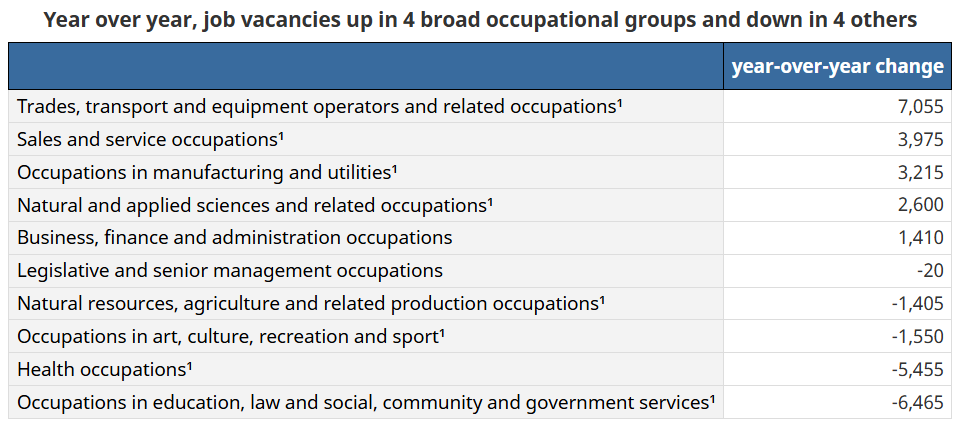
Vacancies declined in education, law, social, community and government services (down 4.6%) and in natural resources and agriculture-related occupations (down 10.4%). Natural and applied sciences occupations gained 4.5% for a second straight quarter, led by software developers and user support technicians. Year over year, gains were also recorded in trades, transport and equipment operators occupations (up 7.7%), sales and service occupations (up 2.6%) and manufacturing (up 19.2%), while education, law and social, community and government services occupations (down 13.3%) and health occupations (down 7.9%) posted the largest annual declines.
Education requirements are shifting too: vacancies for roles requiring a high school diploma or less rose 2.4% year over year, the first such gain since 2022, while postings requiring a bachelor's degree or higher fell 5.9%. Recruitment teams can find sector-level detail in HRD Canada's coverage of the fractured labour market picture.
Inflation and payroll data add wider context
Beyond the vacancy figures, separate research from the Canadian Federation of Independent Business (CFIB) offers a wider view of the economic backdrop HR leaders are navigating. CFIB's Main Street Quarterly report, developed with economic consulting firm AppEco, found that consumer price index inflation held at 2.1% in the first quarter of 2026 before rising to 3.1% year over year in the second quarter. The organization's forecast projects inflation edging up further to 3.4% in the third quarter, a trend CFIB linked partly to tensions involving Iran.
Core inflation, which excludes food and energy costs, eased slightly to 1.7% in the second quarter, according to CFIB, though its forecast anticipates a rebound to 2.0% by the third quarter. These figures are separate from Statistics Canada's confirmed vacancy and wage data and reflect CFIB's own economic forecasting, based on its Business Barometer survey of small and medium-sized enterprises.
On payroll employment, CFIB reported that growth remained stable in the first quarter of 2026, with its forecast pointing to modest gains of 0.4% in the second quarter and 0.3% in the third quarter, a pace CFIB called consistent with recent quarters. That trajectory is broadly in line with the 0.3% payroll employment gain Statistics Canada recorded alongside its second-quarter vacancy figures.
Wages cool as regional gaps emerge
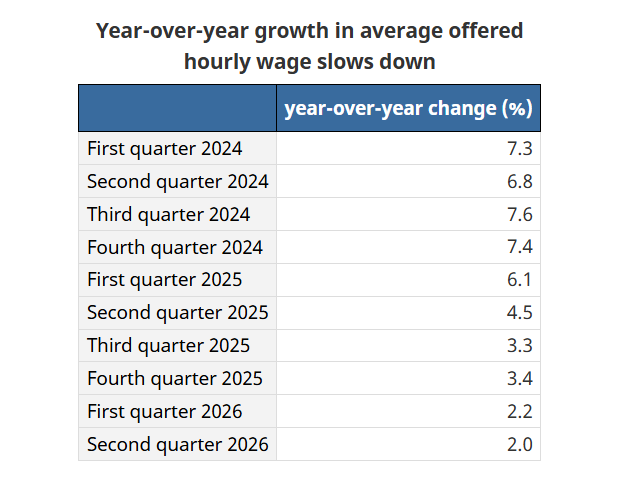
The average offered hourly wage for vacant positions rose 2.0% year over year to $28.55, decelerating from 2.2% growth in the first quarter and well down from a 7.6% peak in late 2024, according to Statistics Canada. Average hourly wages for all employees grew 3.6% over the same period, a wider gap reflecting the wage slowdown Statistics Canada has tracked since 2024.
Regionally, Newfoundland and Labrador posted the largest quarterly gain, up 700 vacancies (14.9%), while most provinces held steady. Year over year, New Brunswick, Newfoundland and Labrador, and the Northwest Territories saw increases, while Nunavut recorded a 38.1% decline.
Toronto led economic-region gains with 3,600 additional vacancies, while Kitchener–Waterloo–Barrie and Kingston-Pembroke posted the largest declines. HR teams operating across regions can compare figures against HRD Canada's report on first-quarter vacancy and wage trends.