‘Strong governance over AI models, their actions and the data they access is no longer optional’

Public servants back sovereign data storage and more domestic data centres, but AI governance and skills gaps loom for HR leaders
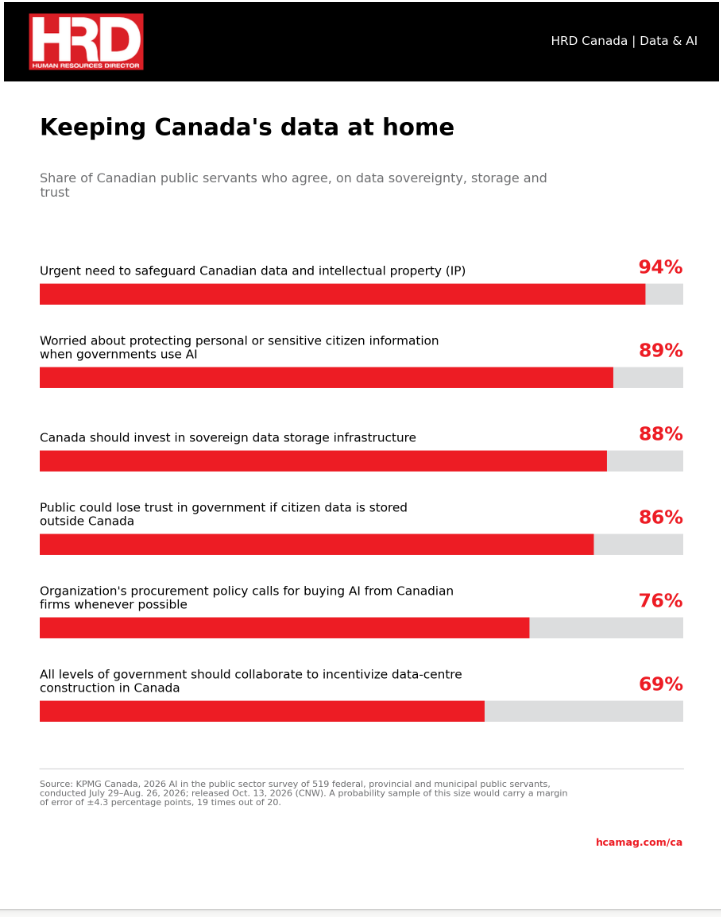
Canadian public servants want the country’s data kept on home soil. Nearly all (94%) say there is an urgent need to safeguard Canadian data and intellectual property (IP), while 88% believe Canada should invest in sovereign data storage infrastructure, according to a KPMG Canada survey of 519 federal, provincial and municipal public servants released Oct. 13, 2026, in Toronto.
Some 69% also want governments to incentivize more data-centre construction as they expand their use of artificial intelligence (AI).
“Public servants understand that Canada’s ability to compete and innovate increasingly depends on how well we protect and govern our data,” says Michael Klubal, National Industry Leader for Infrastructure, Government and Healthcare at KPMG Canada.
Why does Canadian data sovereignty matter to HR leaders?
KPMG Canada found 89% of public servants worry about how sensitive citizen information will be protected when governments use AI, and 86% fear public trust could suffer if that information is stored outside Canada.
The cost of falling short is spelled out in a 2018 Treasury Board of Canada Secretariat white paper on data sovereignty and public cloud. It warns foreign agencies can use their own laws to compel cloud providers to hand over government data, sometimes without notifying Ottawa – a risk it says could damage the government and cost it Canadians’ trust.
“Storing data on Canadian soil does not protect it,” wrote Barry Appleton, a fellow at the Balsillie School of International Affairs in Waterloo, Ont., in a March 2026 report on the U.S. CLOUD Act and Canadian data. Accepting routine foreign access, he argued, would be no compromise: “That is not a trade-off. It is nothing less than a surrender.”
Ottawa’s National Artificial Intelligence Strategy: AI for All, released June 4, 2026, notes Canadian companies store sensitive data in foreign jurisdictions and flags that AI will make consequential decisions about Canadians, including in hiring.
For human resources (HR) leaders, that puts employee records at the centre. As AI moves into recruitment and payroll platforms, where that data sits becomes a people issue as much as an IT one.
What should governments and employers do?
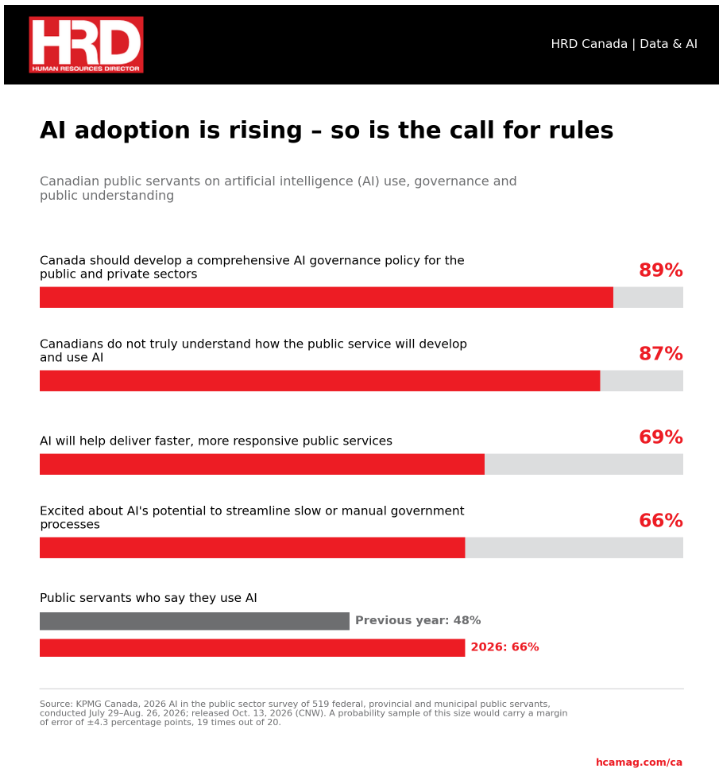
Some 89% of respondents want a comprehensive AI governance policy covering the public and private sectors, KPMG Canada reports.
“Trust remains the currency of the public sector, with strongly governed sovereign data at its core,” says Ven Adamov, Partner, Risk Services and National Leader for Data and Analytics at KPMG Canada.
“Strong governance over AI models, their actions and the data they access is no longer optional; it is foundational to building trust and realizing AI’s full benefits,” he adds.
AI for All commits Ottawa to modernizing consumer privacy law and building sovereign compute under Canadian control. Federal, provincial and territorial privacy regulators’ generative AI principles, issued in December 2023, already expect organizations to establish legal authority and meaningful consent for using personal information, be transparent about privacy risks, make AI tools explainable and limit sharing of sensitive data.
Closing the AI skills gap starts with people
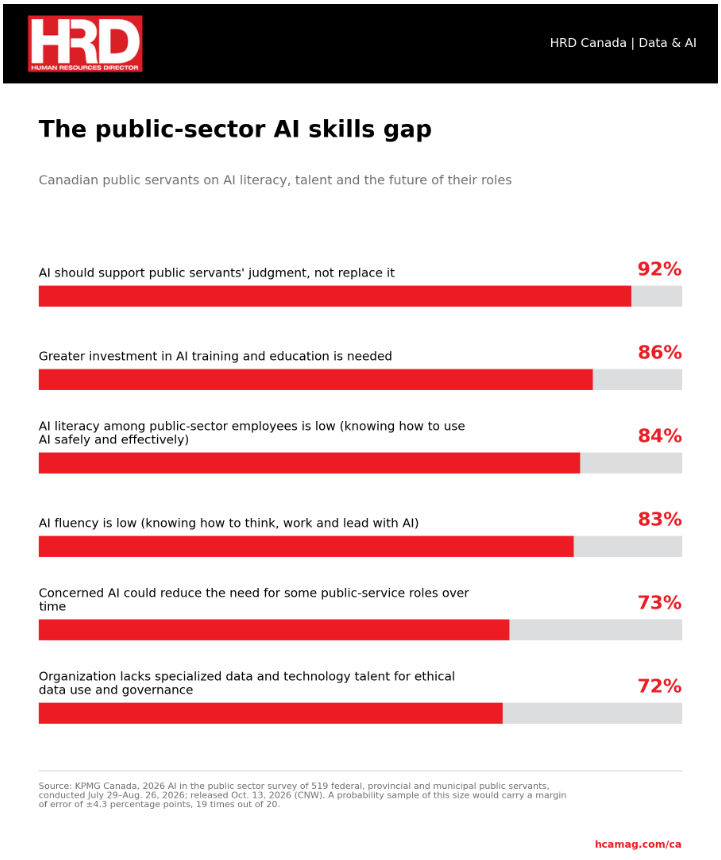
Talent is scarce: 72% of public servants say their organization lacks the data and technology specialists to build robust frameworks. Most (84%) rate public-sector AI literacy – knowing how to use AI safely and effectively – as low; 83% say the same of AI fluency, or knowing how to think, work and lead with it.
More than eight in 10 (86%) want greater investment in AI training. The results echo earlier findings that Canada lags in AI confidence, training and trust and that the AI skills gap in Canada continues to widen. Ottawa has responded with the federal government’s new National AI Literacy Initiative.
Job security is a worry: 92% believe AI should support rather than replace public servants’ judgment, yet 73% fear it could reduce some roles. “Addressing these concerns starts with people,” Adamov says.
KPMG Canada surveyed respondents online from July 29 to Aug. 26, 2026.