Shipments quadrupled this year and Tesla has begun production. Industry data shows most of the machines are still in labs and showrooms
Tesla began building its Optimus humanoid robot on a production line in Fremont, California, this quarter. Elon Musk told investors on the company's Oct. 21 earnings call that output would grow slowly and be "somewhat bumpy because it is such a radically new product." He said Tesla would need at least a year to reach 20,000 robots a week and expects to start selling Optimus to other companies around the end of 2027, beginning with industrial, dangerous, repetitive or around-the-clock work.
The first robots most employers could buy will be aimed at specific tasks that are hard to staff or unsafe for people, and Tesla's are more than a year away. A few employers, one of them in Ontario, already have humanoids doing narrow jobs, and the data from those deployments is a reasonable guide to the timeline for everyone else.
Most of this year's robots went to labs and showrooms
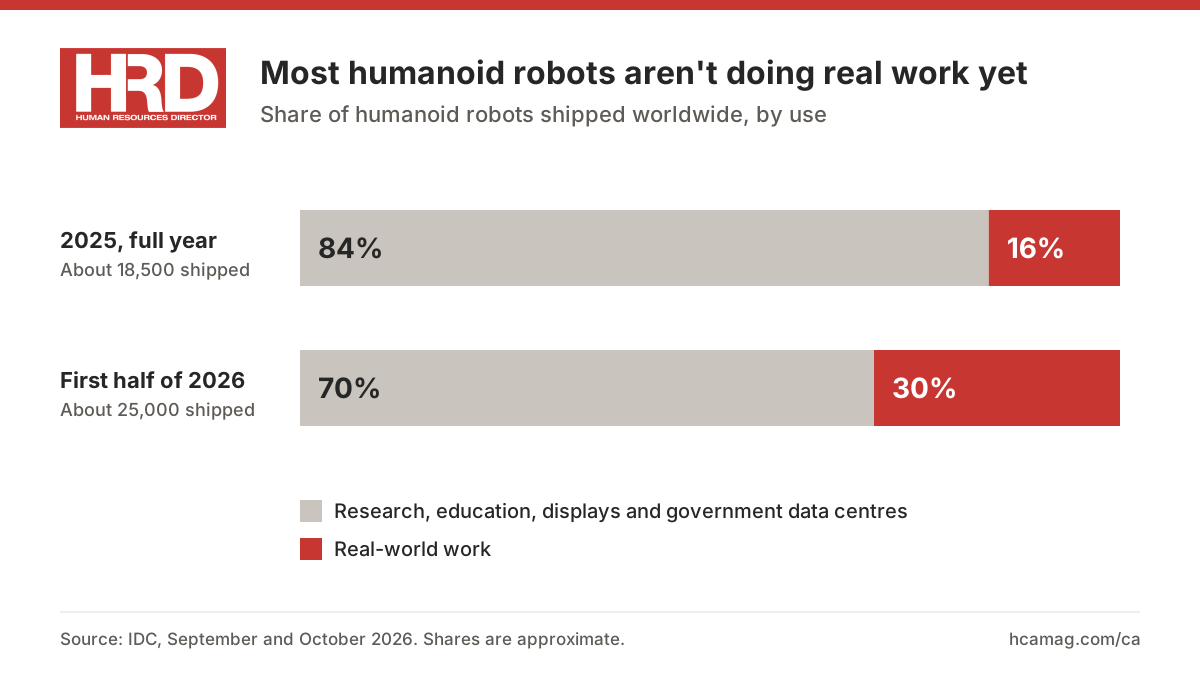
Robot makers shipped close to 25,000 humanoids worldwide in the first half of 2026, up 432% on a year earlier, according to IDC. The total for all of 2025 was about 18,500. Chinese manufacturers built about 95% of them.
IDC estimates that about 70% of first-half shipments went to research labs, schools, exhibitions and government data-collection centres. Around 30% went into real-world work, up from about 16% in 2025.
Revenue for the period was more than US$740 million, which Forbes calculated as an average of about US$29,600 a robot. IDC expects annual shipments to exceed 750,000 by 2030.
Read next: How close are robots to replacing human workers?
Where humanoids are working now
Agility Robotics lists Toyota Motor Manufacturing Canada among the customers for its Digit humanoid, alongside GXO, Schaeffler and Amazon. Digit has moved more than 100,000 totes at GXO Logistics' warehouse in Flowery Branch, Georgia. In a filing with the U.S. Securities and Exchange Commission ahead of a planned stock market listing, Agility said Digit moved about 25,000 totes with roughly 98% operational accuracy at Schaeffler facilities. The company says Digit has been in commercial use for nearly three years.
The filing also shows what a trial costs. Employers in Agility's Customer Acceleration Program pay a fee of about US$500,000 to test Digit in their own operations.
BMW used Figure AI's Figure 02 robots for 11 months at its plant in Spartanburg, South Carolina. They loaded more than 90,000 sheet-metal parts and worked on production of more than 30,000 BMW X3s before Figure retired them. BMW is now testing Hexagon Robotics' AEON humanoid in Leipzig, Germany. Michael Nikolaides, head of BMW's production network, said Spartanburg showed a humanoid could operate "in an existing automotive manufacturing environment." The company describes the robots as a supplement to its existing automation.
Each of these deployments covers one task in one controlled area, and 100,000 totes is a small volume for a large distribution centre.
Analysts expect few large rollouts before 2028
Gartner predicts that through 2028, fewer than 100 companies worldwide will move humanoid trials past the experimental stage and fewer than 20 will put them into production in supply chain or manufacturing. It expects most of those to operate in tightly controlled settings.
Abdil Tunca, a senior principal analyst at Gartner, said "the technology remains immature and far from meeting expectations for versatility and cost-effectiveness." The firm thinks wheeled, purpose-built robots will outperform humanoids in busy warehouses for now, and that humanoid pilots suit companies that can tolerate high risk.
Arnaud Robert, president of Hexagon Robotics, is more optimistic. He said the industry is now focused on how quickly humanoids can become "productive, versatile, and scalable."
Read next: Amazon looking to replace over 600,000 U.S. jobs with robots: report
Employees may be asked to train the robots
Humanoid AI models learn from video of people doing physical tasks, and robot makers need far more of it than exists. NPR reported in October on workers in India filming tasks such as folding and packing aprons with head-mounted cameras, including one woman paid about US$2.60 an hour. In the U.S., Figure started a marketplace called Index in August that pays people to film themselves doing chores and other jobs. Chief executive Brett Adcock said it had paid out US$15 million so far.
Some factories are now fitting their own staff with cameras, and eWeek reported that some also use the footage to assess productivity. An employer asked by a vendor to record employees for a robot pilot should treat the request as electronic monitoring. In Ontario, employers with 25 or more employees on Jan. 1 must have a written electronic monitoring policy in place by March 1 of that year, describing how and in what circumstances they monitor employees. HRD has covered the province's guidance on those policies. Employers elsewhere should check federal and provincial privacy law. Employers should also agree in writing who owns the footage, whether employees are paid for it and whether it can be used in performance reviews.
Safety standards are unfinished
A conventional industrial robot arm is bolted down and stops when the power is cut. A humanoid stays upright by constantly adjusting its balance, so a power failure can cause it to fall. ISO 25785-1, the first international safety standard for this kind of robot, is still being drafted. Employers still carry their occupational health and safety obligations in the meantime, so safety managers and joint health and safety committees should be involved in any evaluation from the start.
U.S. trade rules will shape the supply
In late July the U.S. Federal Communications Commission added foreign-made humanoid and quadruped robots to its Covered List, which blocks new models from U.S. equipment authorization. IDC projects U.S. humanoid revenue will be 58% lower by 2030 than it would have been without the restriction, and expects Chinese manufacturers to send more of their robots to Europe. The rule does not apply in Canada, but employers with operations on both sides of the border may find that a robot approved for one site cannot be used at the other. Legal and compliance teams should be part of purchasing decisions.
Read next: Robots expected to become 'allies' in closing labour gaps
Planning for 2027
The deployments above automate parts of jobs, such as moving totes between conveyors or loading parts into fixtures, and leave decisions and exceptions to people. HRD has covered why machines still struggle with common sense, and this year's data doesn't contradict it. For most employers, that makes individual tasks a more useful unit of planning than whole roles.
Steps employers can take over the next 12 to 18 months:
- Identify repetitive materials-handling tasks that sit between existing automated systems, since that is where current pilots are concentrated.
- Budget for program fees, integration, safety reviews and human backup as well as the robots themselves.
- Set a policy on consent, pay, ownership and retention before any employee footage is collected.
- Plan for technician and supervisor roles. The number of robots one person can oversee has a large effect on cost.
- Tell staff early what is being tested and why, and bring unions in at the start where a collective agreement applies. Research covered by HRD found that working alongside robots can reduce employees' sense of autonomy and meaning.
For office-based workforces, software is the bigger near-term change. HRD has reported that employees who rarely use AI tools have been laid off at higher rates than frequent users.
Read next: From automation to augmentation: How HR can future-proof through AI
Musk described Tesla's expected output as an S-curve that starts slowly, and Gartner's 2028 forecast and IDC's 2030 projection point to a similar pattern across the industry. Employers that start tracking which tasks could be automated, what a pilot would cost and what their employees think will have the information they need when the robots are ready for wider use.