Canadian employers shape AI plans without HR leaders, though CHRO involvement is linked to stronger results, research shows
Canadian employers are building artificial intelligence (AI) into their operations without human resources (HR) at the planning table, even as new research suggests HR technology strategy is becoming a deciding factor in whether AI pays off.
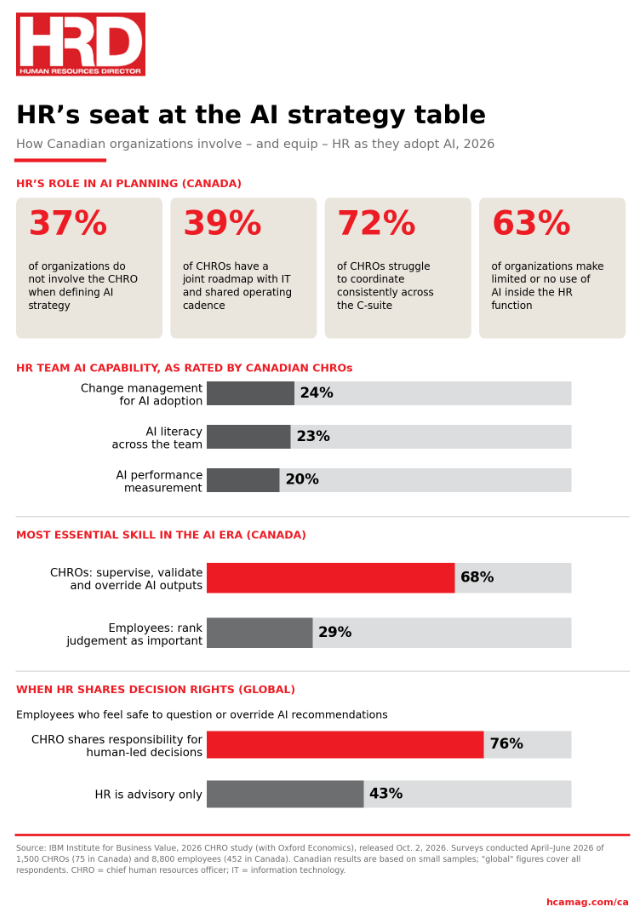
A study released Oct. 2, 2026, by the IBM Institute for Business Value found 37% of Canadian organizations do not involve the chief human resources officer (CHRO) when AI strategy is being defined. Only 39% of Canadian CHROs reported a joint roadmap with information technology (IT) backed by a shared operating cadence, and 72% said they struggle to coordinate consistently across the C-suite. The Canadian results draw on 75 HR executives and 452 employees.
The global findings point to what that exclusion may cost. Where the CHRO at least shares responsibility for which decisions stay human-led, 76% of employees feel safe to question or override AI recommendations, compared with 43% where HR is only advisory, IBM said. Organizations with mature HR AI capability, including governance, architecture and measurement, were nearly twice as likely to report a higher number of positive business key performance indicators (KPIs).
"As AI becomes more deeply embedded in how work gets done, organizations have an opportunity to strengthen the human capabilities that matter most," said Brandon-Jo Mouna, director of human resources at Markham, Ont.-based IBM Canada. "Critical thinking, judgement and the ability to challenge AI-generated outputs will become increasingly important as employees work alongside AI."
HR's own AI capability trails its mandate
HR is also behind on using the technology it is expected to steer. IBM found 63% of Canadian organizations make limited or no use of AI inside the HR function. Canadian CHROs rated their teams low on AI literacy (23%), AI performance measurement (20%) and change management for AI adoption (24%).
Canadian CHROs and employees also diverge on priorities. While 68% of CHROs rank the ability to supervise, validate and override AI outputs as the most essential workforce skill, 29% of employees rank judgement as important, a divide HRD Canada explored in its report on why AI fluency is now Canada's most urgent HR imperative.
"Offering an organization a design framework for transformation is HR work. It's actually the HR work everyone aspires to," said geneviève bich, vice-president of human resources and CHRO at Montreal-based grocer METRO, in the IBM release.
Workforce skills become a technology decision
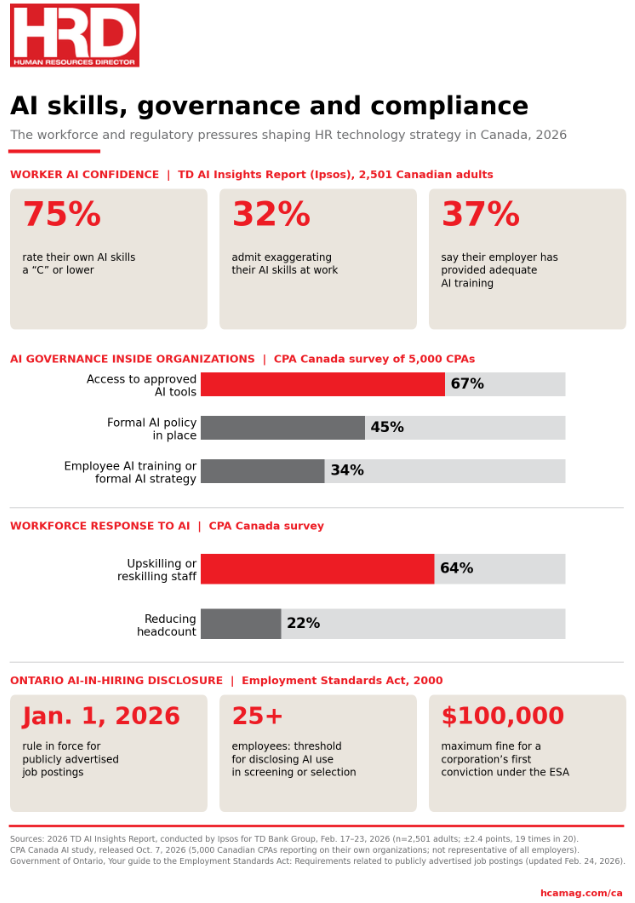
The skills data HR would need for that work is uneven. The 2026 TD AI Insights Report, conducted by Ipsos for TD Bank Group (TD) among 2,501 Canadian adults in February 2026, found 75% grade their AI skills a "C" or lower, 32% admitted exaggerating them at work and 37% said their employer had provided adequate AI training. HRD Canada examined those results in its report on the widening AI skills gap among Canadian workers.
"The future of work will require organizations to help people develop new skills as technology evolves," said Melanie Burns, senior executive vice-president and CHRO at Toronto-based TD Bank. "Those that prioritize learning and equip employees with the right tools and support will ensure their people thrive."
Employers are leaning on that skills route rather than job cuts. In a survey released Oct. 7, 2026, by the Toronto-based Chartered Professional Accountants of Canada (CPA Canada), 5,000 CPAs describing their own organizations reported upskilling or reskilling staff (64%) far more often than reducing headcount (22%). The sample is not representative of all Canadian employers.
Bar chart showing 67% of CPA Canada survey respondents have access to approved AI tools, 45% have a formal AI policy and 34% report employee AI training or a formal AI strategy AI adoption is outpacing governance, CPA Canada survey, 2026
The same survey found 67% of respondents had access to approved AI tools, but 45% reported a formal AI policy and 34% said their organization had introduced employee training or a formal AI strategy.
HR technology choices move into compliance and operations
Some of those technology decisions are now subject to provincial law. Since Jan. 1, 2026, Ontario's Employment Standards Act, 2000 (ESA) has required employers with 25 or more employees to state in publicly advertised job postings whether they use AI to screen, assess or select applicants, according to the Government of Ontario's guide to the ESA. The duty also covers third-party recruiters, and a corporation convicted under the ESA faces a fine of up to $100,000 for a first offence.
That places recruitment software squarely within HR's compliance remit, an issue HRD Canada covered in its report on employers deploying AI tools faster than they can govern them.
Other employers are wiring HR processes directly into their AI systems. Vancouver-based TELUS Digital said Oct. 1, 2026, that its customer experience (CX) contact-centre model uses AI to review every customer interaction and route skill gaps into targeted coaching, which improved coaching efficiency by 26% in one deployment.
"As AI becomes more deeply embedded in day-to-day business processes, governance can no longer be an afterthought," said Melissa Robertson, AI and technology lead at CPA Canada.