Ontario, Alberta and Nova Scotia already govern public service artificial intelligence as unions seek job protections

Saskatchewan’s government is building an artificial intelligence (AI) office to coordinate its AI use, as unions press for job protections.
The Saskatchewan AI office sits within the Information Technology Division of the Ministry of SaskBuilds and Procurement, according to a SaskTenders request for services. It seeks consultants to build AI governance, priority use cases and staff training.
Blake Fleischhaker, the ministry’s executive director of architecture and planning, explained the office’s purpose at an October 2026 procurement forum in Regina. “The AI office is going to be in place for us to build out our governance for AI, strategy, road maps and pretty much enable government to use AI responsibly,” he told CTV News.
Unions push for guardrails on AI and jobs
The provincial government says it has no intention of using AI to replace jobs, CTV News reported. AI could still surface in future bargaining.
At a Saskatchewan Federation of Labour meeting, Adam Conover, a Writers Guild of America member active in the 2023 writers’ strike, urged union members to negotiate strict guardrails. “What AI can do is really oversold. I think it can’t replace workers the way that the companies claim, but they can use it to try to make their product worse, lay people off,” he told CTV News.
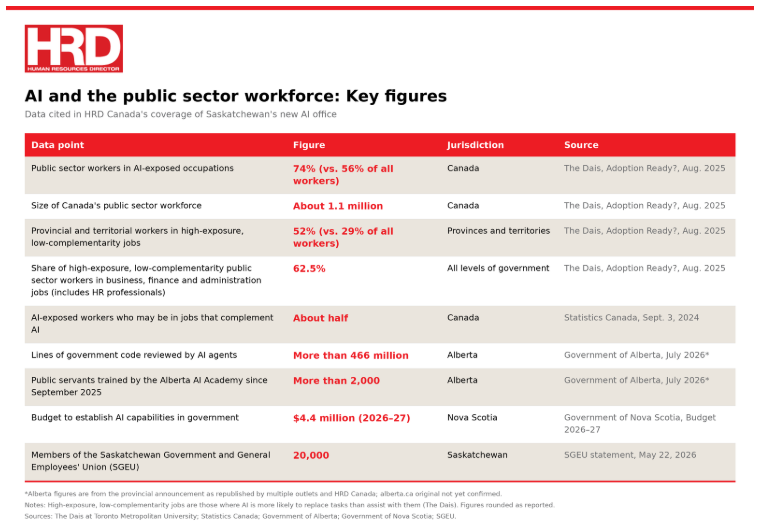
The Saskatchewan Government and General Employees’ Union (SGEU), with 20,000 members, has set out its expectations. In a May 22, 2026, statement on the sale of Information Services Corporation (ISC), it warned that cost pressure frequently leads to “automation without adequate worker protections” and demanded “meaningful safeguards and training surrounding technological changes.”
How other provinces manage AI in government
Other provinces moved first. Ontario, which calls itself the first province or territory with public sector AI guardrails, has required ministries and agencies to manage AI risks and report their AI use under a directive that took effect Dec. 1, 2024.
Alberta has moved faster. In July 2026, it said AI agents built with Anthropic’s Claude models reviewed more than 466 million lines of government code, as HRD Canada reported on how Alberta plans to replace 185 aging systems with AI-built applications. Its AI Academy has trained more than 2,000 public servants since September 2025, the province says.
Nova Scotia is also investing. Its 2026–27 budget sets aside $4.4 million to establish AI capabilities, budget documents show, as tracked in HRD Canada’s analysis of provincial AI workforce training spending in 2026.
Is a central AI office good for public sector workers?
For employees, the stakes depend on exposure. An August 2025 report by The Dais, a Toronto Metropolitan University think tank, found that 74% of Canada’s roughly 1.1 million public sector workers are in AI-exposed occupations, compared with 56% of the overall labour force.
Among provincial and territorial workers, 52% are in high-exposure, low-complementarity jobs, where AI is more likely to replace tasks than assist, versus 29% overall. Across all levels of government, business, finance and administration occupations, which include human resources professionals, account for 62.5% of workers in that category.
“The potential downside risk is as large as the opportunity,” Viet Vu, the report’s co-author and manager of economic research at The Dais, told The Globe and Mail.
Exposure is not job loss, though. Statistics Canada estimated in 2024 that about half of AI-exposed workers may be in jobs that complement AI, as HRD Canada reported on how 60% of Canadian jobs are highly exposed to AI.
The Dais recommends employers develop plain-language AI strategies with workers and unions, with HR teams leading a rolling review of job classifications. That is the checklist Saskatchewan’s new office now faces.