Investments will 'create good, well-paying jobs and give the next generation a path to a secure and prosperous future’

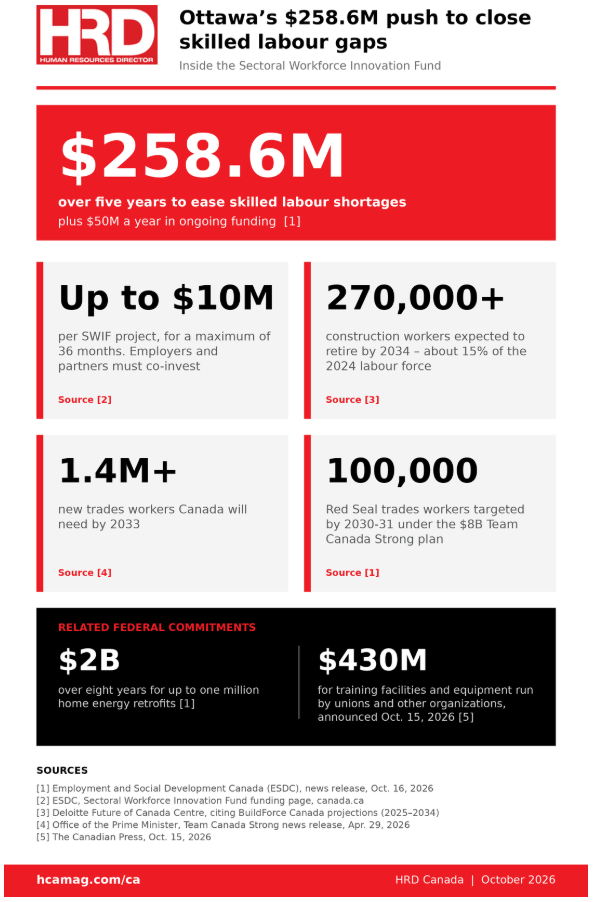
Employers must put their own money into training partnerships to access a new $258.6-million federal fund aimed at easing skilled labour shortages, according to Employment and Social Development Canada (ESDC).
Patty Hajdu, minister of jobs and families and minister responsible for the Federal Economic Development Agency for Northern Ontario, announced the five-year commitment through the Sectoral Workforce Innovation Fund (SWIF) during a visit to Klimit Mechanical Ltd. in Thunder Bay, Ont. Ottawa will add $50 million a year after the initial five years, according to the department's news release.
ESDC said the fund will back industry-led projects that help key sectors and regions recruit, train and retain skilled workers, with priority for projects that bring trainers and employers together.
Construction employers face a wave of retirements. Deloitte's Future of Canada Centre, citing BuildForce Canada projections, estimated that more than 270,000 construction workers – about 15% of the 2024 labour force – will retire by 2034.
Employer co-investment required
SWIF projects must include private sector investment, according to ESDC's program page. They must also be delivered through partnerships with post-secondary schools, training providers and employers, and produce measurable results.
Each project can receive up to $10 million over a maximum of 36 months. Businesses, not-for-profits, municipalities, Indigenous organizations, training institutions and provinces and territories can apply. The call for proposals opened on Aug. 28, 2026, and intake will continue until funds are exhausted, ESDC said.
An ESDC backgrounder issued in August 2026 said funded projects should reduce critical skills gaps and hiring delays and improve retention. Examples it listed include accelerated training, micro-credentials and skills assessment tools for workers changing sectors. Projects must remain sustainable after federal support ends.
Retrofits and major projects drive demand for skilled trades
Hajdu linked the fund to a separate commitment from Prime Minister Mark Carney of $2 billion over eight years to support up to one million home energy retrofits. ESDC said SWIF will help build the workforce to deliver that work.
"Behind every major project and every retrofitted home are skilled workers. Through the Sectoral Workforce Innovation Fund and Team Canada Strong, we are investing in training and supporting more of them, so that communities across the country have the people they need to get the work done. These investments will help families lower their energy costs, create good, well-paying jobs and give the next generation a path to a secure and prosperous future," Hajdu said in the release.
According to ESDC, SWIF is designed to address immediate shortages, while Team Canada Strong – an $8-billion federal plan to recruit, train and hire up to 100,000 Red Seal skilled trades workers by 2030-31 – targets the longer-term pipeline. The Prime Minister's Office said in April 2026 that Canada will need more than 1.4 million new trades workers by 2033.
Fund joins Workforce Alliances and apprenticeship supports
The announcement came a day after Ottawa unveiled $430 million to help unions and other organizations cover training facility and equipment costs, The Canadian Press (CP) reported.
SWIF also operates alongside six sector-based Workforce Alliances that bring employers, unions, educators and industry groups together to set workforce priorities, according to ESDC. HRD Canada has reported on how Ottawa broadened its Workforce Alliances to tackle skills gaps and on the Advanced Manufacturing Workforce Alliance launched in response to tariffs.
The fund adds to earlier measures, including Ottawa's expanded apprenticeship funding for Red Seal trades. ESDC said SWIF will focus on helping new and mid-career workers gain skills for growing industries.