An organizational psychologist reads the Freeland-Trudeau breakdown through an HR lens – and finds familiar patterns
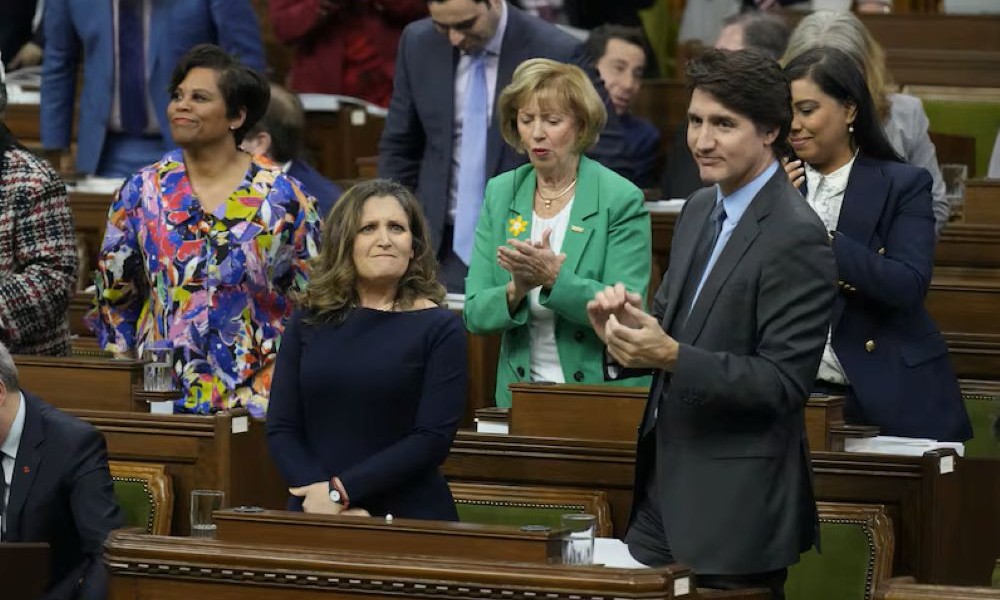
Photo: Adrian Wyld/The Canadian Press
Former deputy prime minister and federal finance minister Chrystia Freeland defines her decade-long working relationship with former prime minister Justin Trudeau by having almost no one-on-one meetings, a demotion delivered over a Friday morning Zoom call, and public correction of cabinet colleagues in place of private feedback. For any organization, these are toxic leadership patterns that harm both people and organizations if allowed to flourish unchecked, according to Dr. Laura Hambley, an organizational psychologist, adjunct professor at the University of Calgary, and founder of Canada Career Counselling and Birchwood Leadership and Culture Consulting in Calgary.
For many readers, Freeland’s memoir Unreliable Boyfriend may serve as a look at some of the political maneuvering around trade negotiations with U.S. President Donald Trump and his team. However, Freeland also provides insight into her working relationship with Trudeau, which eventually crumbled to the point where Trudeau fired her from her position as finance minister on Zoom, three days before she was to deliver the government’s fall 2024 economic statement.
There’s difference between a difficult leader and a toxic one, and it’s a distinction that changes what organizations can realistically do about it, says Hambley, who says difficult leaders may take on leadership roles through promotion or votes but aren’t ready for them.
“They learn by trial and error, and they can be quite difficult and frustrating to work with… but a difficult leader can have self-insight and develop into a better leader – they just need the right support, the right environment, and the right mentorship,” she says. “The problem with some of these leaders is they didn’t have that – or they should have never been leaders in the first place. The systems are flawed, which leads to the promotion, hiring, and voting of leaders.”
The danger of a toxic leader
Toxic leaders are a fundamentally different problem, as their personality issues are deep-rooted and harm people, and ultimately the organization, says Hambley. “They can be overt behaviours – the bullying, harassment sort of behaviours that we think about when we think of a toxic boss – or they can be more covert, like manipulation, gaslighting, subtle behaviours. Too many of those really make me nervous, because they go undetected for a long time in organizations.”
A difficult leader can be coached, while a toxic one almost never can – because they are, by definition, closed to the feedback that would make development possible, says Hambley. “They won’t ask the question, ‘Am I a toxic leader?’ They would never ask that,” she says. “It’s always everyone else’s fault.”
A Global Leadership Forecast 2027 by DDI found that just one in three managers and one in five individual contributors trust senior executives, warning that without intervention, that decline will cascade and damage retention, the leadership pipeline, organizational performance, and psychological health and safety in the workplace.
Public show, behind-the-scenes failure
Among the patterns most recognizable in Freeland’s account of Trudeau’s leadership is what Hambley calls the showman paradox: leaders who perform brilliantly for external audiences but consistently avoid the individual relationships that build trust.
“A leader who’s primarily focused on ‘me’ – an ego-based leader – can be a great showman or showwoman,” says Hambley. “They can be charismatic, they can entertain people, they can give people confidence and hope in them because they’re just so bloody confident – but the showman type of leader is dangerous when there’s not the substance under it and when they’re not doing the job of a leader, which is leading with courage, curiosity, and care.”
Hambley believes that without one-on-ones, the care and curiosity part of that equation simply isn’t possible. “If all you’re being is about show and tell and attention-seeking, those are the behaviours of narcissism.”
Just one in four employees believe HR will address toxic behaviour at work, according to a 2025 U.S. study by iHire – a signal of how far the damage from ego-driven leadership can travel before it is named. The showman leader – comfortable commanding a room, avoidant in direct peer relationships – creates precisely the vacuum in which toxic culture filters from the top down.
The toxic leader dilemma for HR
When toxic behaviour originates at the C-suite level, the structural dilemma facing HR leaders is acute, says Hambley. “You’re often trapped in the middle, even as an HR executive,” she says. “But there are things that HR can really play a key role in doing.”
A primary intervention available to HR leaders involves safe reporting mechanisms that route concerns to the board or to whoever the senior leader answers to, according to Hambley. “When it’s in the C-suite, there needs to be whistleblowing mechanisms to the board,” she says. “It’s about having safe reporting mechanisms where if I report something that’s going on, my job isn’t at risk. I’m protected.”
She also names a risk that rarely surfaces publicly: when toxicity is within HR itself. “I see a lot of instances where there’s toxicity within the HR department,” she says. “It’s brutal, because it’s supposed to be the safe space in an organization.”
Hambley says her ongoing research on HR and toxic leadership across North America is surfacing evidence of how common that pattern is – and what supervisors mocking their teams costs Canadian workplaces.
Courage and safe reporting mechanisms
For those who see a serious problem at the executive level but feel constrained by power dynamics or fear of repercussion, Hambley suggests an approach in three steps: prune, protect, and pivot.
“We need to prune toxicity – we need to be on the lookout for it, assess for it in our hiring practices, but also in our organizational climate,” she says. “We need to protect people with safe reporting mechanisms and we need to know when to pivot.”
That final step – recognizing when a culture is so embedded in toxicity that it won’t change – is the hardest to act on, says Hambley.
“It’s the courage to address it,” she says. “And it’s knowing when the toxicity is so deeply rooted in the culture, it’s not going to change – you need to know when to pivot.”
The leadership patterns Freeland describes in her memoir are recognizable well beyond politics. They’re the signs of a leadership relationship that broke down long before anyone named it – and a reminder that organizations, unlike governments, can still choose to act.
“A great leader turns around and people are following, and people will talk about them at their dinner table, like, ‘I learned so much from that leader,’” says Hambley. “But with a toxic one or even a difficult one, it's the opposite. They're causing people stress.
“What we need out of leaders these days is open, authentic communication, reassurances, and the trust that the leader will have our backs.”