New royalty framework aims to fast-track oil sands projects – and employers will need to recruit at scale to keep pace

Recruiting engineers, welders, pipe fitters and other skilled workers is set to become a top priority for HR leaders across Alberta’s oilpatch as the province moves to accelerate oil sands growth.
The government of Alberta has announced its Oil Sands Growth Program (OGP), which offers 10 years of reduced royalties on new oil sands production.
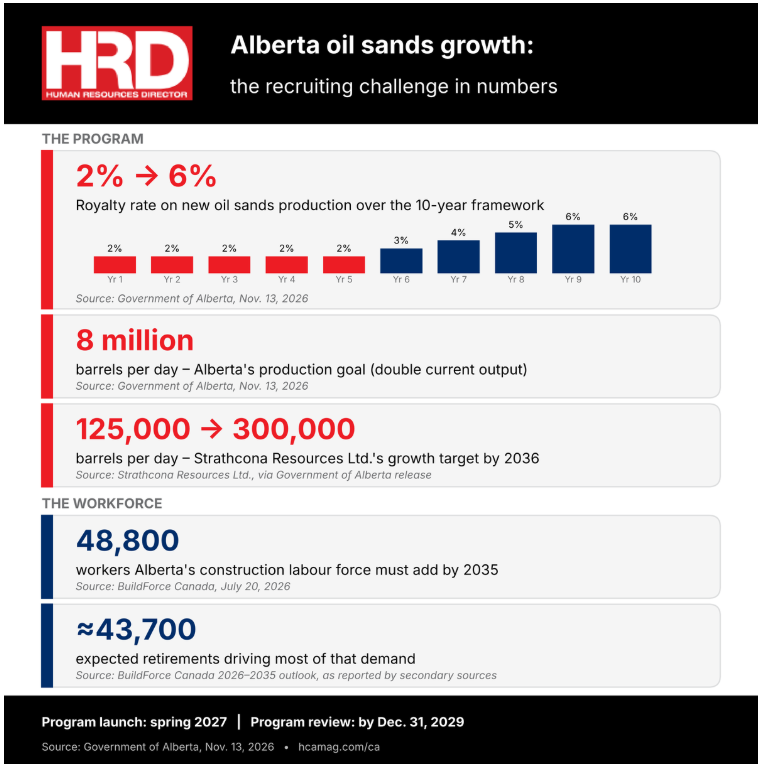
Approved projects would pay a two per cent royalty for five years, rising to six per cent by years nine and 10. The program is targeted to launch in spring 2027, and the province aims to double oil production to eight million barrels per day.
Producers are already planning for that growth. Adam Waterous, executive chairman of Calgary-based Strathcona Resources Ltd., said in the provincial release that the company intends to grow “from 125,000 barrels per day to 300,000 barrels a day by 2036.” Kendall Dilling, president of the Oil Sands Alliance, added: “These investments will create tens of thousands of jobs and provide governments with tax and royalty revenues for decades to come.”
Oil sands growth meets shrinking talent pool
Those jobs will have to come from a labour pool that is already thinning. BuildForce Canada projected in July 2026 that Alberta’s construction labour force must add 48,800 workers by 2035, with roughly 43,700 expected retirements driving most of that demand.
The concern extends nationally. Lance Mortlock, managing partner at EY Canada, told The Canadian Press (CP) in October 2026: “We’re going to need tens of thousands of workers across the country to build this stuff: engineers, professionals, welders, pipe fitters. I’m not sure where all these people are going to come from if we do half the projects that we have the desire to construct.”
Energy employers will also compete with other sectors. The Toronto-based Future Skills Centre (FSC) reports that construction, health care and manufacturing employers have the most difficulty hiring, as covered in Human Resources Director (HRD) Canada’s report on how skills-first hiring and training are key to staffing Canada’s major projects.
Will this hiring cycle look different?
The last oil sands expansion, from the mid-2000s to mid-2010s, brought cost inflation, labour scarcity and housing shortages, CP reported.
Political leaders insist this cycle will differ. Alberta Premier Danielle Smith pointed to autonomous haul trucks, saying companies “have managed to find a way to increase production without having the kind of dramatic pressure that we saw in the past of a large number of people moving here, not able to find homes,” CP reported.
With the program review set for Dec. 31, 2029, employers have a window to build multi-year workforce plans tied to project milestones.
For HR leaders, widening the talent pool is one lever. BuildForce Canada says increasing the participation of women, Indigenous Peoples and new Canadians could help Alberta’s construction industry meet its labour needs. Raymond Powder, Chief of Fort McKay First Nation, said in the release that “responsible oil sands growth creates opportunities for us to build, own and lead, bringing good jobs, strong business partnerships and lasting prosperity.”
Tracking the wider market will help too, as HRD Canada’s coverage of Canada’s job vacancies holding steady in the second quarter of 2026 shows. Retention will matter as much as recruitment, and the organizations in HRD Canada’s Best Places to Work in Canada: The Listening Advantage report offer useful benchmarks.