‘Businesses can only operate in endurance mode for so long’
Still dealing with a productivity crisis, the Canadian economy stands to take another hit with manufacturers planning to relocate – to the benefit of the United States.
Four in 10 manufacturers have already relocated production to the U.S. or are considering it amid trade uncertainty, a shift that could affect workforce levels across the sector, reports KPMG.
Nearly 3 in 10 (29%) have already moved some or all production to the U.S. Another 13% plan to move, with 77% of that group expecting to do so within two years.
Labour productivity in Canada's business sector fell for a second consecutive quarter in the first quarter of 2026, while the cost of producing each unit of output rose for a fourth straight quarter, new Statistics Canada figures show.
‘Endurance mode’
More than half of respondents (52%) say their companies are operating in "endurance mode," a term KPMG Canada used to describe firms absorbing costs while holding steady rather than expanding.
"Last year, the conversation was about survival. This year, it's about endurance," says Anamika Gadia, Partner and National Leader of Industrial Markets at KPMG Canada. "Manufacturers have shown incredible resilience, adapting to tariffs and uncertainty to navigate this period of heightened volatility.
“But businesses can only operate in endurance mode for so long. Companies can delay investments, absorb higher costs and adjust their operations, but they can't remain in a holding pattern indefinitely. At some point, uncertainty begins to shape long-term decisions about where investment, production and growth will occur.”
The survey found 57% of manufacturers have paused, reduced, or cancelled capital expenditure projects due to tariffs and uncertainty. Separately, 42% said they had scaled back or paused research and development spending.
"Sustaining Canada's manufacturing sector will require businesses to continue investing in productivity, technology and market diversification, while governments work to reduce uncertainty and improve competitiveness,” Gadia says. “The question now is whether Canada can create the conditions that give manufacturers the confidence to keep building, investing and staying here."
Joy Nott, Partner, Trade and Customs at KPMG Canada, pointed to a U.S. regulatory change adding pressure on Canadian firms. "The June 3, 2026 White House Executive Order on Strengthening Customs Enforcement creates another reason for companies to consider relocating production to the U.S.," Nott said.
Trade dependence and headquarters plans
The KPMG survey of 275 Canadian Manufacturing companies conducted in May found 61% of manufacturers agreed their business cannot survive without access to the U.S. market. Nearly 9 in 10 (86%) export goods outside Canada, and 96% of exporters said their products comply with the Canada-United States-Mexico Agreement, avoiding tariffs.
Most manufacturers (80%) plan to keep headquarters in Canada, while 11% plan to move headquarters to the U.S. within five years, a figure KPMG Canada says carries outsized economic weight.
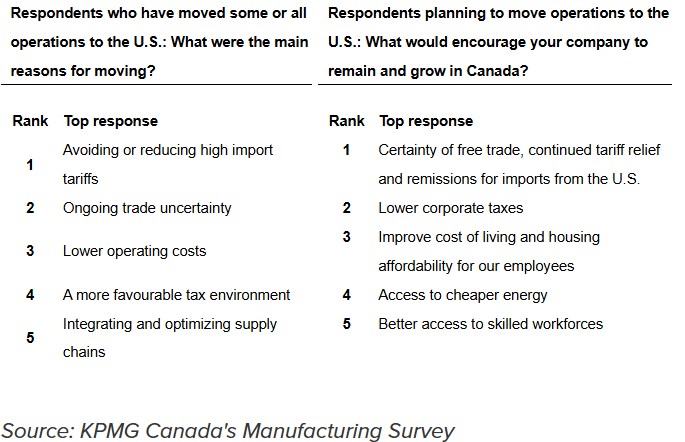
Top reasons cited for relocating included avoiding tariffs, trade uncertainty, lower operating costs, a more favourable tax environment, and better supply chain integration, according to KPMG Canada.
The survey comes as Canada pursues a goal of doubling exports to markets outside the U.S. by 2035.
Canadian employers should brace for at least 18 months of constrained hiring and compensation pressure after Deloitte Canada forecast on Thursday that the national economy will grow just 0.7% in 2026.
Here the tariffs that the U.S. imposed on Canada that are still in effect today:
|
Tariff / Measure |
Rate |
Treatment of CUSMA-Compliant Goods |
Effective Date |
Government Source |
|
Steel and aluminum (Section 232) |
50% on full value |
Non-U.S. content taxed at 25%; total duty not below 15% ad valorem |
April 6, 2026; adjusted June 8, 2026 |
The White House; Government of Canada, Department of Finance |
|
Copper and copper derivatives (Section 232) |
50% on semi-finished and intensive derivative products |
Copper input materials and scrap excluded |
August 1, 2025 |
The White House |
|
Automobiles (Section 232) |
25% |
Tax applies only to non-U.S. content of CUSMA-compliant vehicles |
April 3, 2025 |
The White House |
|
Auto parts (Section 232) |
25% |
CUSMA-compliant parts exempt, except knock-down kits and parts compilations |
May 3, 2025 |
U.S. Customs and Border Protection |
|
Softwood timber and lumber (Section 232) |
10%, global |
No CUSMA exemption |
October 14, 2025 |
Global Affairs Canada; The White House |
|
Upholstered wooden furniture (Section 232) |
30% |
No CUSMA exemption |
Increased to 30% effective January 1, 2026 |
Global Affairs Canada |
|
Kitchen cabinets and vanities (Section 232) |
50% |
No CUSMA exemption |
Increased to 50% effective January 1, 2026 |
Global Affairs Canada |
|
Softwood lumber anti-dumping duty (separate from Section 232) |
20.56% for most Canadian companies |
Applies regardless of CUSMA status |
In effect since September 2025; seventh review results expected as early as August 2026 |
U.S. Department of Commerce |
|
Softwood lumber countervailing duty (separate from Section 232) |
14.63% for most Canadian companies |
Applies regardless of CUSMA status |
In effect since September 2025; seventh review results expected as early as August 2026 |
U.S. Department of Commerce |
|
Temporary global import surcharge (Section 122) |
10% |
Does not apply to CUSMA-compliant goods or certain agricultural products |
February 24, 2026; set to expire after 150 days, on or about July 24, 2026, unless extended by Congress |
The White House |
|
De minimis exemption suspension |
Duty now applies to low-value shipments |
CUSMA status does not restore duty-free treatment |
August 29, 2025 |
The White House |