Which sectors are driving the decline?

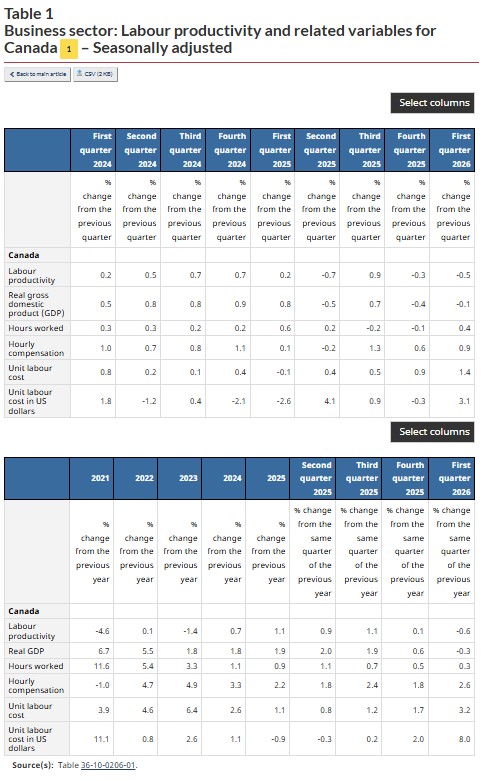
Labour productivity in Canada's business sector fell for a second consecutive quarter in the first quarter of 2026, while the cost of producing each unit of output rose for a fourth straight quarter, new Statistics Canada figures show.
Productivity slipped 0.5% over the quarter, the agency reported, as output contracted slightly and hours worked rose.
According to StatCan, the labour productivity of Canadian businesses fell 0.5% in the first quarter, after edging down in the previous quarter (-0.3%). The agency said the latest drop "reflects the mild contraction in the pace of business output," with real GDP in the business sector down 0.1%.
“Canada's economy is producing less per worker than is being produced in a number of other countries around the world that are competitive nations of similar economic status to Canada,” Jeff Doucet, CEO of Thrive Career Wellness, previously told Canadian HR Reporter.
Goods producers drive the decline
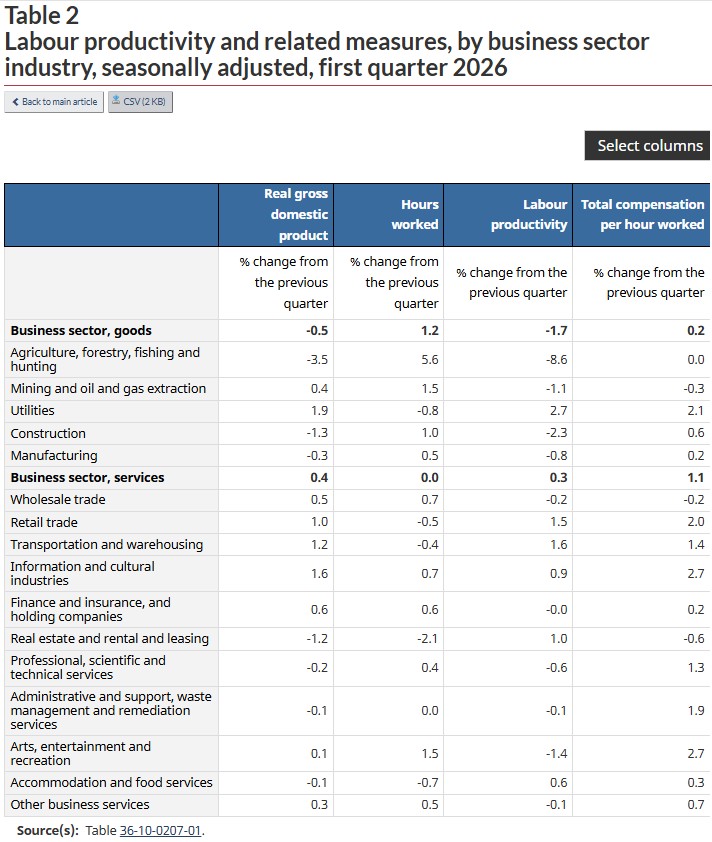
The quarter's decline was concentrated in goods production. StatCan reported that the first quarter decline in business sector productivity was driven by goods-producing businesses (-1.7%), while productivity in services-producing businesses edged up 0.3%.
Productivity fell in 10 of the 16 main industry sectors. The agency noted that construction and agriculture, forestry, fishing and hunting were “the main contributors to this decline,” while retail trade and transportation and warehousing saw the strongest increases in productivity.
Agriculture, forestry, fishing and hunting posted the steepest drop at 8.6%, and construction fell 2.3%, per Table 36-10-0207-01. Transportation and warehousing rose 1.6% and retail trade gained 1.5%.
The split signals that goods-sector and services-sector employers are entering mid-year facing very different productivity conditions.
Hours up, costs climbing
Hours worked turned higher after two soft quarters. StatCan said hours in the business sector increased 0.4% in the first quarter, after posting slight declines in the previous two quarters, supported by a 0.1% rise in jobs and a 0.3% increase in average hours. Hours in goods-producing businesses rose 1.2%, while hours in service-producing businesses were unchanged.
That mix of more hours and falling output drove unit labour costs higher. The agency reported that the 0.9% rise in hourly compensation resulted in a 1.4% growth in unit labour costs to businesses, “which marks the fourth consecutive quarterly increase."
Measured against a year earlier, unit labour costs were up 3.2%. StatCan defines unit labour costs as "the labour costs required to produce one unit of output."
Canada’s productivity challenge is as much organizational and cultural as it is economic, according to two experts.
According to the Canadian Immigration Lawyers Association (CILA), the most promising untapped fix for Canada's stalled labour productivity is to clear the path for far more entrepreneurs and investors to immigrate and build businesses in this country.
Writing for CILA, Business Immigration Committee chair Siavash Shekarian frames the stakes bluntly: "Canada's productivity challenge is the silent crisis of our time." He argues the obstacle is domestic, not a shortage of willing applicants: "The problem isn't a lack of interest by business immigrants; it's a lack of ambition by our policymakers."
On what is lost through delay, he writes: "When a visionary entrepreneur is forced to wait years for a decision, they don't just wait—they take their capital, their jobs, and their tax revenue to the United States, Australia, or the UK." He closes with a warning: "The global race for talent is on. If we don't clear the path for the world's entrepreneurs and investors, someone else will."