New Statistics Canada figures show the country barely grew last year. That’s a real concern for employers

At a glance
- Canada added 189,425 people in the year to July 1, 2026, growth of 0.5%.
- The number of people aged 20 to 29 fell by more than 150,000.
- Median age is rising again, to 40.9.
- Ontario, Quebec and BC grew at a fraction of the national rate.
For much of the past year, forecasters have been bracing for Canada to shrink. In May, RBC Economics warned that caps on temporary and permanent resident arrivals from abroad meant the population was on track to shrink for the first year on record in 2026.
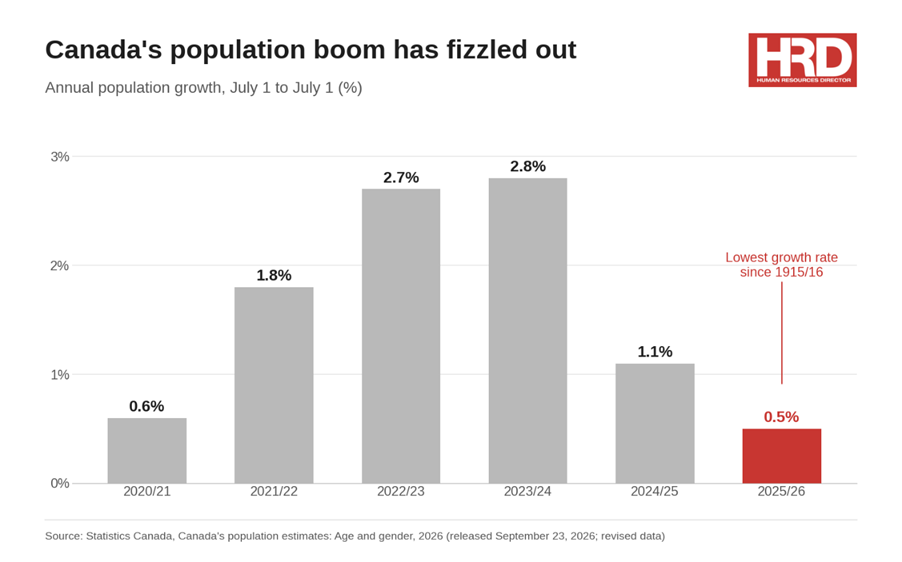
It hasn't happened, at least not yet. According to Statistics Canada data released today, the population reached an estimated 41,798,407 people on July 1, 2026, an increase of 189,425 people (+0.5%) from July 1, 2025.
That is still historically weak. It is the smallest July-to-July increase in raw numbers since 1944/1945 and the lowest growth in percentage terms since 1915/1916. It was even slower than 2020/2021, when pandemic border restrictions were in place. Growth peaked at 2.8% in 2023/2024 before slowing to 1.1% in 2024/2025 and 0.5% in 2025/2026.
The gap between the gloomy forecasts and the final number comes down to revisions. Earlier this year, preliminary estimates showed the population decreased by 102,436 people from January 1, 2025, to January 1, 2026. Statistics Canada has since revised its figures.
Non-permanent resident estimates, and consequently population estimates, have been updated from July 1, 2021, onward, partly because newer immigration department data contained substantially more records of permit extensions. Put simply, more temporary residents stayed longer than the early figures showed.
The missing cohort
The age breakdown matters more to employers than the headline figure. The two five-year age groups with the largest decreases in 2025/2026 were 20 to 24 years (-63,838; -2.4%) and 25 to 29 years (-91,135 people; -3.1%). That is the group that fills graduate intakes, apprenticeships, retail floors and call centres.
The country is getting older again as a result. During the post-pandemic immigration surge, the median age decreased and the average age remained relatively stable, since international migrants tend to be younger. On July 1, 2026, the median age of people in Canada was 40.9 years and the average age was 42.1 years.
Immigration was never a permanent fix for an aging workforce, though. Parisa Mahboubi, a labour economist at the C.D. Howe Institute, made the point to CNBC last year: "immigration … is not able to prevent Canada from aging because immigrants also age."
HRD has previously reported that the share of older workers in Canadian firms has doubled over two decades.
A tale of two Canadas
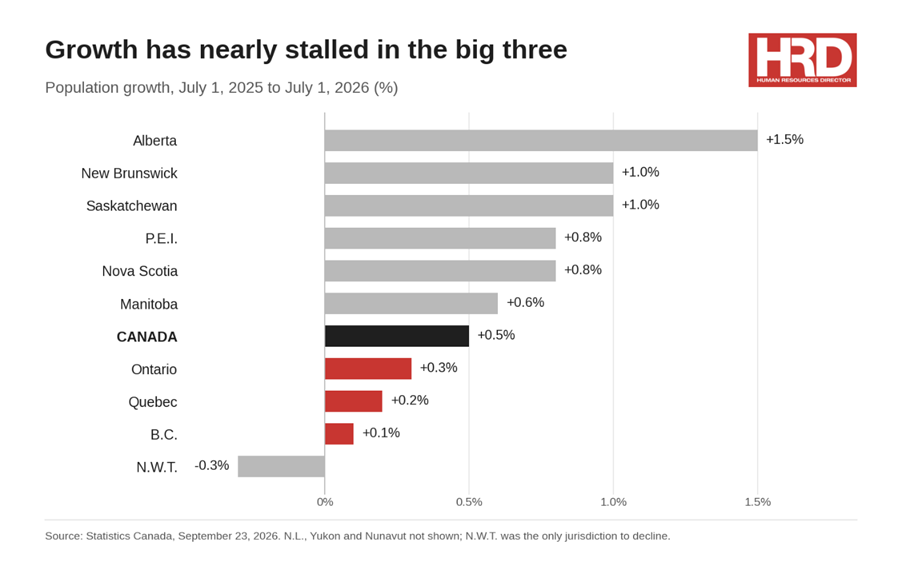
Where you hire makes a big difference. Alberta (+1.5%), New Brunswick (+1.0%), Saskatchewan (+1.0%), Prince Edward Island (+0.8%), Nova Scotia (+0.8%) and Manitoba (+0.6%) all grew faster than the country as a whole.
The three largest provinces lagged behind: Ontario (+0.3%), Quebec (+0.2%) and British Columbia (+0.1%). Statistics Canada says these provinces tend to welcome the largest share of international migrants, so they are more exposed to changes in immigration levels. The only province or territory to lose people was the Northwest Territories.
For employers in Toronto, Montreal, and Vancouver, this means the local labour pools that expanded fastest during the immigration surge are now contracting fastest too.
Retirements at one end, a thinner pipeline at the other
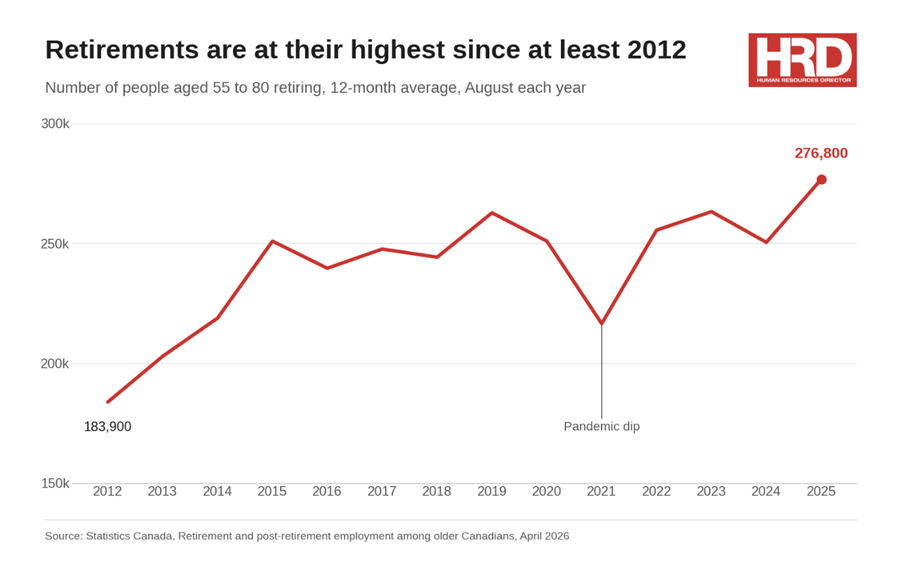
The RBC analysis, by assistant chief economist Nathan Janzen and economist Annie Zheng, shows both ends of the workforce shifting at once. Monthly retirements have climbed to roughly 0.12% of the labour force, about 25,500 workers per month, nearly double the roughly 14,000 per month of two decades ago. There is more to come: the youngest baby boomers will turn 65 in 2029.
Fewer young workers are coming through at the same time. RBC found the population under the age of 35 declined by a record 120,500 year over year in April, with the available workforce in that age group down 76,000. Without immigration, the bank estimates the population aged 15 to 34 would decline by roughly 186,000 per year over the next five years.
Why it doesn't feel like a labour shortage yet
Most hiring managers aren't feeling a talent crunch right now. StatCan’s August Labour Force Survey showed employment declined by 42,000 and the unemployment rate was unchanged at 6.4%. Young people are still struggling to get a first job. The youth unemployment rate edged up to 12.9%, higher than the pre-pandemic average of 10.8% recorded from 2017 to 2019. HRD has tracked how youth hiring remains a challenge even as the summer job market steadied.
Vacancy data tells a similar story. Job vacancies held at 510,200 positions in the second quarter, with 3.0 unemployed people per vacancy.
The slack won't last forever. The RBC report concludes that for businesses, "labour shortages will, eventually, return once the unusually high level of unemployment is absorbed." Some parts of the economy are already there. About 17% of firms in Canadian Federation of Independent Business surveys still report shortages of un/semi-skilled workers, already tracking around pre-pandemic norms while unemployment remains elevated. Accommodation, food services and construction report shortages more often than other sectors.
This fits earlier warnings that Canada's labour market is heading for structural tightening as the population ages.
Immigration policy is the wild card
Much depends on how long Ottawa keeps its immigration restrictions. The government says it remains committed to reducing the temporary population to less than 5% of the total population by the end of 2027. This year's temporary worker arrival targets are 230,000 (170,000 under the International Mobility Program and 60,000 under the Temporary Foreign Worker Program).
RBC expects the 5% target to be reached around mid-2027. It suggests current caps may need to be eased once the temporary resident population approaches that level. Ottawa has already loosened some rules at the margins. From April 1, 2026, to March 31, 2027, rural employers can retain their existing number of low-wage temporary foreign workers and increase their percentage from 10 to 15%. In Quebec, employer groups have been pressing both levels of government to stop trained temporary workers from being forced out. That follows the province's overhaul of its immigration streams last year.
The untapped pool: retirees who want to work
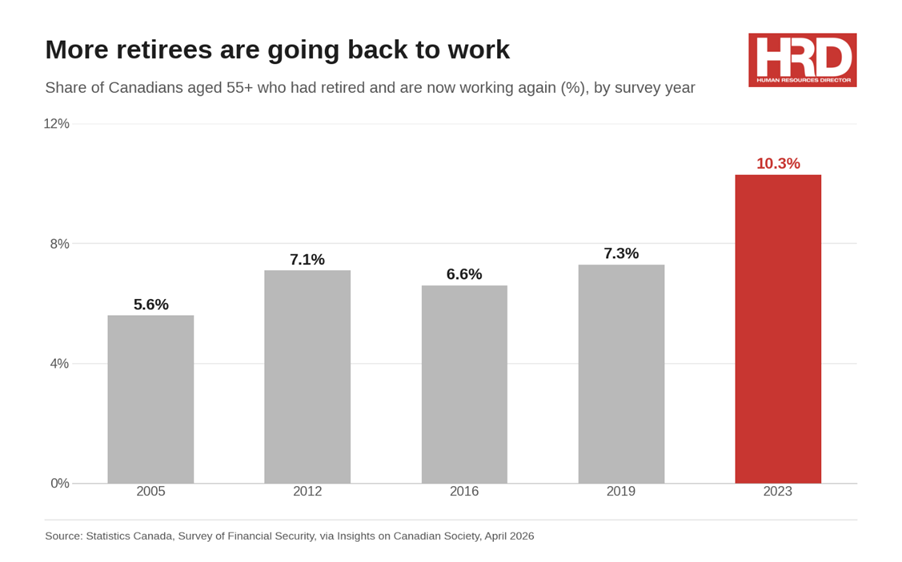
One group many employers overlook is people who have already retired. A Statistics Canada study published in April found that in 2023, 1 in 10 Canadians aged 55 and older who had retired were working again, up from 7% in 2019. Almost three in four of them (73%) were working part time, and one in three (33%) was self-employed.
Money is a big factor in when people retire. In 2025, financial considerations were the main reason people cited for the timing of their retirement, followed by their own or their spouse's health. The study's authors say rising retirements are likely to affect the availability of skilled workers, which makes retaining older workers an important issue for employers.
Keeping the pipeline in focus
Right now, employers have more applicants than openings for many junior roles. Within a few years, the supply of people in their twenties could be noticeably thinner, just as retirements peak. Employers that stop hiring and training junior staff now may struggle to rebuild that pipeline later.
HR teams can prepare in four ways:
- Keep entry-level programs running. Co-op placements, apprenticeships and graduate intakes are cheap to maintain while hiring is soft and expensive to restart from scratch.
- Treat knowledge transfer as a project. Give it owners and deadlines, especially in teams where several long-tenured staff are close to retirement.
- Offer part-time and project work to retirees. The StatCan data shows that is the kind of work returning retirees tend to take.
- Keep temporary foreign worker programs compliant. Compliance matters as rules keep shifting. Under the federal compliance regimes, penalties range from warning letters to administrative monetary penalties of up to $1M each year, and bans from the program.
Canada has avoided shrinking this year. But the workers who are leaving are the young ones employers will be competing for later in the decade.