Economist says Canada needs to 'recalibrate interpretation' of labour market data amid slower population growth, decreasing job creation

Canada’s labour market is entering a new phase that will change how headline job numbers should be read, according to a new analysis.
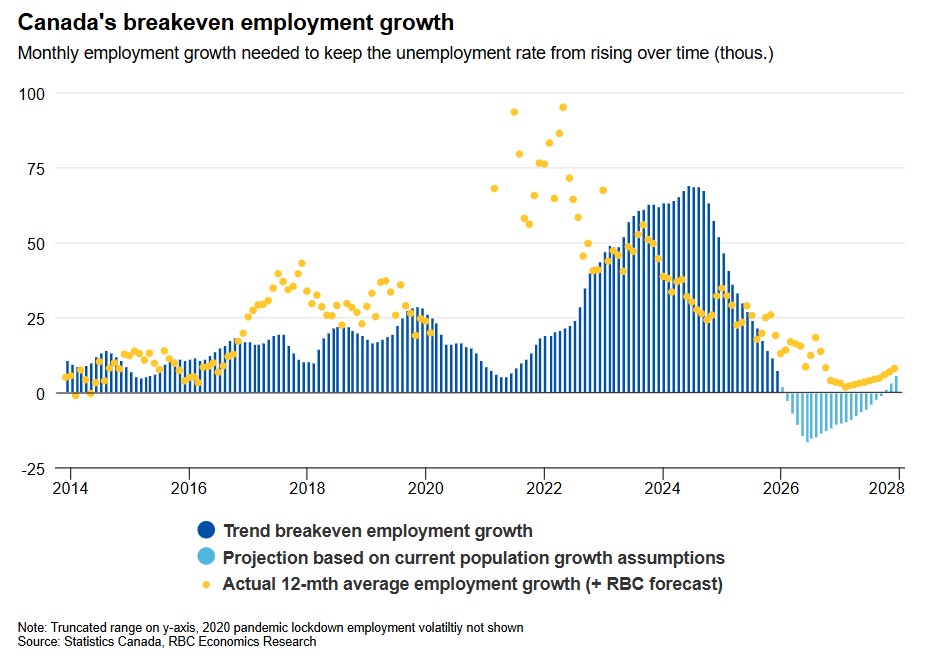
In a report, Nathan Janzen, assistant chief economist at RBC, says the country is undergoing “a fundamental structural shift” as population growth pauses after an unprecedented surge in recent years. As a result, the “breakeven employment” rate—the pace of monthly job creation needed to stop unemployment from rising—is “shrinking dramatically” because fewer jobs are now needed to absorb new entrants into the labour force.
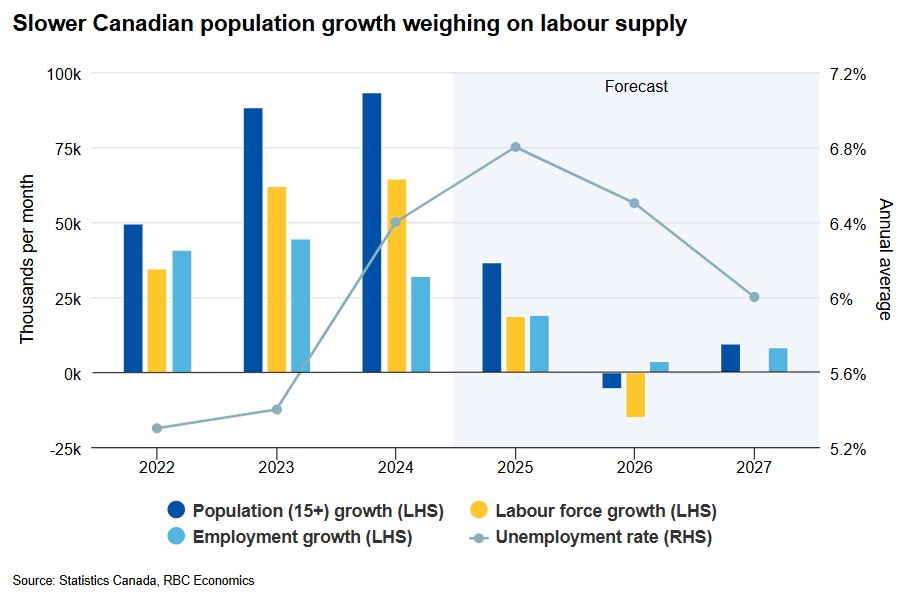
Janzen notes that Canadian labour data are “notoriously volatile month to month,” but argues that, on average, “smaller job gains in 2026 (or even small declines) would likely still be sufficient to move the unemployment rate lower—a sharp contrast to 2023‑2025—when ostensibly solid job growth was still not enough to absorb new market entrants, and the unemployment rate rose.”
He says this shift “requires policymakers and analysts to recalibrate their interpretation of labour market data,” adding that aggregate growth “may not look better in 2026” even as per‑household and per‑worker conditions improve and the jobless rate declines.
Canada’s labour market showed more signs of cooling in the third quarter of 2025, with employers posting fewer job openings even as overall labour demand and payroll employment edged higher, according to Statistics Canada.
Growing population’s impact on employment numbers
The report highlights that average job growth of 45,000 per month in 2023 and 32,000 per month in 2024 represented “the strongest two‑year pace on record outside the pandemic recovery.” Yet, when adjusted for what Janzen calls “unprecedented population (and labour force) growth,” the unemployment rate still climbed by nearly two percentage points—“a rate of increase historically indistinguishable from a recession.”
RBC estimates that over that period, the breakeven level of job creation was closer to 60,000 positions per month. Actual hiring fell short of that mark, which explains why a seemingly strong labour market coincided with rising unemployment.
That calculus is now changing. The federal government has moved to curb temporary resident arrivals and cap certain immigration streams after two years of rapid population growth. “In 2025, reduced temporary resident arrivals already lowered the breakeven employment rate to 25,000 jobs per month. By 2026, this will decline further,” Janzen writes.
“With population growth at a standstill, and an aging population pushing the labour force participation rate gradually lower, the Canadian workforce could outright shrink in the year ahead by our count,” he adds. Against that backdrop, he says Canada’s breakeven employment growth rate “is on track to be slightly negative—about -10,000 jobs per month on average in 2026.”
In practical terms, that means “modest job losses that would normally trigger recession concerns would instead be entirely consistent with a stable or slightly declining unemployment rate in the year ahead,” while RBC’s projection for modest job gains “would still be enough to push the unemployment rate lower.”
Canada’s tightrope labour market is expected to edge toward improvement in 2026, but the theme is stability more than strength, as hiring remains subdued and policy uncertainty clouds the outlook, according to a previous report.
Immigrants, aging population
Beyond the near term, Janzen identifies population aging as a key structural challenge. “Canada’s population is continuing to age as post‑WWII baby boomers retire,” he writes. That process is “creating a widening structural gap between consumer demand and available labour supply since retirees remain economically active consumers, but no longer contribute productive working hours.”
He notes that new immigrants are typically younger than the Canadian‑born population. “That means reducing temporary resident arrivals will accelerate population aging and intensify future labour shortages,” the report says.
RBC calculates that population aging has already reduced the labour force participation rate by more than four percentage points since 2008, and warns that baby boomers “will continue to hit retirement age in greater numbers over the remainder of the decade.”
 Janzen argues that an aging population shrinking the workforce relative to demand could, “absent offsetting labour productivity‑enhancing investment, relatively quickly lead to a return in labour shortages and make current immigration restrictions more difficult to sustain.” Policymakers, he suggests, will be wary of returning too quickly to a period of rapid short‑term population growth while housing and public‑service pressures—“highly evident in 2023 and 2024”—remain unresolved.
“But an aging population comes with its own costs,” he writes, and if unemployment falls as RBC expects in 2026, “pressure could grow to relax restrictive temporary resident caps currently in place into 2027 and beyond.”
Janzen describes the recent rise in unemployment as “somewhat anomalous,” pointing out that “labour shortages were a growing persistent issue for businesses over most of the prior decade.” With an older population and slower labour force growth, “those labour shortages could return more quickly than otherwise would be the case,” he concludes.
Canadian employers are heading into 2026 with slow economic growth, cautious hiring plans and limited wage pressure, even as conditions are being laid for a modest recovery later in the year, according to a previous report.