Manufacturing workforce aging faster than any other sector, Statistics Canada finds

The share of older workers in Canadian firms doubled over two decades, with manufacturing showing the steepest shift of any industry and the trend accelerating across almost every sector of the economy, according to a new Statistics Canada study published June 24.
The study, authored by Hassan Faryaar of Statistics Canada's Economic and Social Analysis and Modelling Division, is the first to measure workforce aging at the firm level across the universe of Canadian companies.
It tracked two indicators between 2001 and 2022: the average age of workers within each firm, and the share of workers aged 55 and older.
The backdrop is a Canadian population that has itself aged considerably. According to Statistics Canada's own demographic data cited in the study, the average age of Canadians rose by more than four years over two decades, from 37.5 in 2001 to 41.7 in 2021. The proportion of Canadians aged 55 and older rose from 20% of the population in 2001 to 32.4% in 2021.
In 2023, for the first time in Canadian history, the population of individuals aged 65 and older surpassed the population of those younger than 18.
Overall results on aging workforce
The firm-level findings track closely with those population trends — but with some sectors diverging sharply from the average.
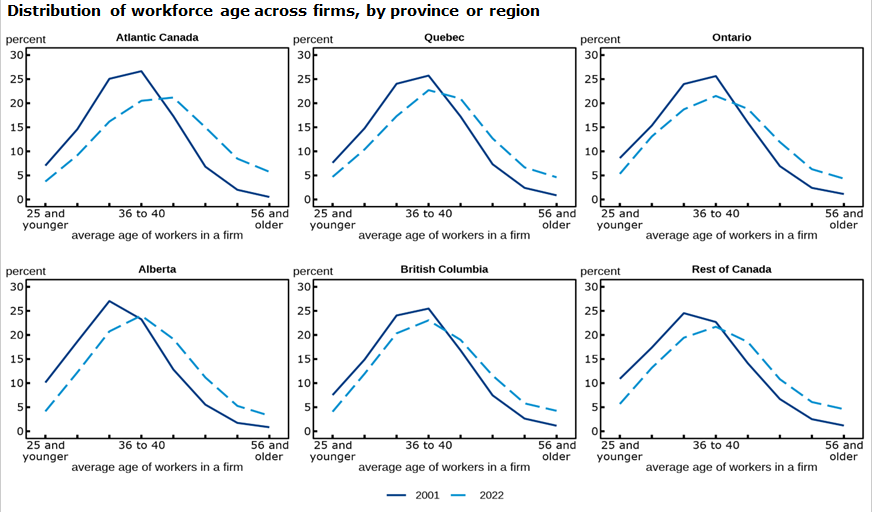
Across all firms, the proportion with an average worker age over 40 rose by more than 16 percentage points over the period, from 26.2% in 2001 to 42.3% in 2022. In other words, by 2022, more than 4 in 10 Canadian firms had an average worker age over 40.
The second measure — the share of workers aged 55 and older within firms — tells an equally stark story. That share doubled over the study period, rising from 9.3% in 2001 to 18.8% in 2022. As Faryaar puts it, "in a typical average firm, the share of workers aged 55 and older increased from 1 in 10 workers in 2001 to nearly 2 in 10 in 2022."
There was one notable interruption in the trend. The share of older workers dipped slightly during the COVID-19 pandemic, between 2021 and 2022. The study attributes this to a combination of factors: early retirements reducing the number of older workers, and an influx of younger immigrants expanding the overall workforce.
Statistics Canada data cited in the study found that 307,000 Canadians retired from their jobs in the 12 months leading up to August 2022 — an increase of 32% from the previous year and 12% above the same period ending in August 2019.
The study also notes that the aging trend has not been driven by demographics alone. Policy changes have played a role, including the elimination of mandatory retirement in several provinces during the mid to late 2000s, and the introduction of income tax incentives designed to encourage older workers to remain in the labour market.
Manufacturing hit hardest
The most striking sectoral finding concerns manufacturing. The share of manufacturing firms with an average worker age over 40 more than doubled over the study period, rising 30.7 percentage points — from 28.5% in 2001 to 59.1% in 2022. As the study states, by 2022, 6 in 10 firms in the manufacturing sector had an average worker age over 40.
The older-worker share within manufacturing firms rose with equal speed. In 2001, 9.8% of manufacturing workers were aged 55 or older. By 2022 that figure had reached 24.2% — an increase of 14.3 percentage points. Faryaar writes that "by 2022, on average, nearly one in four manufacturing workers was aged 55 or older."
The study draws on earlier Statistics Canada research to help explain the shift. From 1996 to 2018, the number of younger workers in manufacturing and utilities declined, while the number of older workers more than doubled. The study notes that researchers "the decline in younger workers in sectors such as manufacturing may be linked to structural changes like automation.”
The second-largest sectoral shift occurred in the combined category of agriculture, forestry, fishing and hunting, mining, quarrying, oil and gas extraction, and utilities. The proportion of firms in that grouping with an average worker age over 40 rose from 24.0% in 2001 to 48.4% in 2022.
Finance and related sectors — covering finance and insurance, real estate, professional and technical services, and information and cultural industries — also saw significant aging, though the study notes these sectors have historically skewed older due to "the nature of the work and career progression patterns."
Construction: the exception
Construction stands apart from the broader trend, recording the smallest shift of any sector. The proportion of construction firms with an average worker age over 40 rose by 12.9 percentage points, from 25.6% in 2001 to 38.5% in 2022 — a meaningful increase, but well below the manufacturing figure.
The study attributes this to the physical demands of construction work, suggesting that workers may retire earlier than in other sectors. Faryaar notes that the construction sector on average, has one of the youngest workforces in Canada.
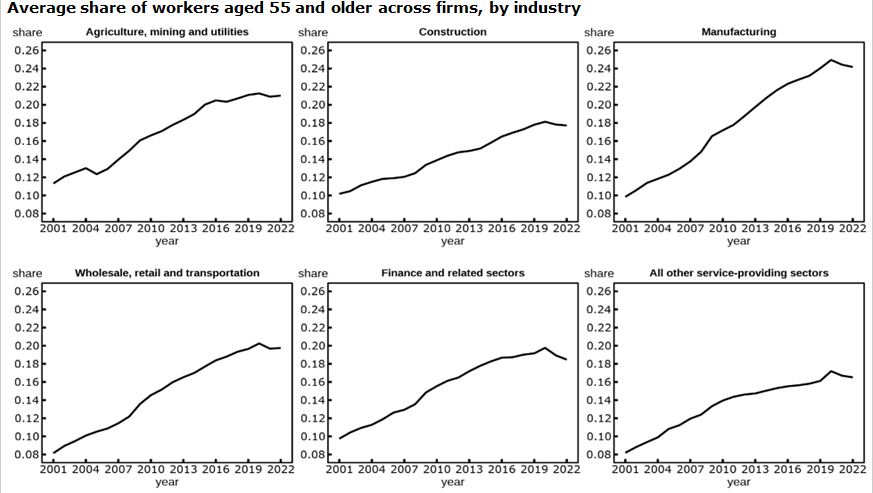
The picture becomes more complicated, however, when very small construction firms are examined. In 2022, the construction sector comprised about 165,900 employer firms, more than half of which had three or fewer workers. Among those very small firms, the share with an average worker age over 55 rose from 13.5% in 2001 to 23.6% in 2022. The study suggests a possible explanation: older construction workers may be moving into very small firms or self-employment, "where tasks rely more on experience than physical strength and offer greater flexibility in working hours." Among construction firms with 100 or more employees, the proportion with an average worker age over 55 remains close to zero.
Atlantic Canada leads regional shift
Regionally, Atlantic Canada experienced the sharpest increase of any part of the country. The share of workers aged 55 and older in Atlantic Canadian firms rose from 8.6% in 2001 to 22.1% in 2022 — an increase of 13.5 percentage points and the highest share of any region. By 2022, more than 1 in 5 workers in Atlantic Canadian firms was in the older age group.
Population aging alone does not fully account for this. The study points to out
migration as a compounding factor, noting that "Atlantic Canada experienced net interprovincial migration losses in nearly every year of the 2010s," according to the Atlantic Provinces Economic Council — meaning younger workers left the region, accelerating the aging of those who remained.
British Columbia saw the smallest regional increase, with the share of older workers rising 7.7 percentage points over the period, from 9.9% to 17.6%. Ontario saw an increase of 14.9 percentage points; Quebec, 17.1 percentage points; Alberta, 17.9 percentage points.
Faryaar says that this paper is a foundation, not a conclusion. He describes it as "the first in a series aimed at better understanding the impact of an aging workforce on firm performance," with subsequent work expected to explore how shifts in workforce age composition affect productivity, innovation and technology adoption at the firm level.