‘The real challenge for leadership isn’t driving adoption, it’s having the insights to clear legacy roadblocks’

Workers are training their artificial intelligence (AI) colleagues on their own – and HR leaders need to catch up. New research suggests the AI upskilling gap in industrial workplaces sits not with frontline employees, but with the executives above them.
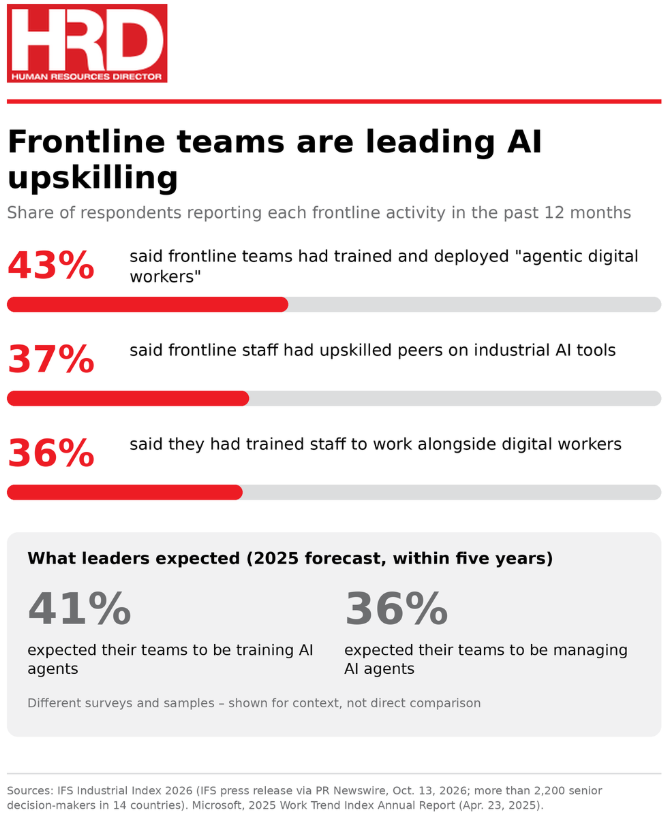
The evidence comes from the IFS Industrial Index 2026, released by enterprise software company IFS: 43% of respondents said frontline teams had trained and deployed “agentic digital workers” – AI systems that carry out multi-step tasks with limited human direction – in the past 12 months. Another 37% said frontline staff had upskilled peers on industrial AI tools, and 36% said they had trained staff to work alongside digital workers.
That pace may outrun executives’ forecasts. In Microsoft’s April 2025 Work Trend Index, leaders predicted teams would be training (41%) and managing (36%) AI agents within five years.
Cathie Hall, chief product and customer officer at IFS, credits the people closest to the work: “The factory floor is moving at full speed. Workers see the operational insights, know their data better than anyone, and they know they need industrial-grade AI solutions to turn that expertise into action. The real challenge for leadership isn’t driving adoption, it’s having the insights to clear legacy roadblocks and delivering the secure industrial harness, data pipelines, and governance required to scale these wins safely and globally.”
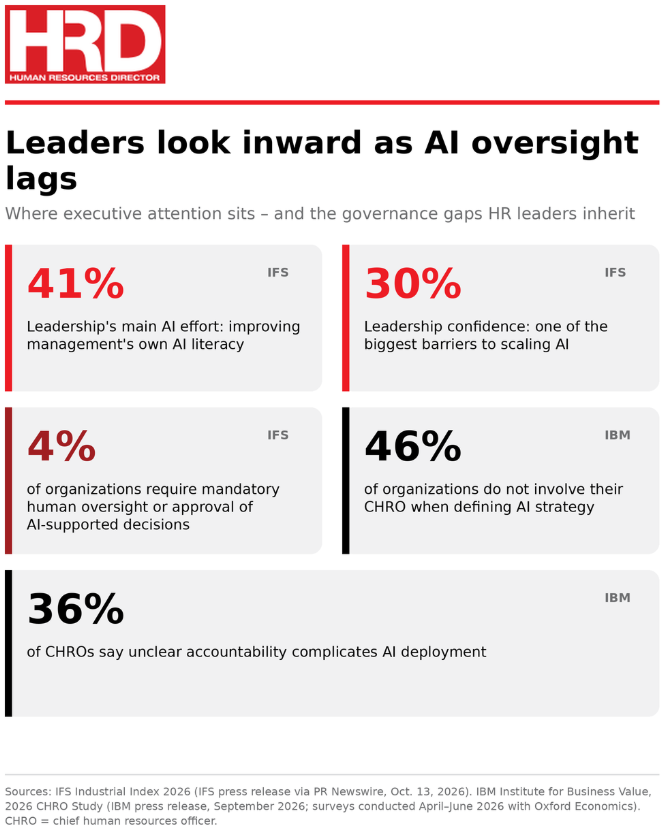
Executives, by contrast, looked inward: improving management’s own AI literacy was their main AI effort (41%), and leadership confidence (30%) emerged as a top barrier to scaling. IFS surveyed more than 2,200 senior decision-makers in 14 countries it has not named.
What does worker-led AI training mean for HR?
That split is HR’s problem. Workforce capability is HR territory, yet informal peer-led training rarely appears in records or job descriptions, and those who coach agents and peers do work no role recognizes.
Often, HR is not in the room. IBM’s 2026 CHRO Study, published in September 2026, found 46% of organizations do not involve their chief human resources officer (CHRO) when defining AI strategy.
Some Canadian unions are not waiting. Unifor’s January 2026 Bell Clerical agreement created a joint committee to review AI’s introduction in the workplace. For employers, that sets a benchmark HR should match.
Three AI upskilling gaps HR leaders need to close
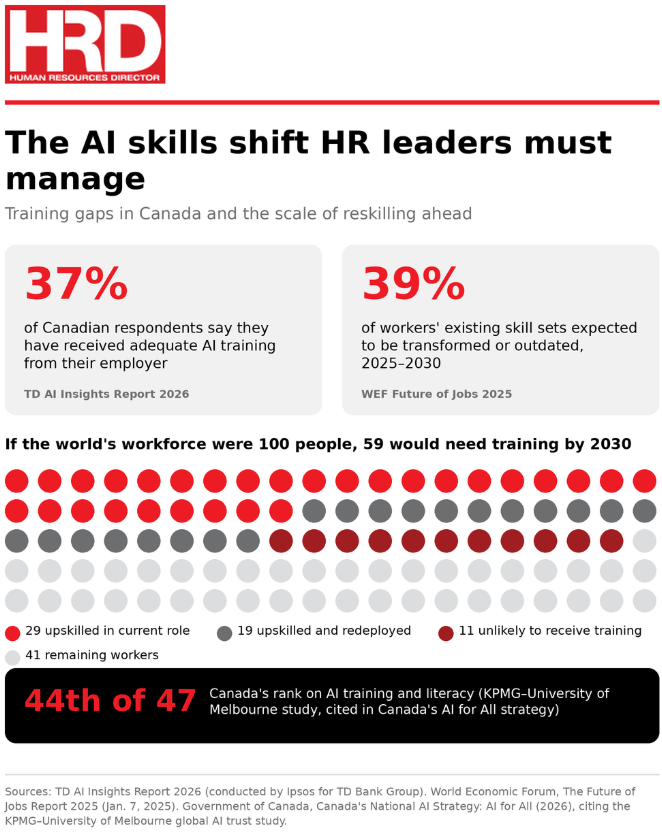
Formalizing worker-led learning means closing three gaps. The first is training that is uneven and undocumented. The 2026 TD AI Insights Report found only 37% of Canadian workers had received adequate AI training from their employer, as detailed in our coverage of Canada’s widening AI skills gap and worker confidence. Small firms lag further, per our story on skills-first hiring and training for Canada’s major projects.
The second is ownership of role design. As digital workers join teams, someone must decide how human jobs change. The World Economic Forum’s Future of Jobs Report 2025 estimates 39% of workers’ skill sets will be transformed or become outdated by 2030.
The third is accountability, where the numbers are starkest. Only 4% of organizations in the IFS study require human oversight or approval for AI-supported decisions, and 36% of CHROs in IBM’s study said unclear accountability complicates AI deployment.
Why the gap sits in the C-suite
Each of those gaps traces back to leadership priorities. Executive under-investment in training also surfaces in research on why AI upskilling falls short when executives prioritize job cuts.
Hiring around the problem won’t work either. Simon Blanchette, a faculty lecturer at McGill University in Montreal, told Canadian HR Reporter in February 2026: “They still hope that they will be able to recruit the person with the right skills, and that’s wishful thinking.”
That puts the onus on HR: identify employees training colleagues and agents, recognize that work in job descriptions and reviews, and set oversight rules. Ottawa’s AI for All strategy, which calls for practical AI training for front-line workers, commits to scaling employer-led programs.