Canadian wages trail prices by a wider gap than in the US. Lightcast and Randstad data show why 2027 pay plans will diverge

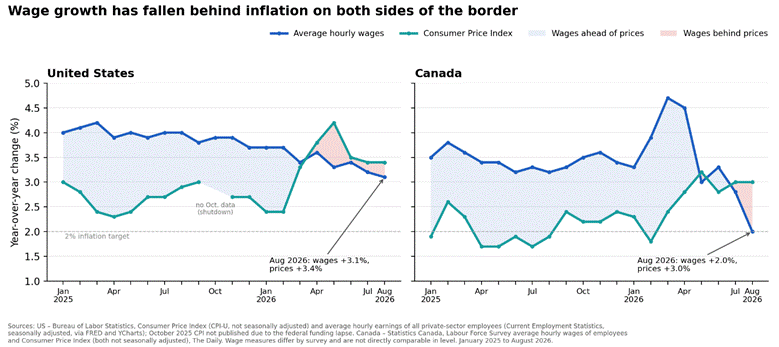
Canadian wages are losing the race with prices, and the gap is wider than in the US. Average hourly wages rose just 2.0 per cent in the 12 months to August, the slowest wage growth since November 2017, excluding 2021, while consumer prices climbed 3.0 per cent, Statistics Canada reported. In the US, average hourly earnings rose 3.1 per cent against 3.4 per cent inflation, according to the US Bureau of Labor Statistics (BLS).
The squeeze looks the same on both sides of the border. The road to it does not, according to speakers at staffing firm Randstad’s 2027 salary trends webinar on Sept. 29, 2026, who argued against building a single North American pay plan around it.
“When we step back and we look across North America, we do see that the US and Canada are moving in a similar direction. But they’re not starting from the same economic conditions,” said Elizabeth Crofoot, principal economist at labour market analytics firm Lightcast [add location] [confirm: said during the webinar].
Two economies, one squeeze
Randstad’s outlook projects US gross domestic product (GDP) growth of 2.2 per cent in 2026 against 1.3 per cent for Canada. August unemployment was 4.1 per cent in the US, according to BLS, and 6.4 per cent in Canada, according to Statistics Canada. The Bank of Canada held its policy rate at 2.25 per cent on Sept. 2.
Canada carries more slack in its labour market, Crofoot said, while the US pairs faster growth with persistent inflation, a mix that hits real wages (pay adjusted for inflation) hardest. BLS data show US wage growth has trailed inflation every month since April, and Statistics Canada data show Canadian wages trailing prices since July.
Crofoot cautioned against reading Canada’s earlier wage gains as good news. “I would be careful about translating that into saying that employees are fine in Canada and they’re less fine in the US,” she said. “Canada is also coming through a period of significant cost of living increases, especially with some of the tariffs that we have seen.”
Webinar attendees pointed the same way in live polls, which were self-selected and not a scientific sample [add number of respondents]. Some 47 per cent named employee cost-of-living pressure against corporate margin squeezes as their organization’s biggest friction. On 2027 merit budgets, the money set aside for performance-based raises, 46 per cent were undecided, 23 per cent were holding flat, 18 per cent were increasing and 14 per cent were cutting base merit to fund variable pay and bonuses. 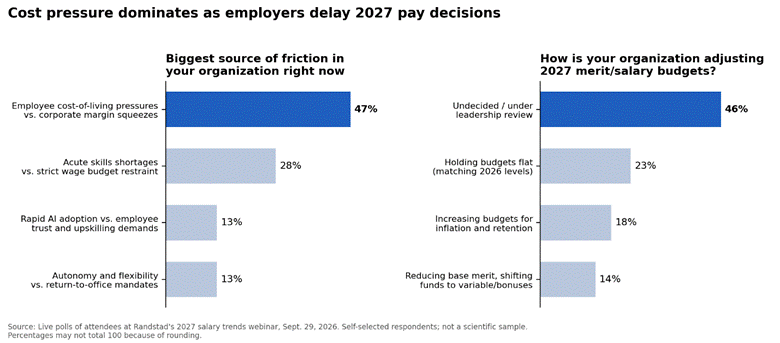
US job ads shout louder about perks
The sharpest split shows up in what employers advertise. Lightcast analyzed mentions of four benefit categories (career development, financial and supplemental pay, wellness, and work-life) in US and Canadian job postings from June 2024 to July 2026. US postings led in most categories across the operational and skilled trades, professional and digital sectors.
The widest gap sits in work-life benefits such as childcare and flexible work. In the professional sector, 26.6 per cent of US postings mentioned them against 7.2 per cent of Canadian postings. In the digital sector, the split was 16.5 per cent to 4.6 per cent.
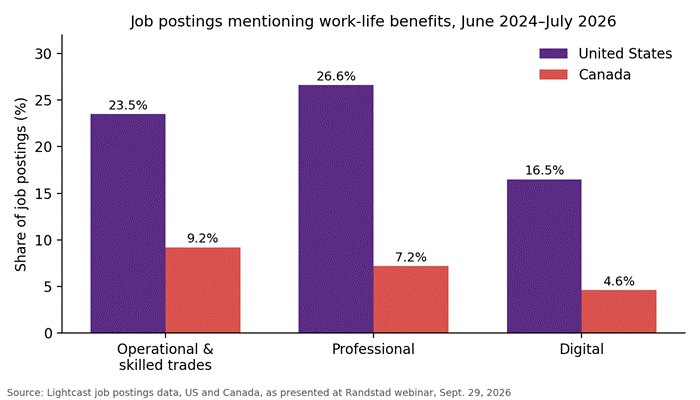
Share of job postings mentioning work-life benefits (childcare, flexible work and other programs), US vs. Canada. Source: Lightcast
Crofoot pointed to law as part of the explanation. “In terms of statutory compensation elements, Canada is much stronger across the board on other medical, retirement, leave pay,” she said. “So Canada sort of ticks the box on all of that, whereas the US has a lot more to make up because we don’t have all of that.”
Canada wins one category: career development in the digital sector, mentioned in 20.2 per cent of Canadian postings against 17.4 per cent of US postings. “Canadian employers are getting the message that they need to invest in their employees in this regard,” Crofoot said.
Follow the 2027 money
Neither market is planning broad raises, extending a pattern of flat pay increases through 2026. In the US professional sector, Randstad’s data shows merit budgets concentrating on financial planning and analysis (FP&A) and high-impact revenue roles at 3.8 per cent to 4.6 per cent, while corporate sales and administrative staff get 1.2 per cent to 2.6 per cent, topped up by variable commissions. In Canada, skilled trades base adjustments range from 2.9 per cent to 3.9 per cent, and shortages of Red Seal tradespeople, certified under Canada’s interprovincial trades standard, push employers toward custom craft rates and shift differentials [name Randstad report, date and link].
Marie-Noëlle Morency, head of brand, content and communications at Randstad North America [add location], said employers now aim money at scarcity, including artificial intelligence (AI) and tech skills. “They may not want to spread raises evenly, but targeting money at some employees with niche skills, for example, in AI and tech, in healthcare and skilled trades, where we actually see skill shortages,” she said.
Pay transparency adds a new line item
Since Jan. 1, 2026, Ontario has required employers with 25 or more employees to publish expected pay, or a range no wider than $50,000, in public job postings, with exemptions for higher-paid roles, and to disclose whether they use AI to screen, assess or select applicants. Randstad’s outlook estimates that emerging provincial pay transparency rules push Canadian organizations to set aside 2.0 per cent to 2.6 per cent of payroll to fix wage compression, meaning newer hires earning close to or more than longer-serving staff, before they post ranges publicly.
Crofoot advised triage over blanket correction. “It’s being really pragmatic about it, identifying again, critical roles, critical geographies, even down to critical stores,” she said.
The playbook splits at the border. Canadian employers need to budget for compression audits ahead of posting salary ranges under new provincial rules and keep funding the digital career development that already sets them apart. US postings carry more of the benefits pitch because Canadian law already covers more of the basics, according to Crofoot.
Jeff Johnson, head of marketing at Randstad North America [add location], summed up the shift for both markets. “Maybe across-the-board raises aren’t the way to go,” he said. “Maybe it’s setting aside discretionary funds for critical skill shortages.”