Statistics Canada data signals mounting workforce pressure with slowing wages and tariff uncertainty

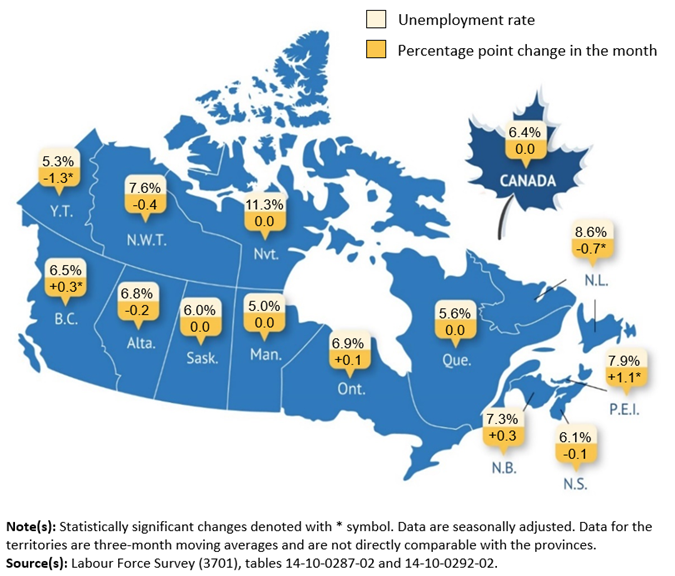
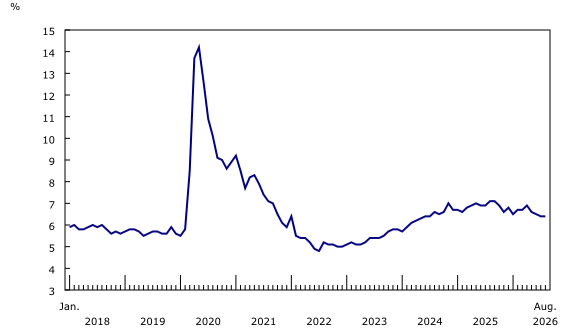
Canada's labour market shed 42,000 jobs in August, ending four consecutive months of growth and falling well short of economist forecasts for a gain of 15,000 positions, according to Statistics Canada's Labour Force Survey (LFS) released Friday. The employment rate – the proportion of Canadians aged 15 and older who are employed – fell 0.1 percentage points to 60.8 per cent, while the unemployment rate held steady at 6.4 per cent.
The August decline follows a cumulative run of 181,000 jobs added between April and July. For HR executives heading into the fourth quarter, the data delivers a more complex signal than the job numbers alone: slowing wage growth, a contracting public sector, persistent long-term unemployment, and rising tariff pressure across export-dependent industries all carry direct implications for workforce planning and people strategy.
Wage growth decelerates to slowest pace since 2017
Average hourly wages among employees rose two per cent year-over-year in August, reaching $37.02 – the slowest rate of wage growth recorded since November 2017, excluding pandemic-distorted figures in 2021, according to Statistics Canada. In June, the comparable figure stood at 3.3 per cent. The deceleration follows an average of 4.9 per cent annual wage growth across 2023 and 2024, and 3.4 per cent throughout 2025.
The slowdown is sharpest at the bottom of the earnings spectrum. Employees in the lowest quarter of the wage distribution saw hourly earnings rise just 1.1 per cent year-over-year to $18.66, while those in the second-lowest quartile recorded growth of 1.3 per cent. Workers in the upper half fared better, with wages in both the third and top quartiles rising 2.1 per cent. The divergence between earnings growth at the top and bottom of the distribution is a structural challenge that will shape attraction and retention decisions for organizations in the months ahead.
Unemployment rate
Public sector contraction accelerates across three months
The public sector shed 20,000 positions in August, its third consecutive monthly decline. Since May, the total number of public sector employees in Canada has fallen by 78,000 — or 1.7 per cent — according to Statistics Canada. Private sector employment was essentially unchanged in the month, though it grew by 156,000 (+1.1 per cent) on a year-over-year basis.
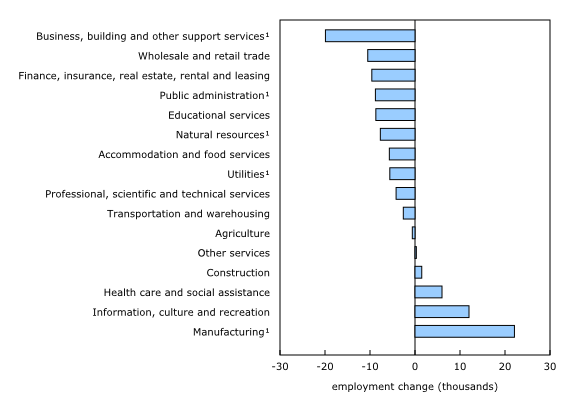
At the industry level, declines in August were concentrated in business, building and other support services (-20,000; -2.8 per cent), public administration (-8,800; -0.7 per cent), natural resources (-7,700; -2.3 per cent) and utilities (-5,600; -3.5 per cent). Manufacturing was the sole sector to record significant growth, adding 22,000 positions (+1.2 per cent) – a result that was somewhat unexpected given the industry's direct exposure to US tariffs, with most of that gain concentrated in Ontario (+14,000; +1.7 per cent).
Over the past 12 months, year-over-year growth was led by health care and social assistance (+129,000; +4.5 per cent), information, culture and recreation (+49,000; +5.9 per cent) and transportation and warehousing (+47,000; +4.4 per cent). Wholesale and retail trade recorded the steepest year-over-year decline at -55,000 positions (-1.8 per cent) – a trend that HR leaders will recognize as a sustained shift as Canada’s trade war with the US is reshaping workforce plans.
Signs of tariff pressure
The August jobs report arrived amid a sharply deteriorating trade environment. Talks between Canada and the US broke down in August, and the US government subsequently imposed fresh tariffs on approximately $28 billion worth of Canadian goods. Ottawa responded with counter-tariffs scheduled to take effect Sept. 8. The employment figures only partially reflect the impact of this new tariff wave, which came into force mid-month – meaning the September data, due Oct. 9, may carry a more pronounced effect.
The layoff rate — the proportion of people who became unemployed as the result of a layoff between July and August — stood at 0.8 per cent in August 2026, slightly below the one per cent recorded 12 months earlier, according to StatCan. However, for workers in industries dependent on US export demand, the 12-month average layoff rate was 0.9 per cent, compared with 0.7 per cent for workers in other sectors – a gap that points to mounting trade-related workforce risk in manufacturing-heavy regions.
Among Canada's 1.5 million unemployed in August, 24 per cent had been continuously searching for work for 27 or more consecutive weeks – the threshold StatCan uses to define long-term unemployment. That proportion remains well above the pre-COVID-19 pandemic average of 17.1 per cent recorded from 2017 to 2019. For HR leaders developing talent acquisition and reintegration programs for long-term unemployed candidates, the data points to a significant pool of workforce capacity that remains underutilized.
Quebec (-19,000; -0.4 per cent) and Ontario (-18,000; -0.2 per cent) led provincial employment declines in August. Quebec was the only province to record a year-over-year employment contraction, down 54,000 positions (-1.2 per cent) compared with August 2025. New Brunswick was the sole province to record meaningful employment growth, adding 2,400 positions (+0.6 per cent). The participation rate — the share of the population either employed or actively seeking work — fell 0.1 percentage points to 65.0 per cent nationally.
Youth employment fell by 19,000 (-0.7 per cent) in August, with the youth unemployment rate edging up to 12.9 per cent – still 1.4 percentage points below August 2025, but remaining above the pre-pandemic average of 10.8 per cent recorded between 2017 and 2019.