‘Few leaders have a broader view of how AI is creating value across the enterprise'

Most chief AI officers can see where artificial intelligence is paying off in their organizations, but few have the authority to act on it, according to a global study released by the IBM Institute for Business Value.
That gap leaves the decisions that shape jobs, skills and how work gets redesigned with other executives, putting people leaders at the centre of whether AI delivers.
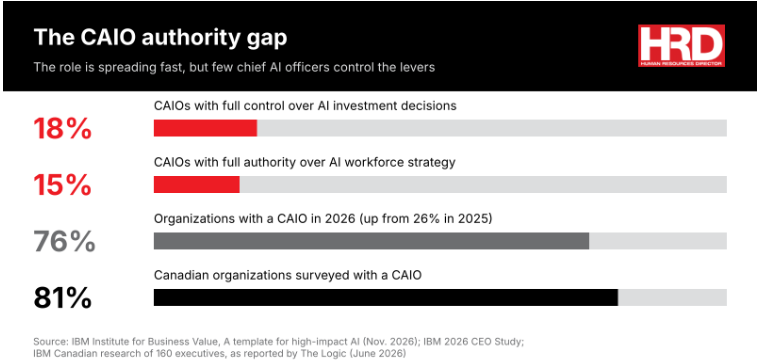
The study surveyed 1,667 chief AI officers (CAIOs) and equivalent enterprise AI leaders across 33 geographies and 20 industries from April to June 2026. Only 18% said they have full control over AI investment decisions, and just 15% have full authority over AI workforce strategy. IBM did not publish a Canadian breakout.
Joanne Wright, senior vice-president of transformation and operations at IBM, summed up the bind in the report’s foreword: “Few leaders have a broader view of how AI is creating value across the enterprise. Yet the outcomes they are accountable for often depend on decisions made by others.”
A fast-growing role in Canada
The bind matters because the role is spreading fast. IBM’s 2026 CEO Study found 76% of organizations now have someone in the role, up from 26% in 2025.
In Canada, separate IBM research of 160 executives found 81% of organizations surveyed have a CAIO, The Logic reported in June 2026.
As of June 2026, Scotiabank had no CAIO, while OMERS, PSP Investments and BCI had placed AI with the chief technology officer, The Logic reported.
The CHRO partnership gap
Wherever the role sits, CAIOs cannot redesign work alone, the report says. It urges them to partner with the chief human resources officer (CHRO) to evolve existing roles, or create new ones, for AI-first workflows, and to update incentives to reward AI-enabled outcomes.
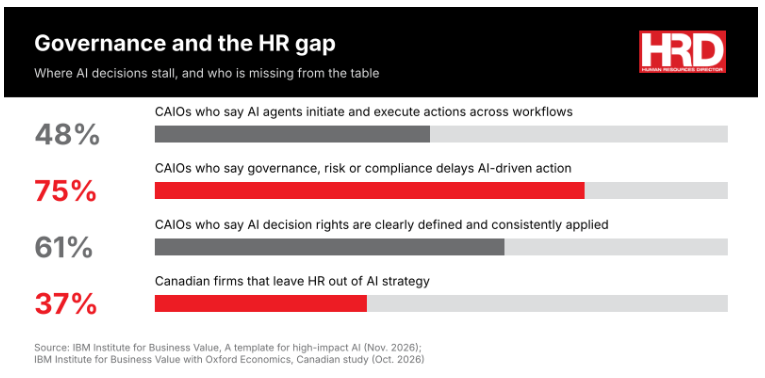
Many Canadian employers are not there yet. An IBM study with Oxford Economics found HR is left out of AI strategy at 37% of Canadian firms, while TD research on Canada’s widening AI skills gap shows the workforce stakes.
Governance adds friction. While 48% of CAIOs said AI agents initiate and execute actions across workflows, 75% said governance, risk or compliance delays AI-driven action. Only 61% said AI decision rights are clearly defined and consistently applied.
What high-impact AI leaders do differently
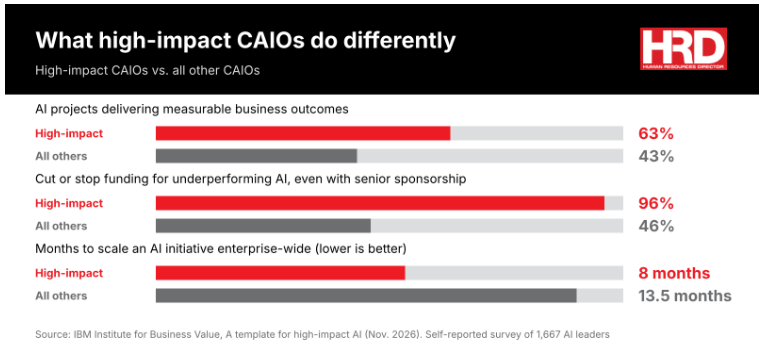
Some organizations have found a way through. IBM identified a group of high-impact CAIOs whose organizations report stronger results: 63% of their AI projects deliver measurable business outcomes, versus 43% elsewhere, and they scale initiatives enterprise-wide in eight months rather than 13.5. The data is self-reported and shows association, not cause.
The clearest difference is financial discipline. Some 96% of these leaders cut or stop funding for underperforming AI initiatives, even with senior sponsorship, compared with 46% of others.
“We stop when the value isn’t there,” said Pascal Belaud, executive vice-president and chief AI and data officer at Truist.
What should a chief AI officer be?
That discipline points to the kind of leader the report describes. Wright wrote that successful AI leadership “requires more than technical expertise or operational oversight,” adding: “It requires gathering evidence, influencing decisions, and measuring success.”
IBM’s action guides show what that means in practice. CAIOs should define which decisions AI can make and which need human judgment, redesign high-value workflows end-to-end around AI, and manage AI as a portfolio, funding what works and stopping what doesn’t.
“The CAIO job is more of an education job than people realize,” said Abhi Seth, chief data and AI officer at The Boeing Company, in the report.
Without authority over workforce strategy, the CAIO’s influence depends on the CHRO.