‘The relationship between employer and employee becomes more transactional in some companies’

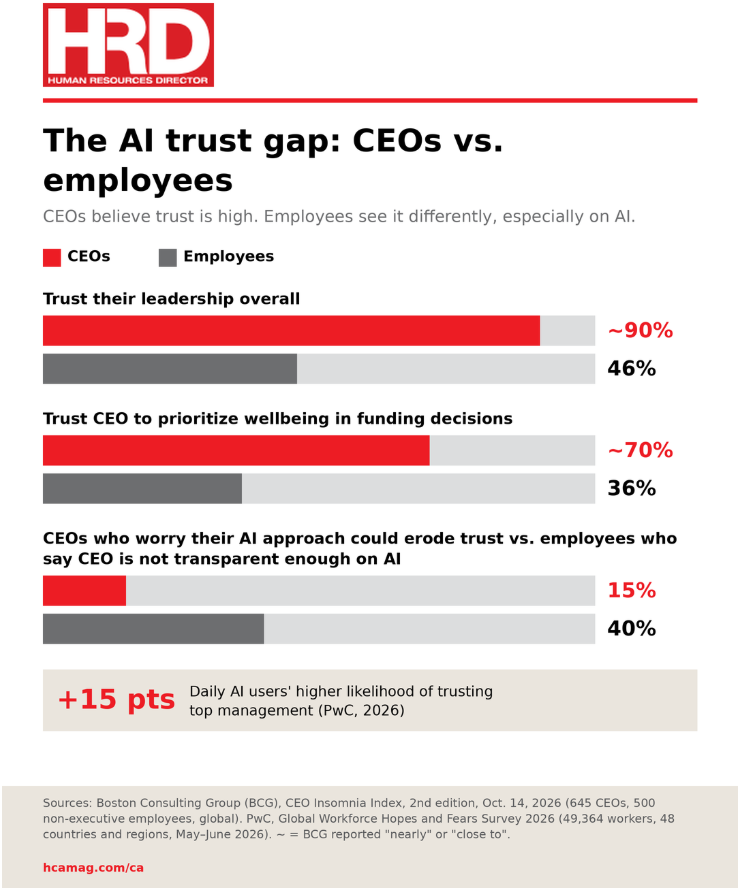
HR leaders face an artificial intelligence (AI) trust problem their CEOs largely don’t see: four in 10 employees say their CEO hasn’t been open about what AI means for their jobs, yet just 15% of CEOs worry their AI push could erode trust.
The findings, from the second CEO Insomnia Index by Boston Consulting Group (BCG), released Oct. 14, 2026, leave HR at the centre of an AI transparency gap that threatens discretionary effort.
The blind spot is broad. Nearly 90% of CEOs believe employees trust their leadership, while 46% of employees agree, BCG reported. Close to 70% of CEOs expect staff to trust them to prioritize wellbeing in funding decisions; 36% of employees do.
For HR, executive confidence is a poor read on workforce sentiment. Usage matters too: PwC’s Global Workforce Hopes and Fears Survey 2026 found employees who use AI daily are 15 percentage points more likely to trust top management.
Julie Bedard, a Boston-based managing director and partner at BCG, called the gap long-standing. “Historically, there’s always been this perception gap,” said Bedard. “Leadership teams, including CEOs, sometimes overestimate this type of trust, and I think it has only increased as the relationship between employer and employee becomes more transactional in some companies.”
What does the AI trust gap cost the business?
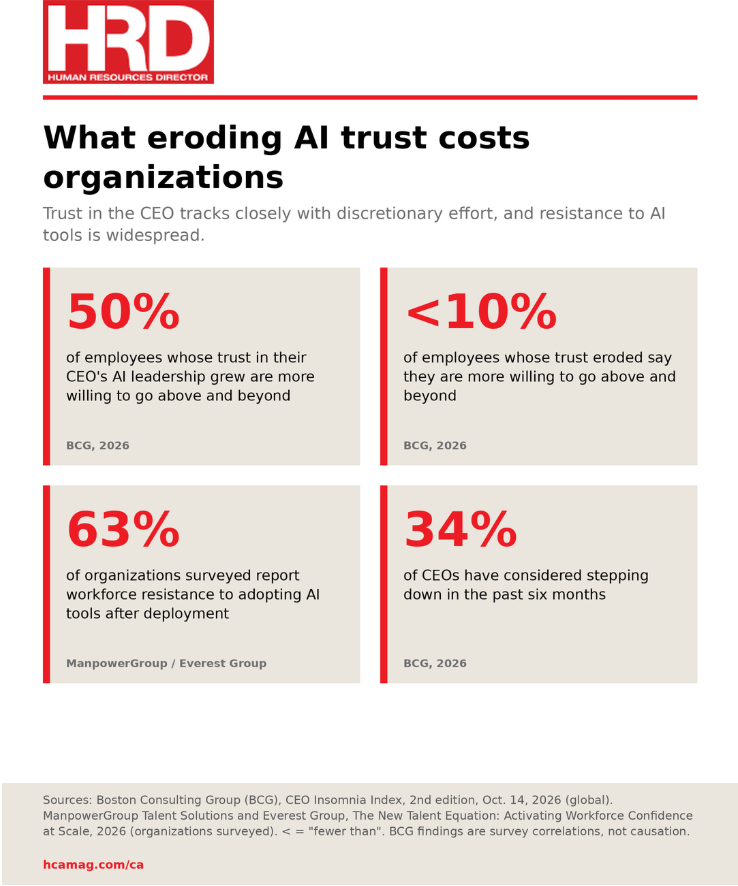
The impact hits metrics HR owns. Half of employees whose trust in their CEO’s AI leadership grew are more willing to go above and beyond, versus fewer than 10% whose trust eroded, BCG found. ManpowerGroup Talent Solutions and Everest Group found 63% of organizations surveyed report resistance to AI tools after deployment, and HRD Canada reported how workforce resistance puts AI transformation returns at risk.
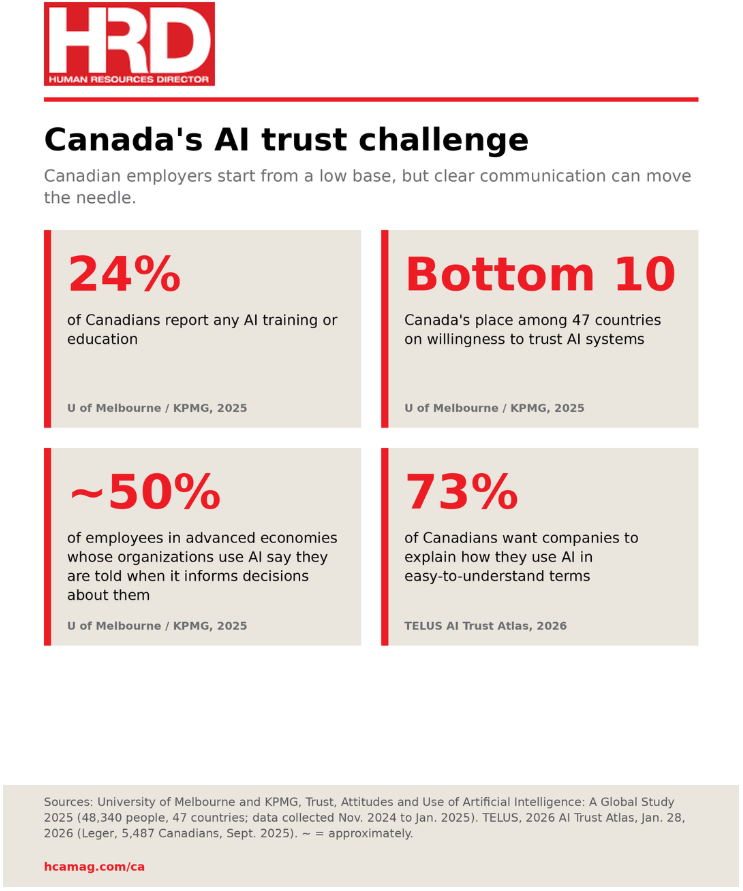
Canadian HR starts lower. A 2025 University of Melbourne and KPMG study of 47 countries placed Canadians among the least trusting of AI, with 24% reporting any AI training – a result HRD Canada explored in reporting why Canada ranks near the bottom on AI trust.
Leadership churn complicates the task: 34% of CEOs have considered stepping down in the past six months, BCG found – turnover that can reset AI messaging.
How can HR leaders close the AI transparency gap?
Rebuilding trust starts with executive behaviour – and HR can hold leaders to it. “CEOs assume that since employees hear their words, that’s enough to build trust, but employees also judge CEOs by their actions,” said Matthias Tauber, a Munich-based managing director and senior partner at BCG. “CEOs must be realistic in their words and consistent in their actions.”
Regulation adds pressure. Since Jan. 1, 2026, Ontario’s Employment Standards Act, 2000 has required employers with 25 or more employees to disclose in public job postings whether AI screens, assesses or selects applicants. The Human Resources Professionals Association (HRPA), which regulates the HR profession in Ontario, urges leaders to model transparency about their own AI use.
HR can supply the evidence executives lack through pulse surveys on AI communication, role-level reskilling plans and clear disclosure of where AI shapes decisions. At organizations using AI, only half of employees in advanced economies say they are told when it informs such decisions, the Melbourne-KPMG study found. Yet 73% of Canadians want companies to explain their AI use in easy-to-understand terms, according to TELUS’s 2026 AI Trust Atlas, covered in HRD Canada’s report on workers’ trust in AI and employer responsibilities.