‘The growing demand for AI-related expertise reflects a broader shift toward specialized skills across the workforce’

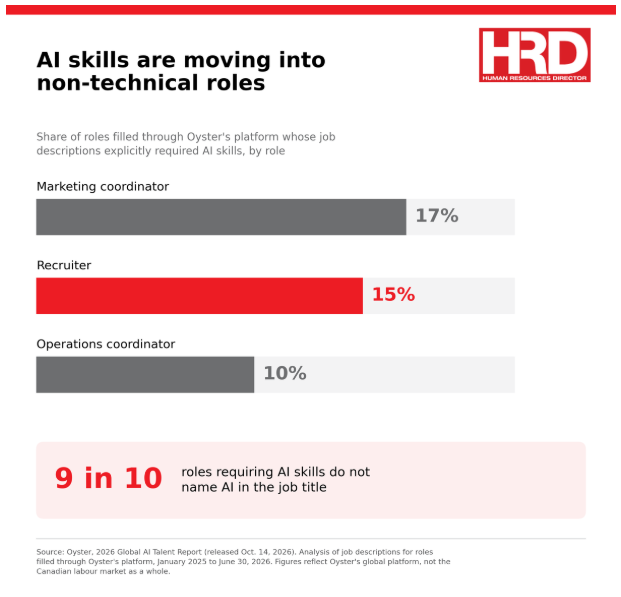
Recruiters – the people who hire AI talent – are being asked for artificial intelligence (AI) skills of their own, with 15% of recruiter roles filled through global employment platform Oyster requiring them, according to a new report.
Oyster's 2026 Global AI Talent Report, released Oct. 14, 2026, covered roles filled through the remote-first company's platform from January 2025 to June 30, 2026. AI requirements also appeared in 17% of marketing coordinator and 10% of operations coordinator roles.
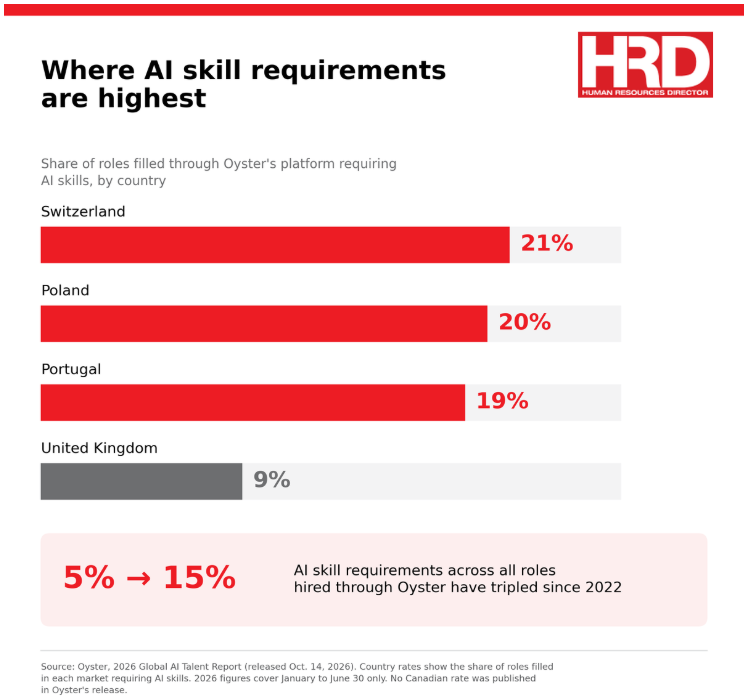
Across all roles, the share requiring AI skills has tripled from 5% in 2022 to 15%. Yet nine in 10 of those roles omit AI from the job title.
Why do AI skills in recruiting matter to Canadian HR leaders?
That gap lands first on recruiters, who often screen candidates for AI skills that job descriptions never mention. Ontario adds a legal duty: since Jan. 1, 2026, employers with 25 or more employees must disclose in public job postings whether AI is used to screen, assess or select applicants.
Statistics Canada found 19.2% of Canadian businesses used AI in a spring 2026 survey, triple the 2024 share. ManpowerGroup's 2026 Talent Shortage Survey found AI skills now top the list of hardest-to-find capabilities, and 71% of Canadian employers reported difficulty finding talent.
That scarcity is pushing up pay: Robert Half's 2027 Canada Salary Guide found 63% of managers are increasing pay for relevant AI skills.
"The growing demand for AI-related expertise reflects a broader shift toward specialized skills across the workforce," said Koula Vasilopoulos, senior managing director at Robert Half Canada in Toronto.
AI demand hides in non-technical roles and unexpected markets
Oyster's data shows demand surfacing where employers rarely look. Switzerland (21%), Poland (20%) and Portugal (19%) led its platform for roles requiring AI skills – more than double the United Kingdom's 9%. Oyster did not report a Canadian figure.
"Founders and leaders tell me every week that the talent they need doesn't exist. They do exist. We find them every day in places nobody puts on a shortlist," said Hadi Moussa, CEO of Oyster.
That conclusion suits Oyster, which sells international hiring services. Others see a problem closer to home: Betul Genc, senior vice-president and country head for Australia and New Zealand at the Adecco Group, has warned that job descriptions are years behind AI and slowing hiring.
Inside organizations, AI work goes unrecognized
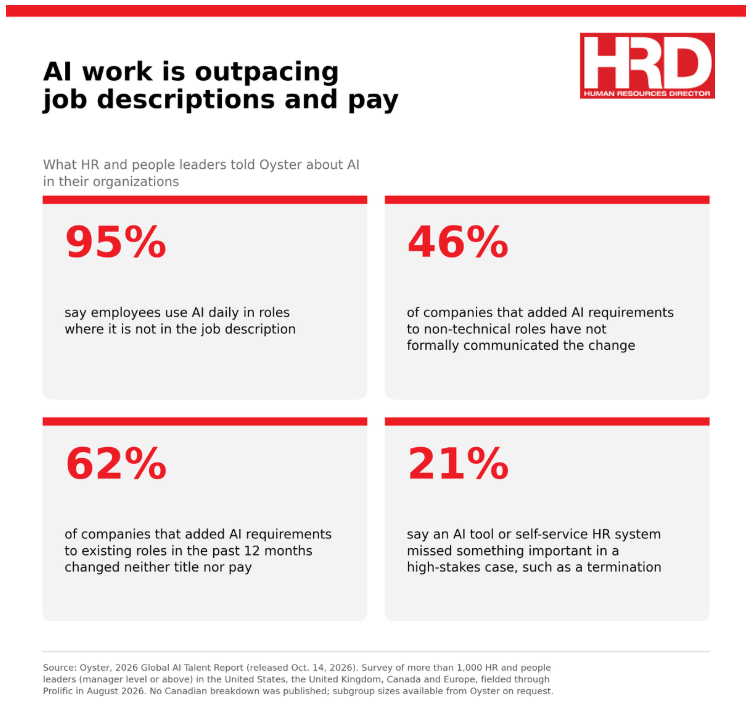
That lag extends to existing staff. In Oyster's August 2026 survey of more than 1,000 HR and people leaders in North America and Europe, 95% said employees use AI daily in roles whose descriptions omit it. Two-thirds have added AI requirements to non-technical roles, and 46% of those companies have not formally told staff. Among companies that added AI requirements to existing roles in the past 12 months, 62% changed neither title nor pay.
Nor is HR technology closing the gap. Twenty-one per cent said an AI tool or self-service HR system missed something important in a high-stakes case such as a termination – and ManpowerGroup found few employers said current AI tools met their expectations.
For Moussa, the blind spot starts at the top. "The people making workforce decisions are often the furthest from the tools doing the work, so the shift is hardest to see from exactly the place it needs to be managed," he said.