Only 13% of higher education leaders rate faculty AI capability as very strong: report
Canadian employers recruiting from the class of 2026 face a shortage of graduates ready to work with artificial intelligence (AI), according to a November 2026 report from Pearson and Amazon Web Services (AWS). The report finds campuses cannot produce AI-ready graduates alone: many new hires can operate AI tools but have rarely applied them to real decisions.
Part of the problem sits with the people doing the teaching. In a global Pearson-AWS survey, only 13% of higher education leaders rated faculty AI capability as very strong, while 40% called it mixed.
Simon Bates, vice-provost and associate vice-president of teaching and learning at the University of British Columbia (UBC), said leaving AI to individual instructors is not enough. "What we actually need is much more of a curricular or programmatic review," he said.
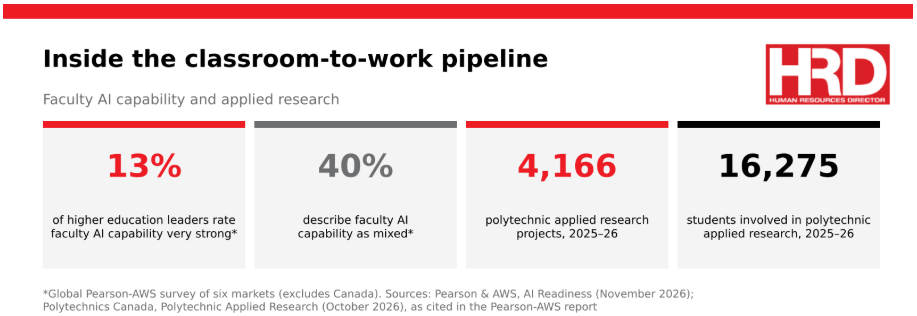
Colleges and polytechnics offer a more applied route. Polytechnics Canada says its members ran 4,166 applied research projects in 2025–26 involving 16,275 students. In a June 2026 statement, its CEO, Sarah Watts-Rynard, said AI's benefits depend on whether people and businesses "have the skills and support to adopt it".
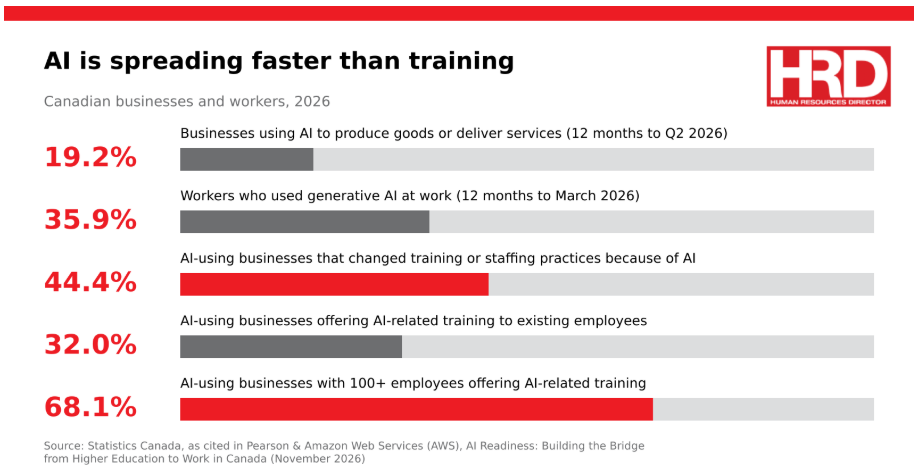
The remaining gap lands on employers just as their own training efforts lag. Statistics Canada data cited in the report show 19.2% of Canadian businesses used AI in the 12 months before the second quarter of 2026. Among AI users, 44.4% changed training or staffing practices because of AI, but only 32.0% offered AI training to existing employees.
The Pearson-AWS report, AI Readiness: Building the Bridge from Higher Education to Work in Canada, argues employers and institutions must share the work. It names six friction points: pace, connection, capability, governance, experience and skills. In its foreword, Jessica Biga-Wadstein, country head at Pearson Canada, says the aim is to "make AI readiness something graduates can prove rather than simply something institutions can promise."
Why AI-ready graduates need more than tool access
The target also keeps moving. "You think about students who are starting a degree now: the skills that they need when they graduate in four years are not going to be the same skills as graduates need today," Bates said.
Statistics Canada data show 35.9% of Canadian workers used generative AI at work in the 12 months to March 2026. Yet in the global Pearson-AWS survey of six markets, which excluded Canada, employers most often cited two barriers to hiring or developing graduates. The first was a lack of hands-on experience with workplace AI tools (42%), and the second was the gap between academic knowledge and workplace application (41%).
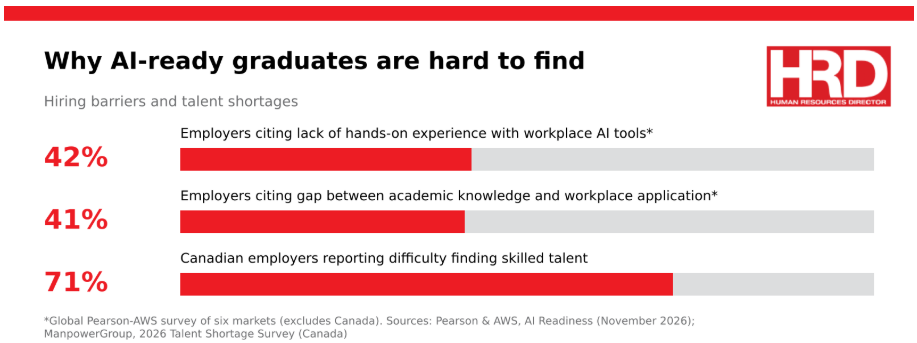
Canadian research points the same way. A Business + Higher Education Roundtable (BHER) study with the Alberta Machine Intelligence Institute (Amii) concludes the focus must shift "from teaching about AI to enabling people to work with AI". ManpowerGroup's 2026 Talent Shortage Survey ranked AI skills the hardest to find worldwide, while 71% of Canadian employers reported difficulty finding skilled talent. That raises the question of whether your recruiters are skilled enough to assess applicants' AI skills.
What does this mean for hiring teams?
The report's message is that readiness must be defined, practised and verified jointly. Geoff Langdon, head of technology for Canadian Wealth & Insurance at BMO, said: "We've been very clear that accountability sits with the human. You apply human judgment, you validate, and you test a little bit to see if the answers are consistent."
The report asks employers to take three steps:
-
Translate broad demand for "AI skills" into capabilities tied to specific roles and sectors.
-
Contribute real problems to students rather than advising from the sidelines.
-
Share timely evidence about how work is changing.
That matters at entry level, where HRD Canada has reported AI is squeezing entry-level jobs and future leaders with them. Recruitment experts have told HRD Canada that AI literacy is now expected of new graduates, as AI redefines entry-level roles for young workers.