‘Canada will fail to fully realize the economic contributions it expects from the immigrants it admits’

Employers counting on immigration to ease skills shortages are hiring from a talent pool Canada routinely underuses, according to new projections from the Institute for Canadian Citizenship (ICC). The Toronto-based charity's report, Selected but Neglected, released Nov. 25, 2026, finds that most university-educated immigrant workers will spend decades in jobs below their qualifications.
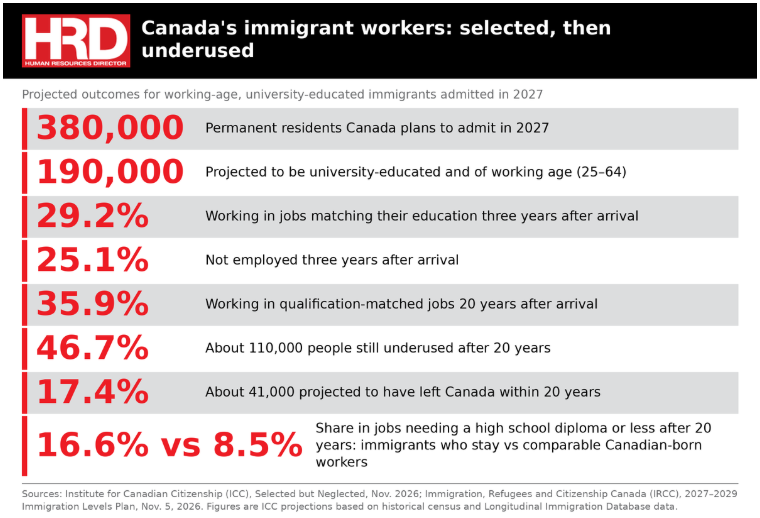
The report estimates that about 190,000 of the 380,000 permanent residents in Immigration, Refugees and Citizenship Canada's (IRCC) 2027–2029 Immigration Levels Plan, released Nov. 5, 2026, will be university-educated and of working age in 2027. Just 35.9% of that group are projected to hold qualification-matched jobs 20 years after arrival.
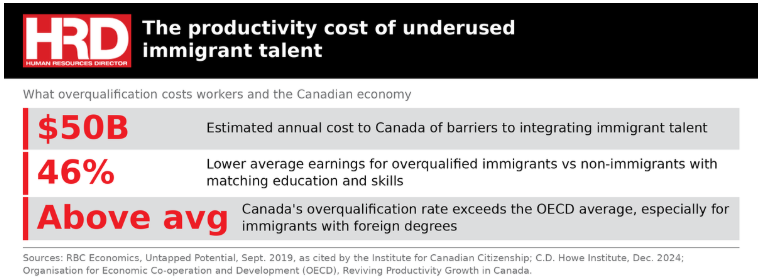
The ICC cites a 2019 Royal Bank of Canada (RBC) Economics estimate that barriers to integrating immigrant talent cost Canada up to $50 billion a year.
"Our projections show, however, that Canada will fail to fully realize the economic contributions it expects from the immigrants it admits," the report states. The ICC adds that IRCC tracks whether newcomers are employed, not whether their jobs match the skills they were selected for.
Immigrant underemployment persists for decades
The ICC's projections apply historical census and immigration data to the 2027 cohort in the levels plan, making them estimates. Three years after landing, only 29.2% are expected to work in degree-level jobs, while 25.1% are projected to be not employed.
Time narrows that gap only slightly. By year 20, 46.7% – about 110,000 people – will still be underused, and 17.4% will have left Canada.
Among those who stay, 16.6% are projected to hold jobs requiring a high school diploma or less, about double the 8.5% rate for comparable Canadian-born workers.
Health-care talent left on the sidelines
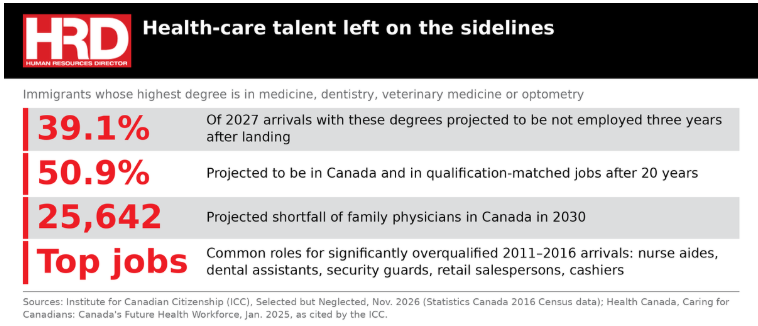
Nowhere is that gap more costly than in health care. The ICC projects that 39.1% of 2027 arrivals whose highest degree is in medicine, dentistry, veterinary medicine or optometry will be not employed three years after landing.
Earlier cohorts with such degrees often landed in jobs such as nurse aides, security guards and cashiers, even as Health Canada projects a shortfall of 25,642 family physicians in 2030, a figure the ICC cites.
"An immigration system that puts over half of qualified immigrant health professionals behind a cash register serves nobody well – least of all millions of Canadian patients who deserve far more timely care," said Daniel Bernhard, CEO of the ICC.
How can immigration boost Canada's productivity?
The answer lies less in admitting more people than in using the skills already here. In its review of Canadian productivity growth and migrant integration, the Organisation for Economic Co-operation and Development (OECD) found that overqualification in Canada exceeds the OECD average, especially among immigrants with foreign degrees, and can drag down labour productivity.
"Effectively integrating immigrants into the labour market is essential for improving Canada's productivity performance," the OECD states.
The earnings data shows what is being lost. "Overqualified immigrants experience the largest earnings gap, earning on average 46 percent less than non-immigrants with matching education and skills, even after controlling for other factors," Parisa Mahboubi, senior policy analyst at the Toronto-based C.D. Howe Institute, said in December 2024.
What can HR leaders do about immigrant overqualification?
The report puts the onus on hiring. "Employers across Canada must put an end to discriminatory hiring practices like Canadian experience requirements, which unfairly penalize immigrant job applicants and more often have the effect of leaving valuable talent untapped," it states. HRD Canada has previously reported on how lowering immigrant overqualification could add thousands of nurses and doctors to the workforce.
In Ontario, this is also a compliance matter. In its policy on removing the Canadian experience barrier, the Ontario Human Rights Commission (OHRC) has held since 2013 that "a strict requirement for 'Canadian experience' is prima facie discrimination."
Retention matters too, since the report links onward migration partly to poor labour market outcomes. Mentorship and credential support may help keep those hires, a concern HRD Canada explored in its analysis of Canada's talent exodus and what senior HR leaders can't afford to ignore.