‘Their greatest mistake was believing that work automation was the point, when workforce amplification was the opportunity’

Organizations that lean on artificial intelligence (AI) to cut jobs may end up paying more to bring workers back than they saved by letting them go, according to new research from Gartner.
The firm projects that by 2029, 30% of employees laid off due to AI replacement will need to be rehired, often at significantly higher cost than their original positions carried.
The finding is part of Gartner's analysis of four shifts it says will define the future of work as chief information officers (CIOs) and other business leaders navigate the early years of enterprise AI adoption.
For HR leaders in Canada, where labour force growth has been flat or declining, the prediction is a caution against workforce cuts made primarily for short-term savings. That caution echoes Statistics Canada's analysis of occupational exposure to AI across Canadian cultural industries, which found more than half of jobs in some sectors could be highly exposed to AI substitution. Gartner argues broad reductions can deplete talent pipelines and erode institutional knowledge that is costly to rebuild.
Amplification – not automation – is the goal
Tori Paulman, VP Analyst at Gartner, said the biggest misstep organizations are likely to look back on is treating automation as an end in itself.
"When business and IT executives look back on the early AI-era, they will realize their greatest mistake was believing that work automation was the point, when workforce amplification was the opportunity," Paulman said.
Gartner's warning is direct: deep, fast staffing cuts risk hurting a company's ability to innovate and compete as AI matures. Instead, Paulman recommended a "talent remix" strategy, using AI to redirect employees from lower-value work toward new roles rather than eliminating positions outright.
Four shifts reshaping the future of work
Gartner's recent findings on how AI is reshaping hiring and job design align with four shifts it has identified for 2026 and beyond:
-
expanding human capability through the human-AI relationship
-
building an AI-ready workforce that adapts rather than simply adopts new tools
-
deepening context, judgment and meaning as AI embeds into business processes
-
and building a foundation for compound value, where each new AI use case becomes faster, cheaper and safer than the last.
On the skills front, Employment and Social Development Canada's departmental planning documents outline federal efforts to expand reskilling and AI literacy programs, a priority Gartner also flags as critical.
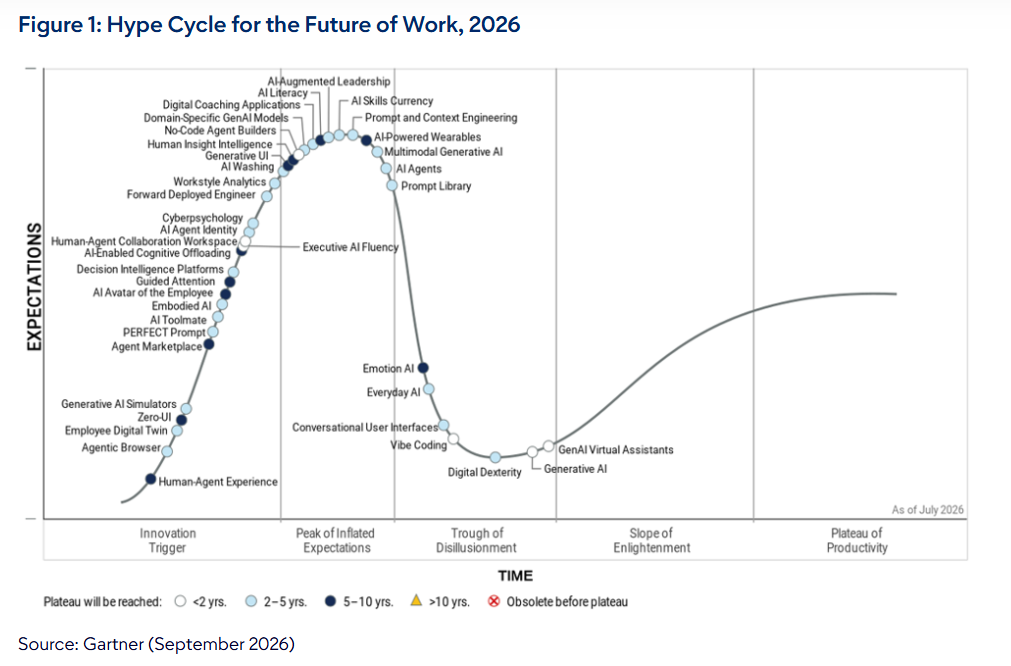
On institutional knowledge, Paulman said the Gartner 2026 Hype Cycle for the Future of Work shows the challenge is no longer technological, but using AI "to amplify human intelligence, expertise and creativity."
Gartner predicts that by 2027, 75% of organizations treating AI productivity gains purely as cost savings will be overtaken by competitors reinvesting those gains into innovation and upskilling.
The findings add to separate research on how managers' attitudes toward AI-driven replacement are shifting, suggesting the conversation around AI and headcount is far from settled. That risk is compounded by pressure on entry-level roles, an area where research on how AI is reshaping early-career expectations has found organizations redesigning junior positions rather than eliminating them.