But half say few employers have committed to retraining staff

Canadian hiring managers favour retraining current staff over new hires, but barely half say their employers have reskilling plans
Most Canadian hiring managers would rather retrain current staff than recruit, but fewer say their employers have committed.
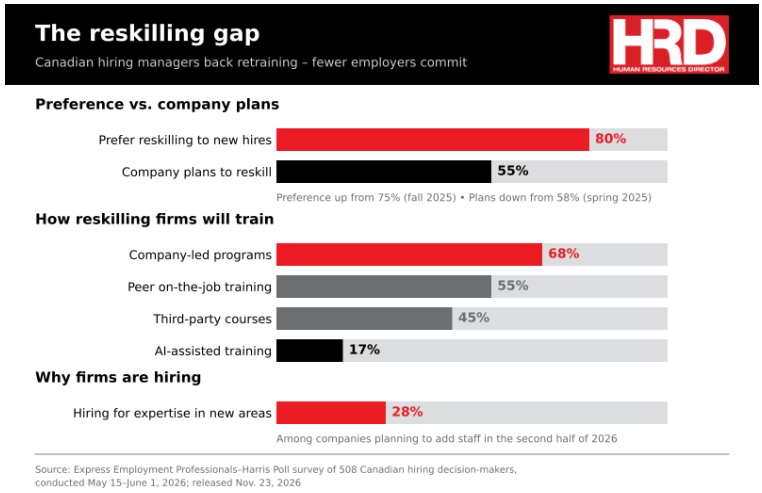
Eight in 10 hiring managers prefer reskilling existing employees for new roles over hiring new ones, up from 75% in fall 2025, according to a Harris Poll survey for Express Employment Professionals released Nov. 23. Only 55% say their company plans to reskill workers, down from 58% in spring 2025.
The survey of 508 Canadian hiring decision-makers ran from May 15 to June 1, 2026.
Why are reskilling plans stalling?
Among firms that plan to reskill, 68% will use company-led programs and 55% peer-delivered on-the-job training, Express found. Only 17% plan to use training assisted by artificial intelligence (AI).
"Existing employees bring valuable knowledge of a company's operations, culture and customers, giving businesses a strong foundation for developing new capabilities," said Bob Funk Jr., CEO, president and chairman of Express Employment International in Oklahoma City, Okla.
Some may be buying skills instead: among companies planning to add staff in the second half of 2026, 28% are hiring to gain expertise in new areas, according to Express.
Younger managers more likely to retrain
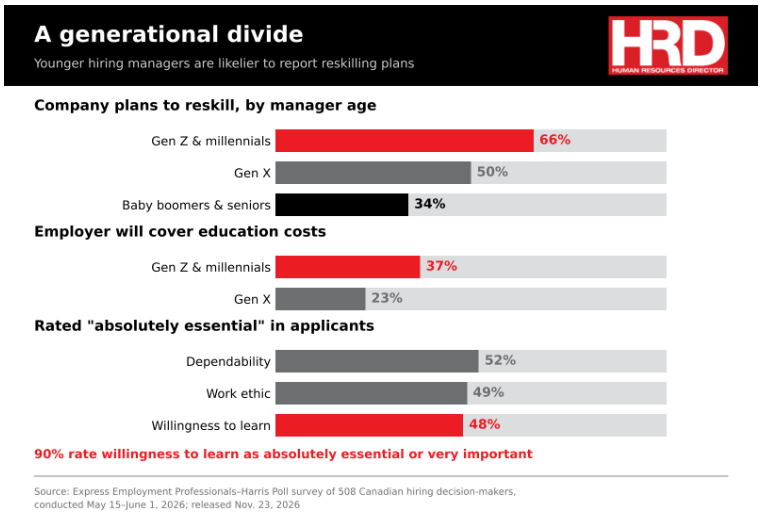
The generation doing the hiring also matters. Two-thirds (66%) of Gen Z and millennial hiring managers report reskilling plans, compared with 50% of Gen X managers and 34% of baby boomers and seniors, according to the Express report.
Younger managers are likelier than Gen X peers to say their employer will fund outside courses (51% vs. 35%) and cover education costs (37% vs. 23%).
However, demand for learning is near-universal: 90% of hiring managers rate willingness to learn as absolutely essential or very important in applicants, Express found.
Training investment trails tech spending
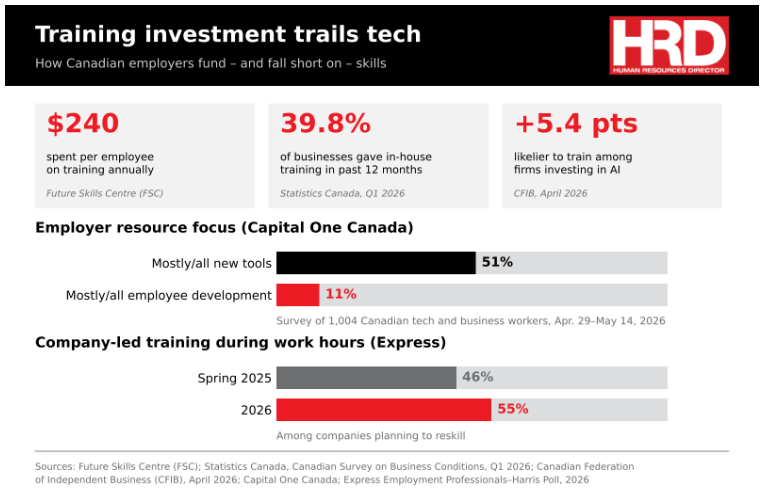
Budgets also play a role, and underinvestment is a long-standing pattern. Canadian firms spend an estimated $240 per employee annually on training and trail international peers in participation and training hours, according to the Future Skills Centre (FSC).
Much training stays in-house. Statistics Canada's Canadian Survey on Business Conditions found 39.8% of businesses provided in-house training over the previous 12 months to address skills gaps.
And technology often wins the budget fight. In a spring 2026 Capital One Canada survey, 51% of tech and business workers said their employer focused most or all resources on new tools; only 11% said the same of employee development, as HRD Canada reported.
Building the business case
Committed firms build training into the workday: among those planning to reskill, company-led training during work hours rose to 55% from 46% in spring 2025, Express found. "When combined with strategic hiring, investing in current employees can help businesses address evolving skill demands while maintaining operational continuity," Funk said.
Yet, barriers remain. Employers that struggle to train cite cost, time, a lack of relevant courses and poaching of upskilled staff, the FSC found, calling support to overcome those barriers key to easing skill shortages.
Businesses investing in AI were 5.4 percentage points more likely to invest in staff training, according to an April 2026 analysis by the Canadian Federation of Independent Business (CFIB).
"Those that prioritize learning and equip employees with the right tools and support will ensure their people thrive," Melanie Burns, chief human resources officer at TD Bank in Toronto, said in comments reported by HRD Canada in October 2026.
HRD Canada has also examined why skills-first hiring and training are key to staffing Canada's $192 billion in major projects. Employers in HRD Canada's best places to work in Canada special report show how employee input can shape those priorities.