‘Hurt feelings report’ complaining of 'whiners' highlights how toxic managers can cripple culture, collaboration, and retention

A frontline supervisor yells at employees on his team and, afterwards, the employees complain about it.
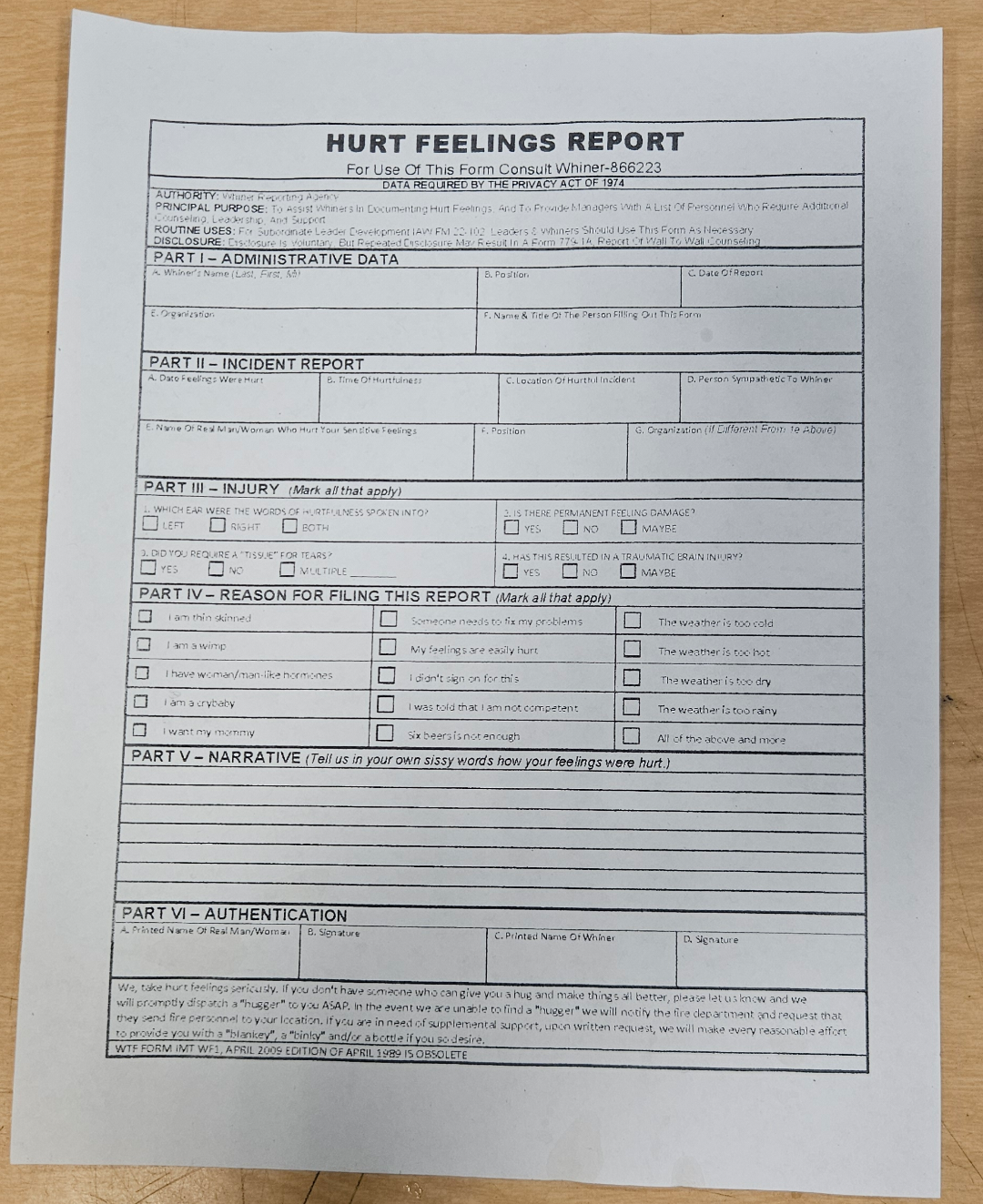
The supervisor’s response? He puts together an official-looking “hurt feelings report” in the break room featuring boxes with “Whiner's name” and “Person sympathetic to whiner,” along with prompts that mocks employees’ motivations for speaking up.
This isn’t something out of the movie Office Space. It actually happened, with one of the employees sharing a photo of the faux report online — where it unsurprisingly sparked significant discussion.
HR leaders’ ability to see toxic supervision depends on proximity, and organization size, and it’s easy for poor behaviour at the frontline level to be missed without formal complaints, says Len Karakowsky, a professor of HR management at York University.
“HR’s visibility is strong once something becomes formal, such as once a complaint is filed or once an investigation is undertaken,” he says. “HR’s oversight is much more limited when it comes to day-to-day interactions between managers and frontline employees.”
For HR leaders, the “hurt feelings report’ story may be a cautionary tale for their organizations. If frontline supervisors respond to concerns with sarcasm and more verbal abuse, employees often conclude that speaking up will cost them, says Beverly Beuermann-King, a workplace culture and resiliency expert at R ‘n’ B Consulting.
Why HR can miss frontline toxic culture
Beuermann-King says that HR can’t assume that if there are problems with toxic supervisors, they will surface through complaints, as conduct such as the supervisor in the story above could discourage employees from speaking up.
“You're hoping that people will complain and bring it to somebody's attention, but that's often not case,” she says. “For the most part, people will try to do their very best either to ignore it or move past it — but in the end, if they find that it's just that toxic, they'll just get up and leave.”
She believes that the challenge is compounded when frontline leaders are skilled at behaving differently when they’re being observed. “People who manipulate are usually really good at manipulation, and they know when to do it and when they can get away with it,” she says. “The blind spots are if you're just going by what you see without actually listening to or asking people.”
A supervisor’s dismissive and mocking response to employee complaints, asin the “hurt feelings report” incident, runs the risk of stopping employees from participating in teamwork, even when leaders are asking for ideas, says Beuermann-King.
“If i have an issue, I'm not going to bring it forward because I don't want to be the one that's targeted,” she says. “I'm certainly not going to share any information, because i don't know how it's going to be used against me — so collaboration goes down, teamwork goes down, and engagement goes down.”
A toxic supervisor can also impact employees' mental health, increasing their anxiety if they feel like they’re walking on eggshells and could be mocked for raising legitimate concerns, adds Beuermann-King.
Karakowski believes that such treatment of employees by supervisor can also intensify organizational risk when complaints aren’t handled appropriately. “It increases legal risk, since failing to address complaints appropriately can result in harassment claims and human rights complaints,” he says.
Improving line-of-sight without constant escalation
The challenge for HR leaders is to find the balance between getting accurate information about how supervisors behave and turning every concern into a high-stakes, formal process, according to Karakowsky. He says the first step is to make it easier and safer for employees to be heard outside of crisis moments, such as through regular check-ins with HR, whether they be through one-on-one meetings or pulse surveys.
“Check-ins can provide leaders with firsthand accounts of how concerns are being addressed and whether employees feel supported,” he says.
Karakowsky also believes that HR and business leaders should review whether complaint handling in the organization is effective in practice, regardless of what the policy states.
“Complaint processes should be audited and assessed in terms of not only the outcomes, but also the quality of follow-up conversations and whether employees feel heard,” he says. “Leaders should also be tracking any patterns over time — toxic pockets often display patterns — and we need to know if there are recurring issues with certain managers or with certain types of complaints and identify systemic problems if they exist.”
Beuermann-King says HR leaders need shared values for the organization that makes it easier to call out inappropriate behaviour when it’s happening, whether by supervisors or employees.
“When we only talk about the word respect and we haven't defined what it looks like and it doesn't look like, it makes it really hard for people to say, ‘Does this really fall into that category?’” she says. “So I think having organizational values well-defined and living them out loud helps to get rid of some of those blind spots because you can have those conversations and ask those questions on your engagement survey, and everybody has the same language to pull that information forward.”
Define clear values and back them up
Karakowsky says organizations need to define respectful leadership clearly, so managers understand what crosses the line and employees can trust that standards will be applied consistently. “Organizations that don’t explicitly articulate what constitutes respectful leadership and what crosses the line put themselves and their managers at risk,” he says.
When toxicity from a supervisor is suspected, Karakowsky says HR leaders can start with the data they already have — from team-level engagement results, turnover patterns, exit interviews, internal transfer requests, and any upward feedback trends — and add targeted listening from confidential interviews from the team in question, rather than launching an immediate investigation. If certain teams consistently show higher attrition or repeated complaints, that’s often a sign that something is wrong, he says.
“It's looking for the signs like absenteeism, disengagement, a lack of collaboration — all the key things that come up in engagement surveys and such, and putting them together, not just looking at them as these separate pieces,” says Beuermann-King. “I think in a lot of cases for HR, actively looking for this stuff can prevent you having to deal with emergencies and the big things in the end, as opposed to catching them and nipping them in the bud at the beginning.”
Beuermann-King notes that toxic behaviour from a leader can affect different people in different ways, but it always spells trouble for the organization.
“If all of this toxicity is there, you don't know how it's going to accumulate — for one person, they may have a really big tolerance for this stuff while others may have very little tolerance,” she says. “And it's not necessarily based on whether they can cope or not, they may just have had enough — and we know since COVID, the ‘what's-enough’ factor has definitely changed for people and many aren’t willing to put up with it anymore.”