AI agent spending soars as oversight costs erode employer returns: report

Half of organizations using artificial intelligence (AI) agents now budget at least $1 million for them, but much of the productivity that money buys is being lost to supervision, rework and weak governance – a problem landing on human resources (HR) leaders’ desks.
The 2026 AI Agents Report by G2, a Chicago-based software review platform, also found 86% of business-to-business (B2B) software buyers purchased AI agent software or services in the past year, up from 69% a year earlier.
Healthcare spends the most, with 57% of organizations budgeting at least $1 million a year for agents, up 10 percentage points. Manufacturing was the only tracked industry where that share fell, from 39% to 34%.
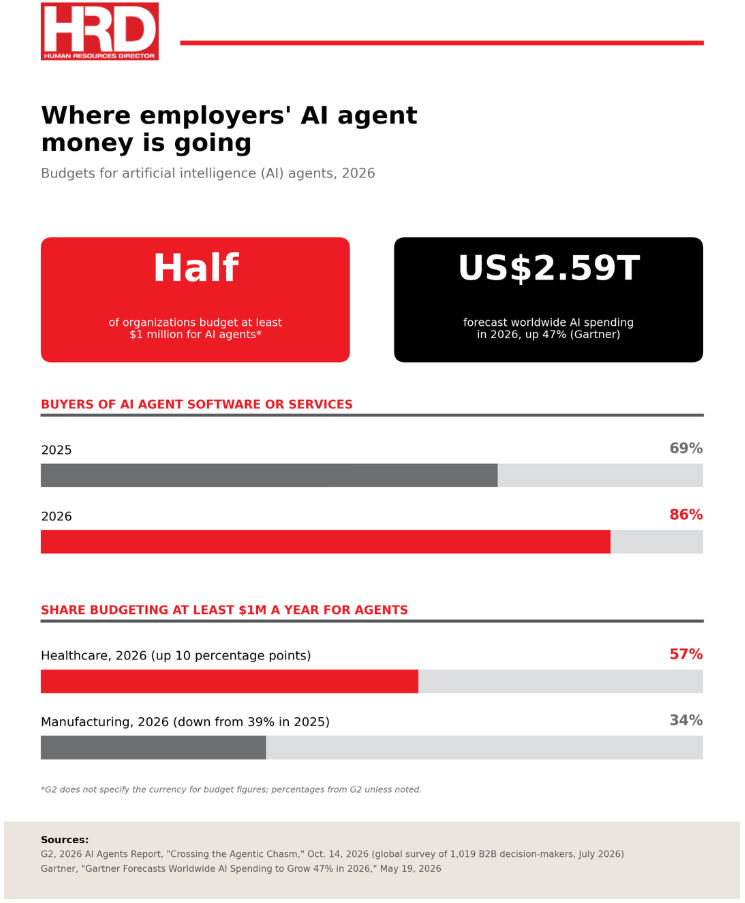
Those budgets are part of a much larger wave. Gartner, the Stamford, Connecticut-based research firm, forecast in May 2026 that worldwide AI spending will reach US$2.59 trillion this year, up 47% from 2025, with spending so far driven mainly by technology companies and hyperscalers.
“Enterprises have yet to really flex their spending potential. That is coming and 2026 will be the inflection year,” said John-David Lovelock, distinguished vice-president analyst at Gartner.
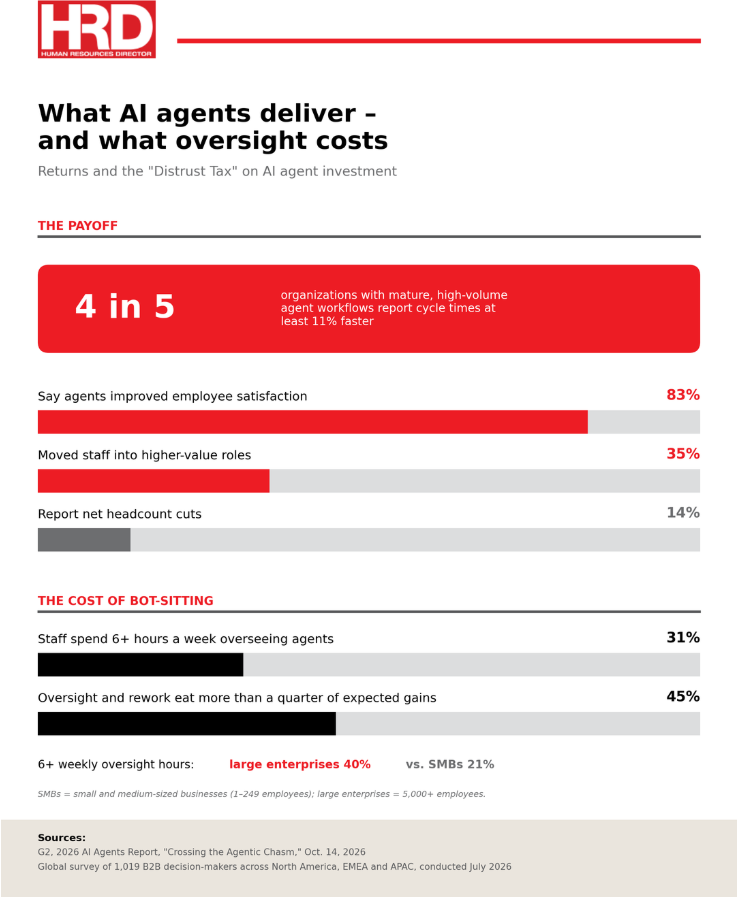
Where the money is already working, it is paying off. In mature, high-volume workflows, four in five organizations in G2’s survey report cycle times at least 11% faster. Staff benefit too: 83% of buyers say agents improved employee satisfaction by reducing repetitive work, 35% have moved staff into higher-value roles and just 14% report net headcount cuts.
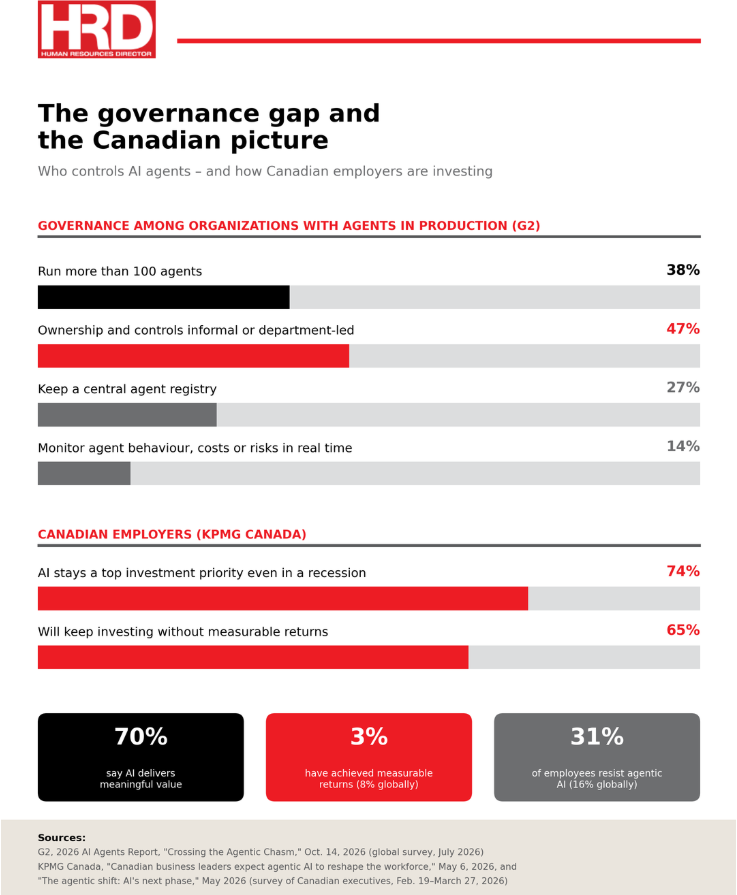
G2’s survey was global, but Canadian employers are investing too: HRD Canada has reported that agentic AI has proven popular with Canadian employers. A KPMG Canada survey of 306 executives, released May 6, 2026, found 74% say AI will remain a top investment priority even in a recession, and 65% will keep investing whether or not they can measure returns.
Measuring those returns is harder here. While 70% of Canadian organizations say AI delivers meaningful business value, only 3% have achieved measurable returns on their AI investments, compared with 8% globally, according to KPMG.
The hidden cost of bot-sitting
G2’s data points to one reason gains are hard to bank: what it calls a “Distrust Tax” – the cost of running agents organizations do not yet trust to work alone.
Much of it is paid in staff time. Nearly one-third (31%) of buyers say employees spend six or more hours a week overseeing agent work, and 45% say oversight and rework consume more than a quarter of expected productivity gains.
The burden grows with size: four in 10 large enterprises report six-plus weekly hours of supervision, against 21% of small and medium-sized businesses.
“AI agents are showing real signs of value, but much of it is being erased by oversight, rework, and exception handling,” said Tim Sanders, chief innovation officer at G2 in Chicago.
Shadow agents widen the governance gap
Oversight gets harder as agent fleets grow. Among organizations with agents in production, 38% run more than 100, yet 47% say ownership and controls remain informal or department-led. Only 27% keep a central agent registry, and 14% monitor agent behaviour, costs or risks in real time.
Those blind spots mirror the shadow AI governance gap that is widest among senior leaders, and they leave a basic question unanswered: who is responsible?
For Olivia Nottebohm, chief operating officer at Box, accountability comes first. “Teams should know who owns an agent, how success is measured, and what performance and security checks it must pass before moving from pilot to production,” she said in the G2 report.
What does this mean for HR leaders?
HR is absent from G2’s breakdown of governance owners – a gap worth closing. Weekly bot-sitting is a workload and job-design issue, not just a technology cost. Affected roles may need new descriptions, training and performance measures, while redeployment requires reskilling plans HR typically owns.
The people side carries its own risk in Canada. KPMG found 31% of Canadian employees show resistance to agentic AI, nearly double the 16% global rate – a gap that change management and training led by HR can help narrow.
Regulation adds pressure, too. Since Jan. 1, 2026, Ontario’s Employment Standards Act, 2000 has required employers with 25 or more employees to disclose in publicly advertised job postings whether AI is used to screen, assess or select applicants.
These demands make HR’s voice in agent governance essential, echoing recent analysis of HR’s AI reckoning as employers deploy tools faster than they can govern them.