Tighter temporary residency rules are thinning talent pools in some industries, raising hiring risks for Canadian employers

Tighter temporary residency rules are thinning talent pools in engineering, hospitality and retail, raising hiring risks for Canadian employers
Canada's tighter immigration policy has cut foreign job seeker interest in Canadian roles by more than half since 2023, and employers in engineering, hospitality and retail may feel the squeeze first, according to new data from Indeed Hiring Lab.
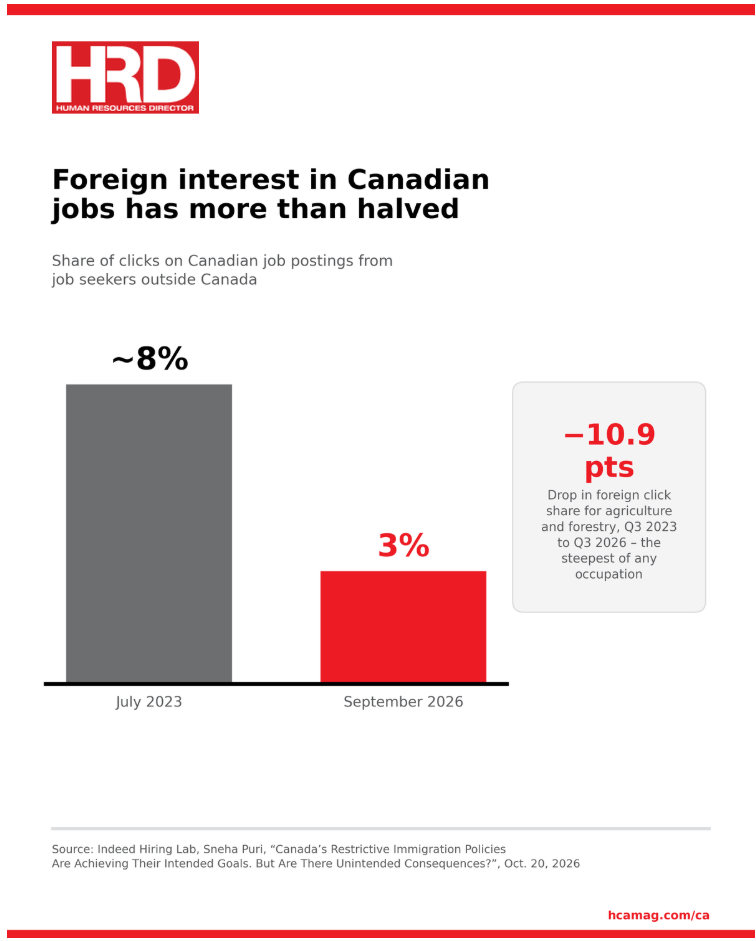
Sneha Puri's Oct. 20, 2026 analysis found that searchers outside Canada accounted for close to 8% of clicks on Canadian job postings in July 2023, falling to 3% by September 2026.
How immigration policy reshaped talent pipeline
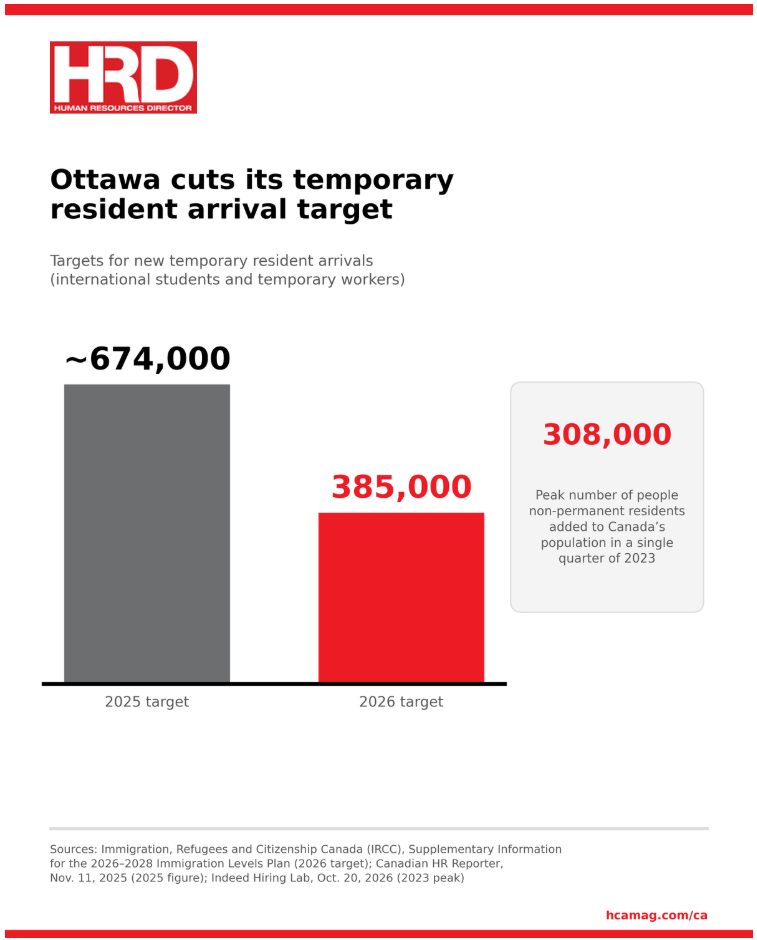
The drop mirrors deliberate policy. Under its 2026–2028 Immigration Levels Plan, Immigration, Refugees and Citizenship Canada (IRCC) set new temporary arrivals at 385,000 in 2026, down from about 674,000 in 2025.
The effect shows in population data. Non-permanent residents added as many as 308,000 people in a single 2023 quarter but have shrunk the population in five of seven quarters through mid-2026, Indeed found.
Rachel Battaglia, an economist at Royal Bank of Canada (RBC), said in November 2025 that "with outflows proving difficult to manage, the government turned to dramatically cutting inflows as the primary tool to meet its population targets." She warned this risks "impacting Canada's pipeline of educated talent."
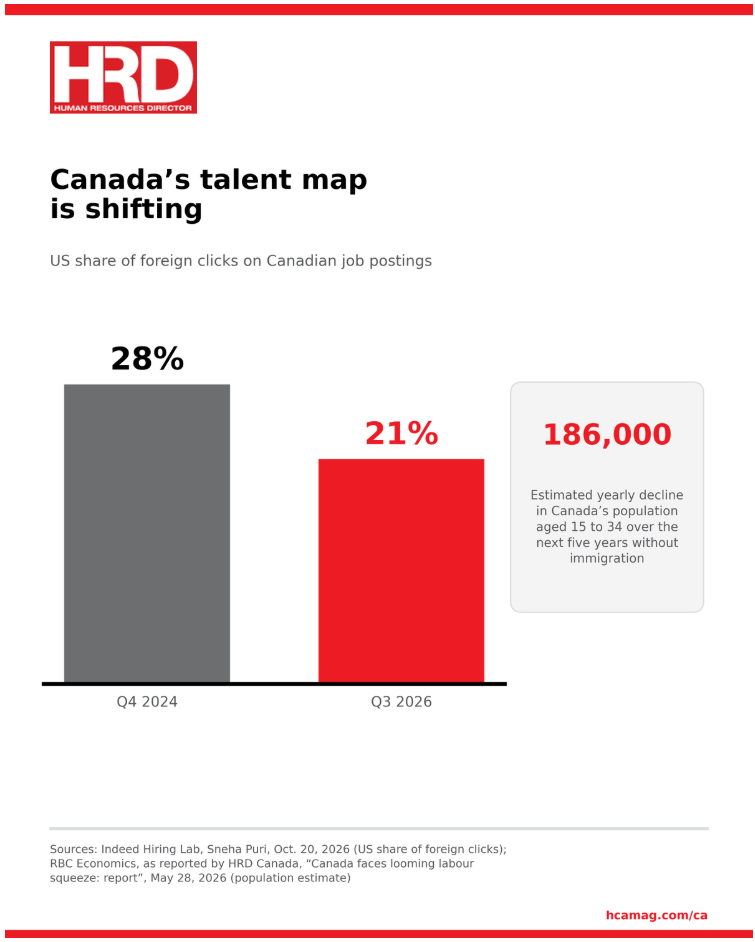
RBC's outlook is starker: it estimates that without immigration, Canada's population aged 15 to 34 would shrink by roughly 186,000 a year over five years. The Bank of Canada said in October 2026 that less immigration means fewer workers and slower growth.
Engineering and hospitality hiring feel the squeeze
Technical and resource fields are hit hardest. Foreign interest has fallen in every sector since 2023, led by agriculture and forestry at 10.9 percentage points, with civil, chemical and electrical engineering close behind, Indeed found.
Yet Indeed's Job Postings Index (JPI) shows civil, electrical and industrial engineering postings well above the headline index, partly on data centre construction, Puri wrote – while thinner candidate supply makes those roles harder to fill.
Beyond engineering, the report flags accommodation and food services, retail and agriculture as most exposed – echoing the RBC report on Canada's looming labour squeeze.
In P.E.I., that strain is already showing. "If we do not hire more people, we'll potentially have to shut down during some hours," Eriks Faccin, director of people and guest experience at Rodd Hotels and Resorts, told CBC News in July 2026.
What does this mean for HR leaders?
Recruitment sources are shifting too. US-based job seekers made up 21% of foreign clicks in the third quarter of 2026, down from 28% in late 2024, while Asia now leads, Indeed reported. Recruiters may need wider nets, particularly where Quebec employers urged swift immigration policy changes.
Stability may matter as much as volume. Mikal Skuterud, a University of Waterloo economics professor and C.D. Howe Institute fellow, argued in a September 2025 memo that "attracting foreign talent requires a system that is stable, transparent, and predictable." He urged Ottawa to protect high-skill streams such as the Global Talent Stream and phase out low-skill streams over three to five years, giving businesses time for "productivity-enhancing training and technological investments."
For HR teams, that argues for prioritizing high-skill pathways for technical roles and budgeting for training now.
The rules may soon shift again. Immigration Minister Lena Metlege Diab has signalled that levels could rise, CTV News reported on Oct. 16, 2026, with the 2027–2029 plan expected in November.
Such volatility strengthens RBC's call for a Canadian immigration system reset and hiring plans that do not hinge on a single pipeline.