‘As AI becomes more integrated into work, people want organizations that pair innovation with opportunities to grow, contribute and develop distinctly human skills’

With most workers across six major economies searching for a new job or likely to start within six months, HR leaders and employers need to ensure their approach to artificial intelligence (AI) – and the AI values behind it – gives staff a reason to stay.
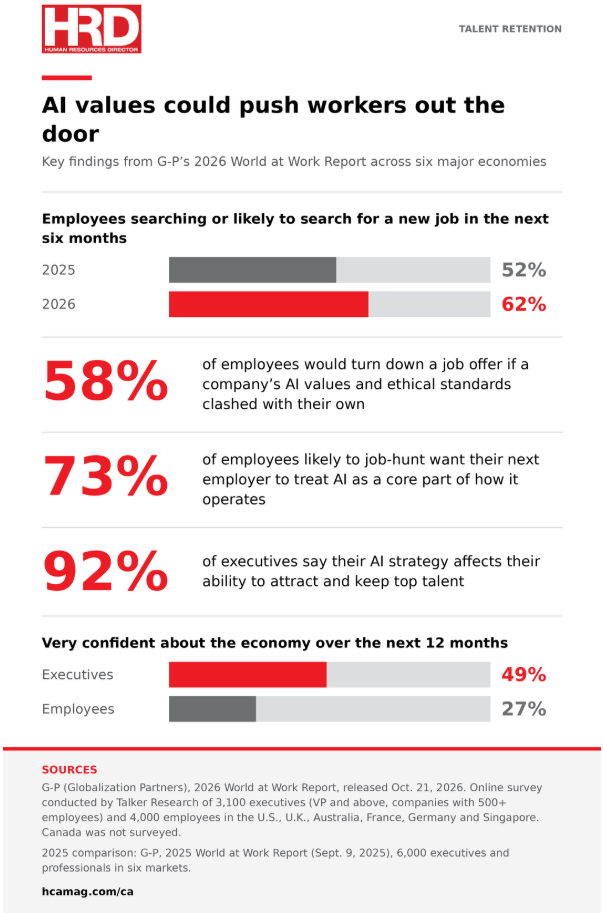
The 2026 World at Work Report from Globalization Partners (G-P), released Oct. 21, 2026, found 62% of employees are looking or likely to look for new work in that window, up from 52% a year earlier. And 58% would turn down a job offer if a company's AI values and ethical standards clashed with their own.
U.S. market research firm Talker Research polled 3,100 executives and 4,000 employees for G-P across the U.S., U.K., Australia, France, Germany and Singapore.
How AI values shape whether employees stay
An employer's AI stance is becoming a selling point. Among employees likely to job-hunt, 73% want their next employer to treat AI as a core part of how it operates. And 92% of executives agreed their AI strategy affects their ability to attract and keep top talent.
"As AI becomes more integrated into work, people want organizations that pair innovation with opportunities to grow, contribute and develop distinctly human skills. Employers that understand that shift will be better positioned to attract and retain talent," said Laura Maffucci, G-P's Boston-based head of HR.
Confidence is another matter. Executives were nearly twice as likely as employees to be very confident about the economy over the next year – 49% compared with 27%.
HRD has also explored how employees process AI-driven change as grief rather than simple anxiety.
Proximity bias and side hustles test employee loyalty
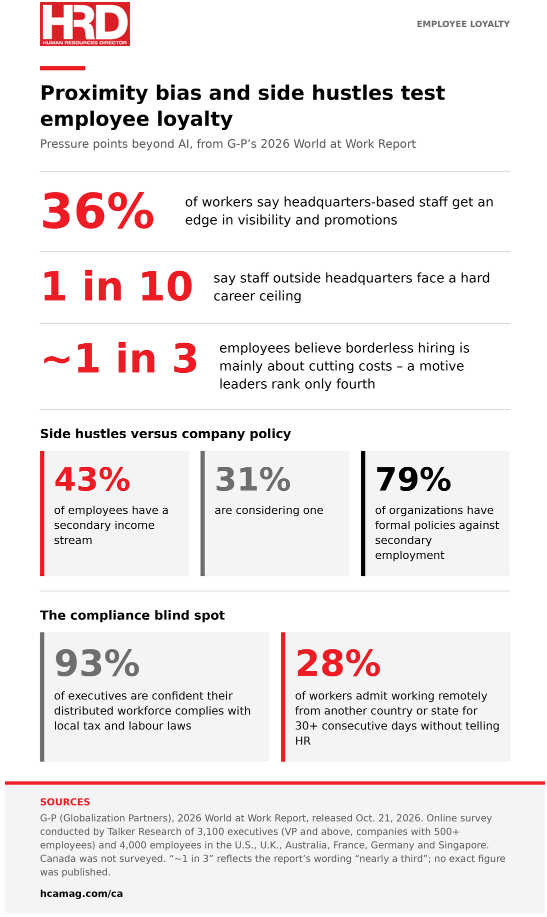
AI is not the only loyalty test. More than a third (36%) of workers said headquarters-based staff get an edge in visibility and promotions, and one in 10 said those outside headquarters face a hard career ceiling. Nearly a third of employees also believe borderless hiring is mainly about cutting costs – a motive leaders rank only fourth.
Many are also hedging their bets. G-P found 43% of employees have a secondary income stream and another 31% are considering one, despite 79% of organizations having formal policies against it.
Leaders may not see the full picture. While 93% of executives were confident their distributed workforce complies with local tax and labour laws, 28% of workers admitted working remotely from another country or state for more than 30 consecutive days without telling HR.
What do the findings mean for Canadian employers?
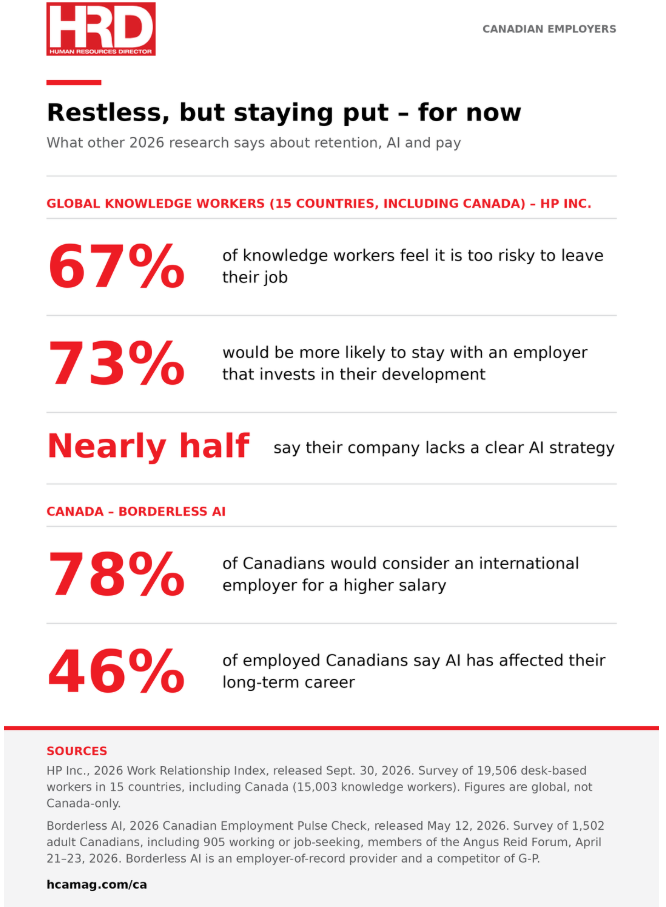
Restlessness does not always lead to resignations. HP Inc.'s 2026 Work Relationship Index, a 15-country survey that included Canada, found 67% of knowledge workers feel it is too risky to leave their job. Still, nearly half said their company lacks a clear AI strategy, and 73% of knowledge workers would be more likely to stay with an employer that invests in their development.
For Canadians, pay remains the tipping point. Toronto-based Borderless AI, an employer-of-record provider and G-P competitor, found in a 2026 survey that 78% of Canadians would consider an international employer for a higher salary, even as 46% of employed Canadians say AI has affected their long-term career. "Canadian pride is alive in Canada's job market, but as the job market tightens, what employers can offer employees becomes the deciding factor," said Willson Cross, its CEO and co-founder.
The market is sending mixed signals. HRD has reported on employers offering salary premiums of up to 15% for AI-skilled staff, but also on a hiring slowdown, not layoffs, driving Canadian unemployment earlier in 2026.
To keep talent from walking, G-P advises HR leaders to refocus AI investment on tools that help employees, modernize risk frameworks for distributed workers, and rebuild job architecture around critical thinking and hybrid human-AI work.