2027 salary survey shows Canadian employers are breaking pay ceilings to compete for senior HR professionals with specialist skills, certification

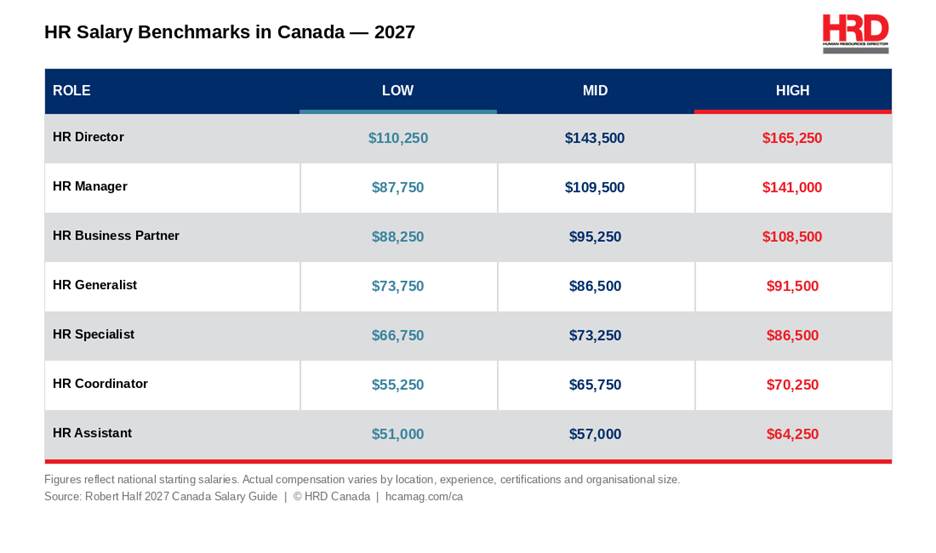
Canadian employers are paying significantly above planned salary ranges to land senior human resources (HR) talent, with HR director roles now commanding a national midpoint starting salary of $143,500, according to the 2027 Canada Salary Guide from Robert Half.
More than half of HR hiring managers surveyed are offering salaries above their planned ranges to secure top talent – a figure that underscores just how competitive the market for experienced HR professionals has become. Eighty-six per cent cite the need to secure candidates with specialized skills as the primary reason for exceeding budget.
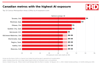
The eight higher-paying HR positions in Canada span a salary range from $100,000 to $143,500 at the national midpoint – a band that reflects how much the scope and strategic weight of HR roles has shifted in recent years, according to Robert Half.
HR director role at the top
At the top of the ladder, the HR director role sits at a national midpoint starting salary of $143,500. HR directors are senior executives responsible for leading and strategically aligning all human resources functions with overall business objectives, overseeing talent acquisition, retention, succession planning, and total rewards programs.
Senior talent acquisition managers follow at $118,250, with compensation managers close behind at $112,750. Compensation managers lead the organization’s pay strategy –conducting market analyses, managing salary surveys, and administering performance-based compensation systems including bonus and incentive plans.
HR managers command a national midpoint starting salary of $109,500. Human resources information systems (HRIS) managers – overseeing platforms such as Workday and ensuring integration with other business systems — sit at $104,250. Talent acquisition managers at the standard level reach $101,000, while learning and development managers and benefits managers round out the top eight at $100,500 and $100,000 respectively.
Why pay is rising fastest at the specialist end
The salary data doesn’t tell a story of uniform wage growth across HR. It tells a story of targeted premiums for expertise that organizations can’t easily replicate.
The survey found that two-thirds of employers are paying more for AI-related skills, with nearly a third – 32 per cent – reporting those salary premiums are higher than for any other technology skillset. The specialized competencies most frequently commanding higher pay include advanced data analytics, Human Resources Information Program (HRIP) implementation experience, labour relations expertise, and people management strategy, according to the report.
Roles requiring specialized skills in compensation, benefits, and recruitment are expected to see salary growth above the projected 1.1 per cent average for HR positions overall. Benefits managers are forecast to see 2.3 per cent salary growth – the highest of any HR role – followed by HR assistants at 1.8 per cent and compensation analysts at 1.6 per cent.
The strongest demand for HR talent
Industries with the strongest demand for experienced HR talent in Canada include consumer products, financial services and insurance, health care, manufacturing, professional services, public utilities and government, technology, and transportation. Across all sectors, the common thread is regulatory complexity, workforce growth, and the need to manage organizational change – priorities that require HR professionals who can operate at a strategic level, not just an administrative one.
This has implications for how Canadian organizations structure their HR teams. When a single role is expected to cover multiple specialized functions without a corresponding adjustment in pay, the Robert Half Salary Survey suggests this leads to difficulty attracting the calibre of professional needed.
Certifications as salary levers
Professional designations can justify higher compensation when they validate expertise in talent management, HR leadership, compliance, workforce strategy, and HR systems. Certifications recognized as influencing earning potential include the Certified Human Resources Professional (CHRP), the Certified Human Resources Executive (CHRE), the Human Resources Information Program (HRIP), and the SHRM Senior Certified Professional (SHRM-SCP).
The survey found that extensive experience, advanced skills, and specialized certifications adds more than $20,000 to the expected starting salary for HR directors, more than $30,000 to that of HR managers, and $13,000 to HR Business Partners.
For HR professionals in Canada considering their next career move, targeted investment in certification – particularly in HRIS platforms, compensation design, and data analytics – is among the most direct routes to the upper end of the salary bands outlined above, according to the report.