Indeed Hiring Lab ranks 41 Canadian metro areas on generative AI exposure, with workforce planning implications for HR
For HR leaders drafting reskilling budgets and workforce plans, location may matter as much as job title. Teams in Toronto, Montreal and Ottawa do more of the work artificial intelligence (AI) is poised to change than staff in resource-based metros such as Red Deer, Alta., new research shows.
The findings come from Indeed Hiring Lab, the economic research arm of job site Indeed, which ranks 41 Canadian metro areas by AI exposure – how much of their local work generative AI (GenAI) could transform. The analysis by An Nguyen, an economist at Indeed Hiring Lab who focuses on the U.S. labour market, links AI's impact to both occupation and location.
"Will AI change your job? The honest answer is: it depends on what you do," Nguyen writes.
The score builds on the GenAI Skill Transformation Index from Hiring Lab's AI at Work Report 2025, which rates almost 2,900 workplace skills, weighted by each metro's mix of Indeed job postings over the 12 months ending July 2026. The result is the share of skills in a typical local posting that GenAI could transform – about 48% in the average Canadian metro.
Which Canadian metros rank highest for AI exposure?
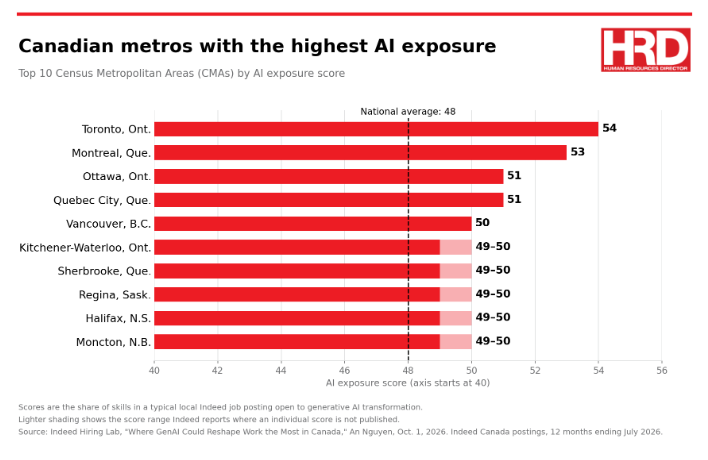
Toronto scores 54, the country's highest, according to Indeed Hiring Lab. Montreal follows at 53, Ottawa and Quebec City are each at 51 and Vancouver scores 50. Kitchener-Waterloo, Sherbrooke, Regina, Halifax and Moncton round out the top 10.
The list blends technology centres such as Toronto, Montreal and Kitchener-Waterloo with government and administrative capitals such as Ottawa, Quebec City and Regina, the report says. Both depend on office-based and technical roles that Hiring Lab identifies as most open to GenAI transformation.
Quebec's seven Census Metropolitan Areas (CMAs) average 49.7, the highest of any province, according to the report. Metros throughout Atlantic Canada also sit above the national average of 48.
Resource-based metros sit at the bottom
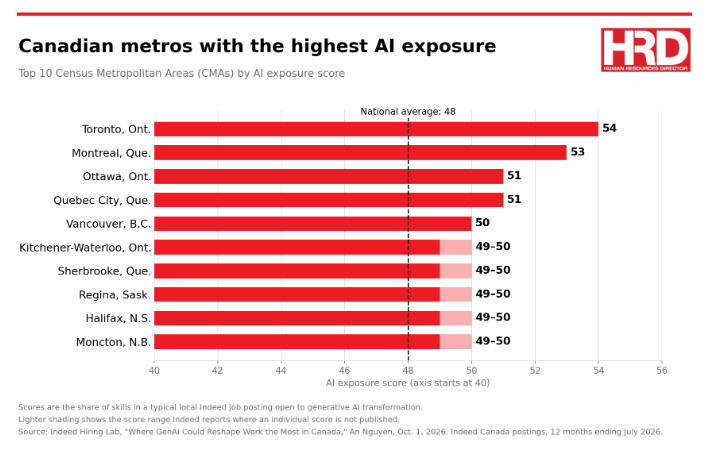
Red Deer and Lethbridge, Alta., Chilliwack and Kamloops, B.C., and Brantford, Ont., each score about 44 to 45. Hiring Lab says these metros rely on hands-on work in energy, agriculture and manufacturing that GenAI is less likely to transform. Alberta posts the lowest provincial average at 45.7, followed by British Columbia at 46.2.
Statistics Canada data on actual use mirrors that divide. In its July 30, 2026, release, the agency reports GenAI use in March 2026 was highest among legislative and senior management occupations (75.1%) and natural and applied sciences (67.5%). It was lowest among trades, transport and equipment operators (14.7%) and natural resource and agriculture occupations (17.0%).
Hiring Lab cautions that the index was built on U.S. skill data before being applied to Canadian postings. It also measures the potential transformation of tasks, not the replacement of workers.
What does AI exposure mean for Canadian employers?
Nguyen frames the findings as a planning resource rather than a job-loss forecast: "For employers, the map is a workforce-planning tool, not a cost-cutting one." In highly exposed metros, the report says, the payoff comes from reskilling workers and redesigning roles around AI augmentation, while lower-exposure metros have more runway.
Exposure becomes real change only as quickly as employers adopt the technology, according to Hiring Lab. The Bank of Canada makes the same point. "How disruptive this change will be depends on the speed and scale of adoption, and on how quickly workers and businesses are able to adapt," Michelle Alexopoulos, external deputy governor of the Bank of Canada, said in a May 13, 2026, speech to the Ottawa Economics Association and the Canadian Association for Business Economics in Ottawa.
That puts training readiness under scrutiny. HRD Canada has reported on the widening AI skills gap among Canadian workers, and Signal49 Research, formerly the Conference Board of Canada, has modelled how AI adoption could disrupt Canadian employment through 2030.
The report says high-exposure metros face the biggest opportunity and the biggest adjustment as GenAI spreads through their dominant industries. Lower-exposure metros are more insulated in the near term but may see fewer productivity gains – a split HRD Canada explored in its analysis of whether Canada is ready for an AI reckoning.