Which sectors are leading the growth?

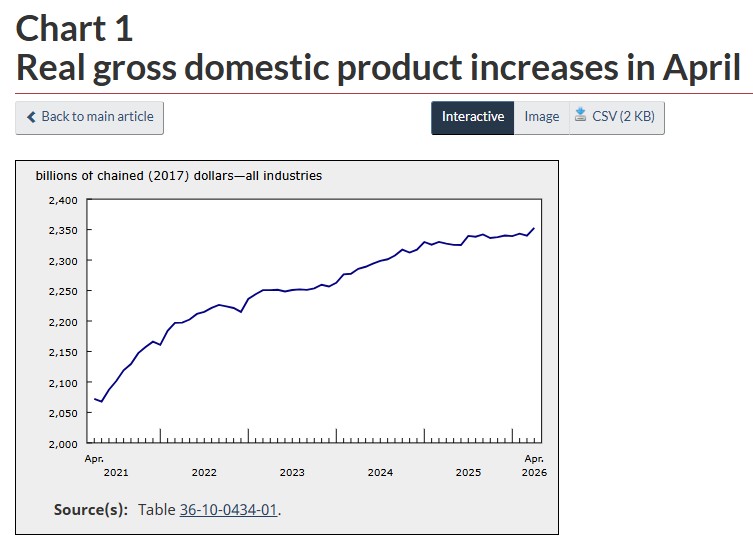
Canada's economy grew 0.5% in April after a March contraction, a rebound that signals tightening labour demand in energy, manufacturing, and construction.
Real gross domestic product rose 0.5% in April, after contracting 0.1% in March, on strength in both goods-producing and services-producing industries, Statistics Canada (StatCan) reported.
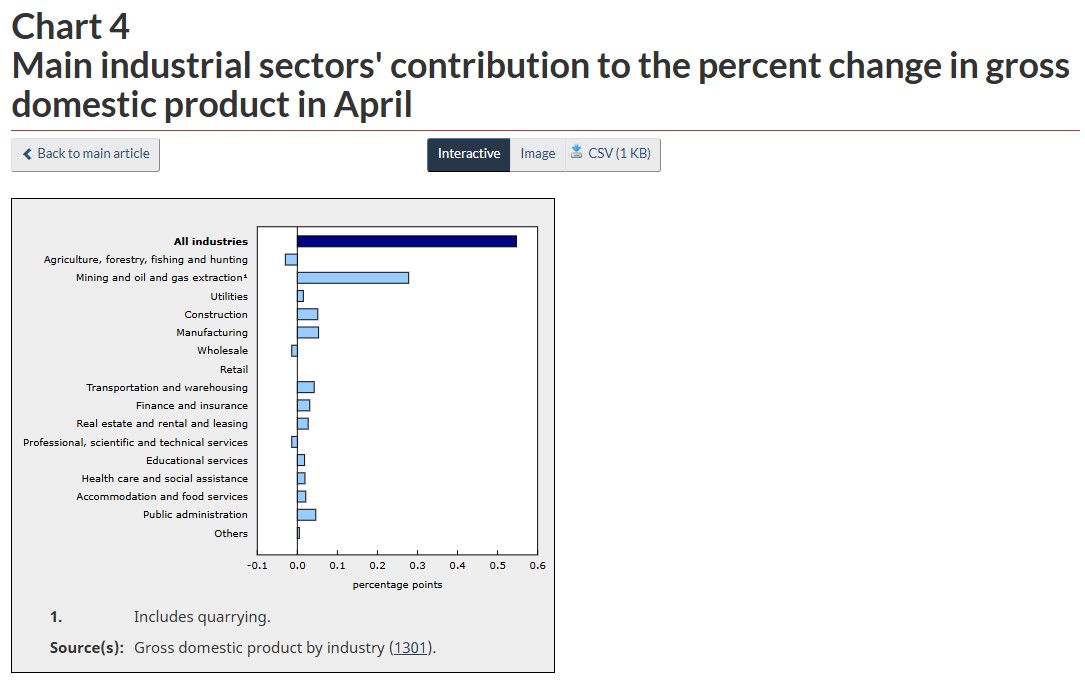
The agency said goods-producing industries rose 1.2% in April, reflecting growth in most sectors and driven by mining, quarrying, and oil and gas extraction, while services-producing industries grew 0.3%, marking a third consecutive monthly increase.
In total, 14 of the 20 industrial sectors grew in April, according to StatCan. The breadth of the increase distinguishes April's performance from more narrowly concentrated gains recorded earlier in 2026.
StatCan also released an advance estimate for May, cautioning that the figure is preliminary. The agency said advance information indicates that real GDP by industry increased 0.1% in May, with increases in finance and insurance and real estate and rental and leasing partially offset by decreases in wholesale trade and agriculture, forestry, fishing and hunting. The official data for May is scheduled for release on July 31, 2026.
Labour productivity in Canada's business sector fell for a second consecutive quarter in the first quarter of 2026, while the cost of producing each unit of output rose for a fourth straight quarter, StatCan previously reported.
Energy and resource sector growth
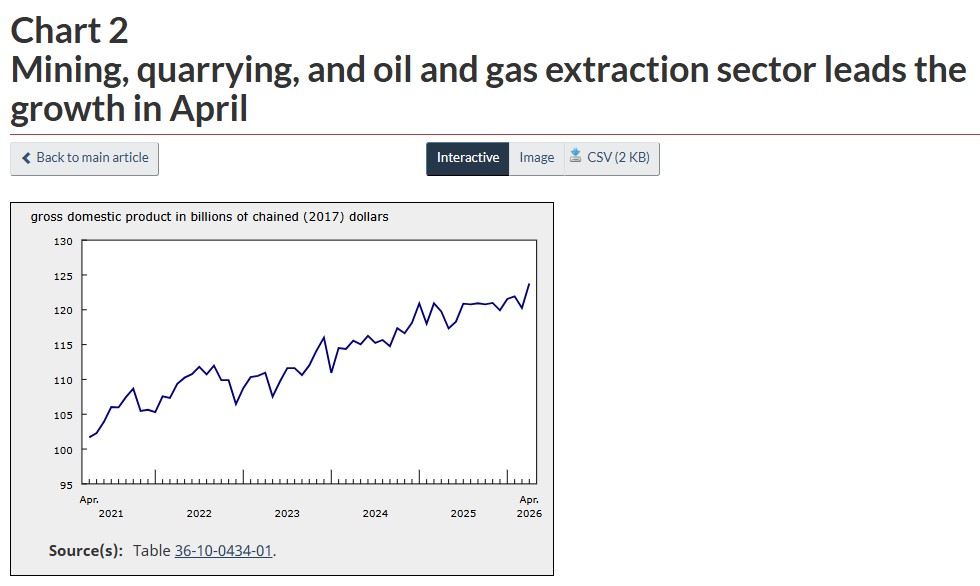
The mining, quarrying, and oil and gas extraction sector rose 2.9% in April, the largest monthly growth rate since February 2024, more than offsetting March's 1.4% contraction, StatCan said. The increase was attributed to gains in oil and gas extraction along with related support activities.
Oil and gas extraction rose 3.7%, also the largest increase since February 2024, led by a rebound in oil sands extraction, which expanded 6.6% as higher synthetic crude oil production offset lower crude bitumen extraction following earlier maintenance disruptions.
Mining and quarrying excluding oil and gas edged down 0.1%, a third consecutive monthly decrease driven by a 2.2% contraction in metal ore mining, as facilities in Northern Saskatchewan faced maintenance-related shutdowns, StatCan reported.
Public sector and manufacturing activity
The public sector aggregate, comprising educational services, health care and social assistance, and public administration, expanded 0.4% in April on widespread gains, StatCan reported. Public administration was the largest contributor to growth for a second consecutive month, with increased activity across all levels of government.
Federal government public administration except defence posted its first increase in four months, rising 0.6%, while defence services recorded a seventh consecutive monthly increase of 0.7%. Health care and social assistance rose 0.2% and educational services rose 0.4%.
Manufacturing rose 0.6%, driven by durable goods, which expanded 1.1% on strength in machinery manufacturing, up 3.0%. Non-durable goods manufacturing was unchanged, as petroleum and coal product gains were offset by a 6.8% contraction in chemical manufacturing.
Construction, transportation, and financial services
Construction grew 0.7% in April, ending four consecutive monthly declines, StatCan reported. Residential building construction rose 1.3% on alterations, improvements, and multi-unit building activity, while non-residential construction expanded 1.2%, its 10th consecutive monthly increase.
Transportation and warehousing rose 0.9%, driven by rail transportation, which climbed 3.8% on grain and automotive carloadings, and pipeline transportation, which rose 2.6% as earlier crude oil movement disruptions eased.
Finance and insurance rose 0.4%, led by banking and depository credit intermediation, while real estate and rental and leasing expanded 0.2% for a third consecutive month amid rising home resale activity, particularly in the Greater Toronto Area, according to StatCan.
Canadian employers should brace for at least 18 months of constrained hiring and compensation pressure after Deloitte Canada forecast that the national economy will grow just 0.7% in 2026.