‘Canada will have to play the hand it is dealt to the best of its ability’
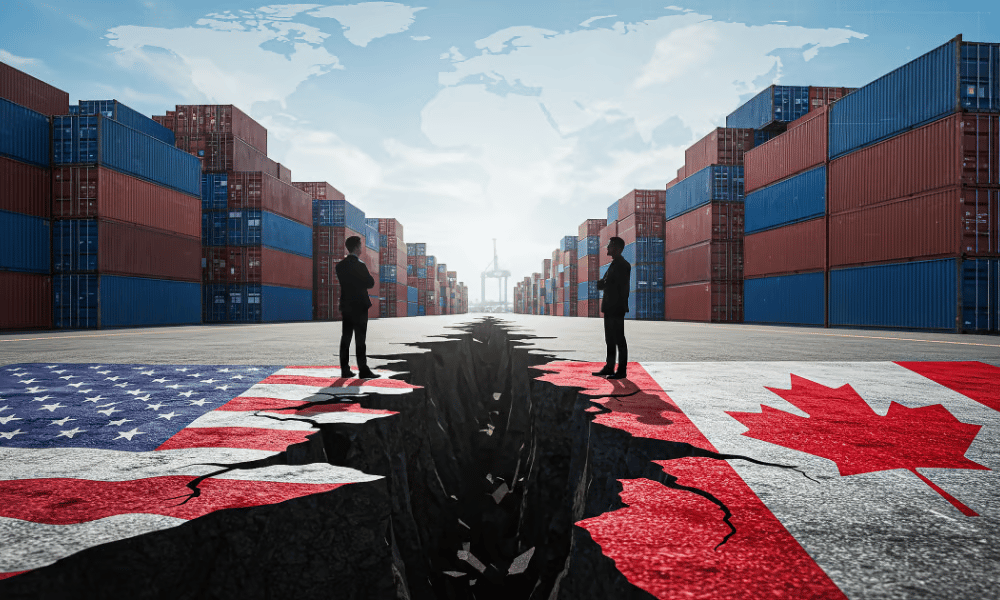
Canada could shed an average of 163,000 jobs annually over the next decade if the United States formally withdraws from the Canada-United States-Mexico Agreement (CUSMA), according to a recent Deloitte report.
The report, authored by Danielle Bochove, Trevin Stratton and Matthew Stewart, models a "downside" scenario in which the US exits CUSMA and trade resets to World Trade Organization most-favoured-nation rates. Under this scenario, Canadian real GDP would fall 1.6% by 2036 relative to a July 1, 2026 baseline, representing $402 billion in lost real GDP over the decade, the authors write.
Average wages would likely decline under this scenario, Deloitte's authors state, cutting into household purchasing power and domestic consumption. Motor vehicles and parts would see the steepest sector decline, with real GDP down 28% by 2036, followed by electronics, machinery and equipment down 21%, rubber and plastics products down 20%, and chemicals down 13%.
Oil and gas, previously shielded by CUSMA exemptions, would also face the existing US 10% global tariff under this scenario, with oil and natural gas exports to the US falling 11% and 30% respectively, Deloitte's modelling shows. The authors project a net loss of 0.4% in real GDP for oil and 0.9% for natural gas by 2036.
Earlier, the Canadian American Business Council (CABC) noted that Canada could lose 102,000 jobs in 2027 alone in case of a total CUSMA breakdown.
Comparing Canadian and US side effects
Deloitte's authors note that Canada's exports to the US would be expected to fall about 21% by 2036 under the downside scenario, but total global exports would fall only about half as much, roughly 10.5%, as displaced Canadian products find new buyers domestically and abroad.
That gap exists partly because US protectionism would raise American production costs, the report states, allowing a "more competitive Canada" to capture some of the US's global market share for certain products. The US currently accounts for approximately 70% of Canadian exports, a concentration the authors describe as a continuing vulnerability.
In Deloitte's alternative "accelerated diversification" scenario, US tariffs hold at baseline levels while Canada expands trade deals elsewhere. That scenario shows Canadian real GDP growing 0.6% by 2036, adding $141 billion in cumulative GDP and about 53,000 jobs a year — roughly one-third of the jobs at risk under the withdrawal scenario.
Will diversification be enough?
Deloitte's authors conclude the gains from diversification, while meaningful, cannot fully offset the losses of a CUSMA breakdown on their own. Prime Minister Mark Carney, quoted in the report, said: "We cannot control the storm blowing in from Washington. We can chart a new course by building Canada strong at home and diversifying our trading relationships abroad."
The authors also point to interprovincial trade barriers as a lever within Canada's control, citing earlier Deloitte Canada research showing that removing them entirely over five years could add $881 billion in economic output by 2040 and create 133,000 jobs.
Summing up the scale of the challenge, the report's authors write: "Canada will have to play the hand it is dealt to the best of its ability."
For HR leaders in exposed sectors such as manufacturing and energy, the modelling signals where restructuring, workforce planning and reskilling investment are most likely to be needed first, regardless of which scenario ultimately unfolds.
Recently, the US imposed new tariffs on Canada, and the Canadian side retaliated.