Economist says details underlying increase in unemployment 'less alarming '

Canada’s unemployment rate rose in April as the economy shed 18,000 jobs, but a new report from RBC Economics says the increase is being driven mainly by weaker hiring rather than layoffs.
The national jobless rate climbed to 6.9% in April, according to Statistics Canada, matching its level a year earlier and sitting between the recent high of 7.1% in September 2025 and the low of 6.5% in January, according to the report by RBC senior economist Claire Fan. RBC Economics estimates that Canada has now lost 112,000 jobs so far in 2026, with April’s decline more than offsetting a modest March gain.
Fan writes that labour market conditions are softer but not indicative of a severe downturn. “Permanent layoffs remained on its trend lower while job leavers and labour market entrants both rose,” she notes, adding that the data are “consistent with rising unemployment being driven by low hiring, and not elevated firing.”
Canada’s economy has weathered a year of U.S. tariff shocks better than expected, but the impact on jobs, regions and sectors is highly uneven – creating fresh risks for employers and HR professionals, according to a previous report.
Layoffs, job leavers and implications for HR
RBC reports that permanent layoffs continued to decline in April, sitting about 10% below their October 2025 peak. The increase in unemployment instead reflects more workers voluntarily leaving jobs in search of new positions and more new entrants who have yet to find work.
“Details underlying the increase in unemployment were less alarming – permanent layoffs remained on its trend lower while jobs leavers and labour market entrants both rose,” according to the report. “These trends are consistent with rising unemployment being driven by low hiring, and not elevated firing.”
According to RBC Economics, employers appear to be slowing hiring and backfilling while avoiding broad rounds of permanent layoffs, suggesting a labour market in adjustment rather than contraction.
Participation, demographics and slowing population growth
The labour force participation rate edged up in April to 65%, driven by core‑age workers aged 25 to 54, whose participation rose to 88.5% from 88.2%, according to RBC Economics.
Despite the uptick, Fan notes that 65% is “still near the lowest rate since 1990s (outside of pandemic) due to aging population.” The report links the low overall participation level to more Canadians moving into retirement.
The working‑age population (15 and over) increased by 9,000 in April, far below the monthly gains of more than 100,000 seen in early 2024. RBC, citing Fan, says it expects “the monthly population growth will turn negative” in coming months, reflecting federal immigration curbs and earlier declines in quarterly population estimates.
Wages, hours and regional disparities
Hours worked were little changed in April after edging up 0.2% in March. Wage growth slowed to what Fan describes as a “more normal‑looking 0.2% monthly (seasonally adjusted) gain,” but year‑over‑year wage growth remained elevated at 4.5%.
Regionally, RBC says Quebec led April’s decline with 43,000 job losses, bringing its 2026 employment drop to 91,000 and pushing its unemployment rate up 0.8 points to 6.2%. Newfoundland and Labrador also saw employment fall, while Saskatchewan and New Brunswick posted smaller declines.
Ontario added 42,000 jobs, nudging its unemployment rate down 0.1 point to 7.5%, though RBC notes this only partially offsets 69,000 jobs lost so far this year. Manitoba recorded the lowest unemployment rate among the provinces at 5%.
RBC Economics and Fan state they “continue to look through near-term volatility,” expecting resilient consumer, business and government spending to “support gradual improvements in labour conditions later this year.”
The report concludes that Canada’s labour market is in a period of adjustment marked by lower permanent layoffs, sector‑specific shifts, slower population growth and continued wage pressures.
Here's what RBC Economics has reported month-by-month over the past year (data from Statistics Canada's Labour Force Survey, as commented on in RBC's data flashes):
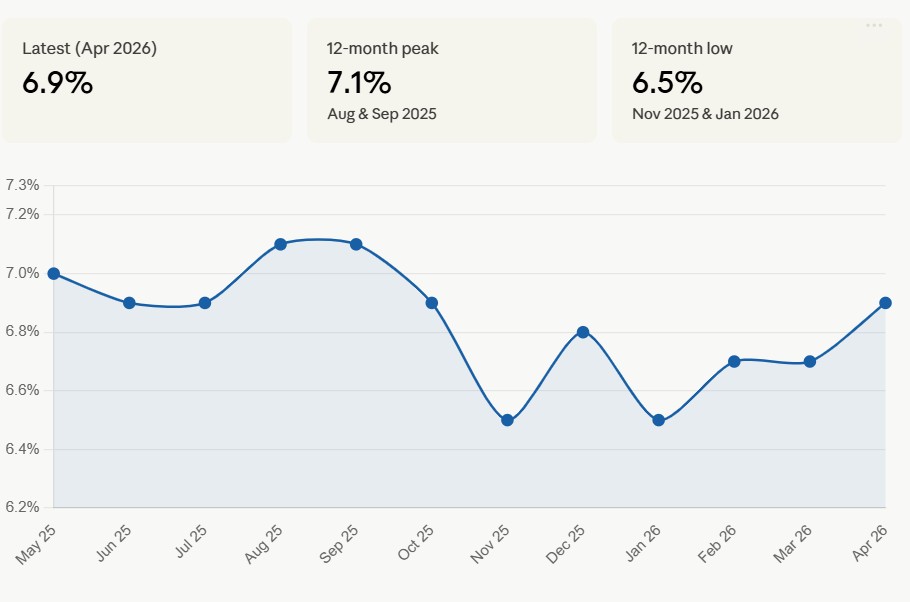
Per RBC Economics, Canada's unemployment rate moved within a narrow band over the past 12 months. It started at 7.0% in May 2025 as trade-war pressures weighed on hiring, then climbed to its highest point of 7.1% in August and September 2025 — the steepest level in nearly a decade outside the pandemic. A rebound followed, with the rate reaching its lowest point of 6.5% in November 2025 and again in January 2026, driven largely by a smaller labour force. It has since drifted back up, finishing at 6.9% in April 2026 as weak hiring, not layoffs, lifted the count.
Artificial intelligence (AI) is poised to trigger a turbulent decade in Canada’s labour market, with significant job losses expected before longer-term employment gains materialise, according to a new report from the Signal49.
In a high AI-adoption scenario, the think tank projects that total employment will initially fall well below its current outlook before rebounding and ultimately exceeding it.
“In total, in this full-adoption scenario, we estimate that employment increases by 2.1 per cent in 2045 (or about 535,000 additional jobs) compared with our baseline forecast,” the report states. “This long-term growth would offset an estimated initial drop in employment of 2.6 per cent in 2030, or about 555,000 jobs.”