Nearly 90,000 jobs at risk as new US tariffs bite — and HR leaders are running out of time to plan
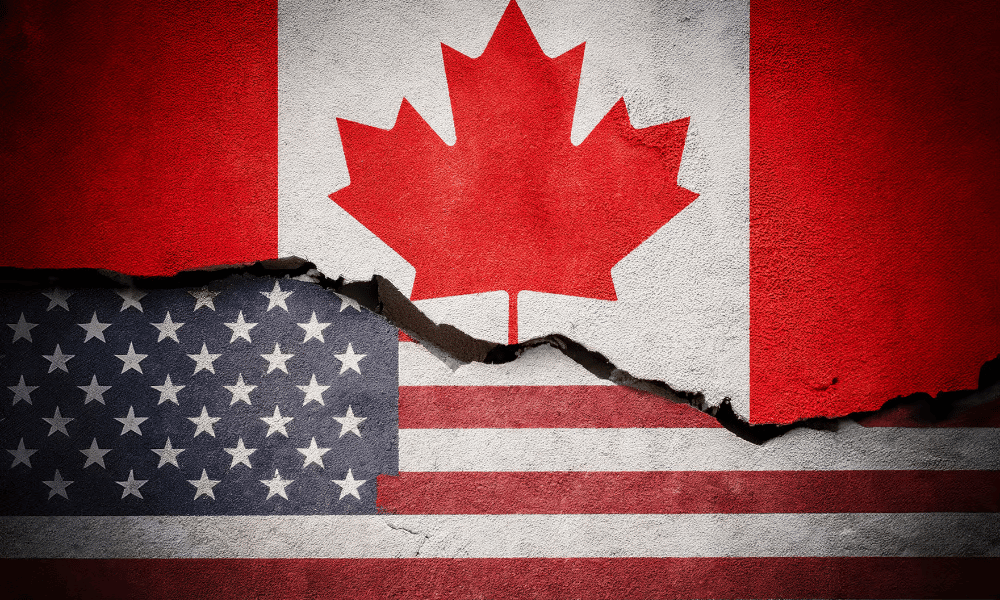
The collapse of Canada–US trade talks in the early hours of Aug. 22 has set off a wave of alarm across Canadian business communities, with new analysis suggesting roughly 87,000 Canadian jobs could be at risk because of the new 50-per-cent tariffs on Canadian goods. For human resources (HR) leaders managing workforces in export-linked industries, the pressure is no longer theoretical — it is arriving on the shop floor.
Canadian Prime Minister Mark Carney called the steep new US tariffs "a miscalculation" after trade talks collapsed late Friday night, with the 50-per-cent duties going into effect at the stroke of midnight. Carney blamed the breakdown of talks on what he said were the Trump administration's "uneconomic" and "unfair" demands.
The tariffs – imposed under Section 338 of the Tariff Act of 1930, which gives the US president power to impose tariffs of up to 50 per cent on goods of countries found to be discriminating against the US and has never been used until now – apply to a sweeping range of Canadian exports. The import taxes that came into effect will apply to hundreds of products from Canada, such as plywood, liquor, electrical equipment and hockey gear.
Canada has pledged to respond. Prime Minister Carney said retaliatory tariffs on US goods will take effect on Sept. 8. The tit-for-tat escalation has left HR executives across manufacturing, forestry and trade-exposed sectors urgently reassessing headcount, hiring plans and contingency strategies.
An economic disruption like never before
The current disruption is unlike anything Canada has faced before – precisely because it’s deliberate and targeted, says Mahmood Nanji, Power Corporation of Canada Policy Fellow and Executive-in-Residence at the Lawrence Centre for Policy and Management, Ivey Business School at Western University.
"The storm seems to just get worse," says Nanji. "Most of the crises that the Canadian economy has faced over the years have had some sort of a global component to them – whether it's COVID, the great financial crisis – but what's unusual about this is the uncertainty of not knowing what the other side is going to look like, just because we've got such an unpredictable partner that we're dealing with."
The new tariffs could cost about 87,000 jobs in Canada, with 52,000 directly affected and 35,000 indirectly, according to Trevor Tombe, an economics professor at the University of Calgary, who posted his analysis on The Hub. The hardest-hit provinces for job losses are Ontario, with an estimated 36,100 positions at risk; Quebec, with 18,300; and British Columbia, with 11,200. The industries set to have the highest number of job losses are machinery, electronics, plastics, and rubber.
Tombe's analysis draws on Statistics Canada's input-output data to model how US consumer behaviour will shift in response to higher prices on Canadian goods, and he estimates the new tariffs would raise the average effective tariff rate facing Ontario and Quebec exporters by about five percentage points – double the national average – and BC exporters by approximately seven per cent. Much of Atlantic Canada, along with Alberta and Saskatchewan, appears largely spared, according to Tombe.
Downstream impacts mean no one is safe
However, no business or province should assume it’s safe, according to Nanji, who points out that these tariffs differ fundamentally from earlier rounds in who they target.
"What’s different between these tariffs and the [previous] tariffs is that the other tariffs, by and large, were impacting large manufacturers – not exclusively, but largely," he says. "These are now going to impact more small and medium-sized businesses – enterprises with less than 100 employees, even those with less than five employees."
That geographic unevenness has implications for workforce planning that extend well beyond directly exposed sectors. Alberta, for instance, faces meaningful job losses despite its own exports being barely touched by these tariffs, because service activity supporting exporters elsewhere wouldn't be spared the disruption.
"You need to understand the integrated nature of supply chains today and the downstream impacts of impacted industries, because you may not think you've got a direct consequence of a trade decision, but you may have an indirect consequence that may turn out to be quite significant to your businesses,” says Nanji. “If you're in a community that has an auto plant or auto parts manufacturer, you'll be impacted – if you're a restaurant, you're going to lose those customers."
Vehicle tariffs add another front
The pressure intensified further on Monday, when US President Donald Trump announced an intention to impose 50-per-cent tariffs on all cars and trucks by New Year's Day, CTV News reported. Ontario Premier Doug Ford responded bluntly to the threat, making clear that Canada's provinces won't absorb these measures without a fight. Ontario's automotive manufacturing sector – which anchors hundreds of thousands of direct and indirect jobs – sits in the crosshairs.
Nanji, who negotiated the restructuring of General Motors and Chrysler during the 2008–2009 financial crisis, said the scale of potential auto sector job losses cannot be overstated.
"Think of Honda and Toyota, who produce close to a million vehicles in this country," he says. "If the Americans put these tariffs on their popular vehicles – the majority of which end up in the United States – and they now see a price increase and Americans are not buying those vehicles, guess what? The operations in Cambridge [Ont.] or Alliston [Ont.] are going to have to reduce their workforce, people will be laid off, and that will cause huge labour force adjustments for many companies to deal with that they might not have anticipated."
The breakdown has broader structural consequences too. The failure to reach a deal adds another complication to the increasingly tense relationship between the two countries. The two sides had already been at the negotiating table regarding their trilateral trade pact with Mexico, known as the Canada–United States–Mexico Agreement (CUSMA), which wasn’t renewed in July over concerns with US terms.
Increased unemployment ahead?
The most exposed organizations are those with significant export revenue tied to the US market in affected goods – particularly manufacturers, forestry-linked businesses, and their suppliers across Ontario, Quebec and B.C.
Job losses on this scale would push the national unemployment rate up by roughly 0.4 percentage points to approximately 6.8 per cent, said Tombe. For HR leaders, that figure is a preview of the labour market their organizations will be recruiting and retaining in, should these tariffs hold.
HR and business leaders need to build contingency plans across multiple scenarios rather than waiting for the situation to resolve itself, says Nanji.
"There has to be a worst-case scenario, a medium-risk scenario, and then of course a low-risk scenario," he says. "Having no kind of plan, just sitting back and watching and saying, 'This storm will just go over it and we'll be fine' — I think is misguided. You've always got to be mindful that that storm may turn a corner and bring conditions that you didn't anticipate."
Workforce planning in the new reality
His most direct advice to Canadian HR leaders is to stop planning around assumptions that may no longer hold.
"If you're doing most of your business with the United States, understand that those conditions are going to change, and it may change dramatically," he says. "Do you have some backup plans of who your new customers are going to be, or new markets to which you're going to go, and have you thought about what kind of talent you're going to need for those markets? Because if you're not thinking about it, chances are you're going to fail in that transition.
“When you try to pivot at the last minute, you may realize that you don't have the talent to make that pivot effectively – and consequently, that will have an impact on your sustainability and your viability."
Nanji believes that Canada has significant leverage that will help it in the longer term, but the new tariffs and the hostility from its biggest trading partner will make it rough in the short term.
“Canada has one of most talented labor forces in the world, and it has plenty of resources when we talk about critical minerals and stuff like that, and it’s a reliable place for investment,” he says. “So Canada does have leverage, and I think there are better days ahead, but I think we may have to weather this storm for awhile.”