Washington is expected to ease duties on paper, plastics and farm machinery while Canada's labour market weakens
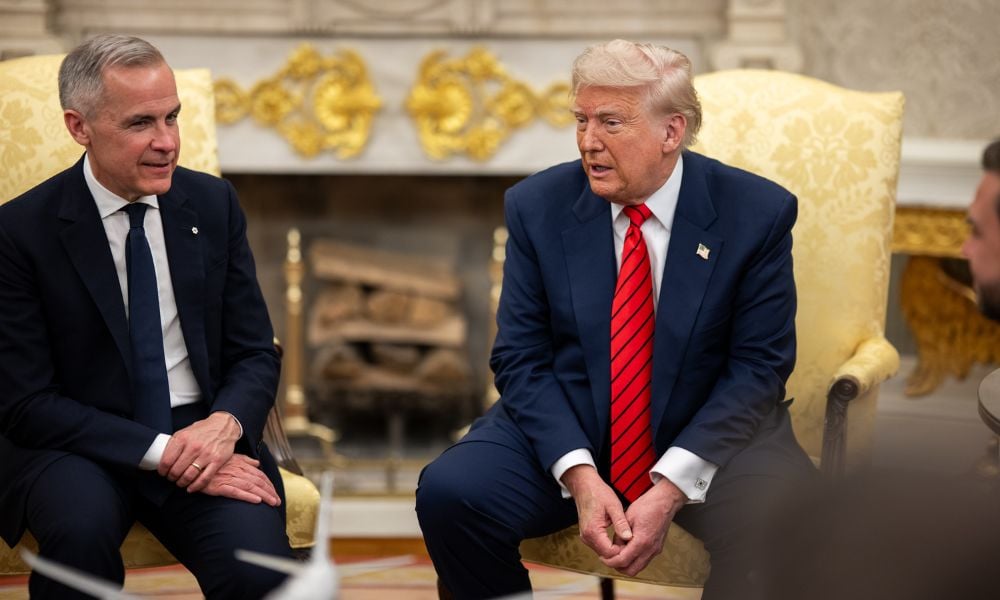
Image from: The White House, Public domain, via Wikimedia Commons
The United States is poised to grant tariff exemptions on a portion of Canadian exports, handing some employers relief at a moment when the wider trade dispute remains unresolved.
Washington is expected to remove 50 per cent tariffs on some Canadian agricultural and forestry products, the Wall Street Journal reported Friday, citing people familiar with the matter. Republican Sen. Susan Collins of Maine said in a statement shortly afterward that the Trump administration will drop duties on nine categories of Canadian goods, including paper and plastic products, refrigeration equipment and agricultural machinery.
The Journal said the cuts could be balanced by higher levies on other Canadian goods, and that a proclamation could come as early as Friday.
What the tariff exemptions cover
Collins said Maine's blueberry, potato, apple and seaweed producers rely on Canadian equipment, packaging and other inputs that American suppliers either don't offer or can't replace without significant expense, CTV News reported.
"I will continue working directly with administration officials to seek additional relief," Collins said in a statement.
Collins' list includes corrugated paper and paperboard boxes, plastic crates and bags, refrigeration and freezing equipment, machinery that sorts and grades farm products, packing and wrapping machinery, and seaweed and algae products for human consumption, Newsweek reported. Employers shouldn't assume a product qualifies until the proclamation spells out the tariff codes.
Midterm pressure drives the timing
Collins is seeking a sixth term in Democratic-leaning Maine against Democrat Troy Jackson, who has made the trade war with Canada a centrepiece of his campaign. Republican Senate candidate Mike Rogers of Michigan has also called for an end to the dispute, saying tariffs have raised prices. Reuters said both states are likely central to Republican hopes of holding the U.S. Senate in the Nov. 3, 2026, elections.
U.S. President Donald Trump said Friday that Canada is working on a trade deal, according to Reuters, though talks have been stalled since they broke down in August. Prime Minister Mark Carney told reporters in Istanbul that Canada remains ready to negotiate in good faith and isn't concerned about timing.
"We could sign it [a deal] this afternoon if the U.S. were there," Carney said.
CTV News reported that Canadian officials haven't ruled out a snap deal before the midterms, although sources said hope is faint.
A weakening labour market limits the relief
The reprieve arrives as employment data deteriorate. Canada lost 68,000 jobs in September 2026, a second consecutive monthly decline that pushed the unemployment rate to 6.5 per cent, according to Statistics Canada's Labour Force Survey.
The tariffs that took effect Aug. 22, 2026, were imposed under Section 338 of the Tariff Act of 1930, a provision never before used that allows duties of up to 50 per cent on countries found to discriminate against American commerce. University of Calgary economist Trevor Tombe estimated they could put about 87,000 jobs at risk, including 36,100 in Ontario, 18,300 in Quebec and 11,200 in British Columbia, as detailed in HRD Canada's analysis of the tariffs' projected job losses by province.
Layoffs are already reaching workers. Stelco, the Hamilton, Ont., steelmaker owned by Ohio-based Cleveland-Cliffs Inc., is cutting up to 500 jobs at its Hamilton and Nanticoke plants, and federal Industry Minister Mélanie Joly has issued a 15-day ultimatum to Stelco's U.S. owner to reverse the layoffs or face court action, HRD Canada reported. Stelco announced the cuts on Sept. 28, 2026, and its chief executive has defended the move, according to earlier coverage of the Stelco layoffs at Hamilton and Nanticoke.
What employers should watch next
Workforce planning shouldn't pause for a partial reprieve. The federal government's $7.5-billion package for tariff-hit workers and employers, announced Aug. 25, 2026, includes the Workforce Retention and Retraining Program, which lets employers cut hours instead of staff while employees collect Employment Insurance (EI) benefits for hours not worked.
Three questions are worth settling before any proclamation arrives. Which products appear under the exempted tariff codes? Could higher duties elsewhere offset the relief, as the Journal's sources suggested? And would contingency plans hold if no deal comes before the midterms? Employers in paper, plastics and machinery should read the proclamation closely, since those are the categories named so far.