Nearly one in four unemployed Canadians has been searching 27 weeks or more, deepening concerns for the health of the talent pipeline

Canada’s job market stalled in October, with employment essentially unchanged and the national unemployment rate rising for a second straight month as more people went looking for work, Statistics Canada reported Friday.
The economy shed a net 4,700 jobs in October, a change of 0.0%, following losses of 68,000 in September and 42,000 in August.
The unemployment rate climbed 0.2 percentage points to 6.7%, as the number of people searching for work rose by 33,000 (+2.2%). The employment rate — the share of Canadians aged 15 and older who have a job — slipped 0.1 points to 60.5%, its third consecutive monthly decline.
Over the past year, the picture is one of stagnation rather than collapse. Employment is up just 17,000 (+0.1%) from October 2025, while the employment rate has fallen 0.3 points. The unemployment rate is 0.2 points lower than a year ago and remains below the recent peak of 6.9% reached in April 2026.
Private employers pull back
Beneath the flat headline number, the mix of jobs shifted sharply. Private sector employees fell by 53,000 (−0.4%), the first decline since February, Statistics Canada reported.
That was almost entirely offset by a 50,000 (+1.1%) increase in public sector employees, which came after four straight monthly declines that had removed 148,000 public sector positions (−3.2%).
Year over year, public sector employment is still down 70,000 (−1.5%), while the private sector is up a modest 35,000 (+0.3%). Self-employment was little changed in October but is up 52,000 (+1.9%) from a year earlier.
Average hourly wages for employees rose 2.2% year over year to $37.89 in October, an increase of $0.83, after 2.3% growth in September (not seasonally adjusted).
Youth unemployment jumps
The unemployment rate for Canadians aged 15 to 24 rose 0.7 points to 13.7% in October, as youth employment edged down and more young people looked for work. It was the first notable move after three months of little change, and the rate is little changed from a year earlier. The youth employment rate stood at 54.0%.
Among young people, students faced a higher unemployment rate (13.5%) than those not in school (12.3%), on a non-seasonally adjusted basis. The share of youth attending school rose to 63.3% from 62.2% a year earlier, Statistics Canada reported.
For workers aged 55 and older, the unemployment rate rose 0.2 points to 5.5% as employment fell by 14,000 (−0.3%). Core-aged workers held steady: the rate was unchanged at 5.8% for men and 5.3% for women, with women’s rate down 0.4 points from a year earlier.
Retail slides, construction builds
Wholesale and retail trade led October’s losses, shedding 29,000 jobs (−1.0%). The sector has now lost 113,000 positions (−3.7%) over 12 months, with the year-over-year declines concentrated in Ontario, Quebec and British Columbia, says Statistics Canada.
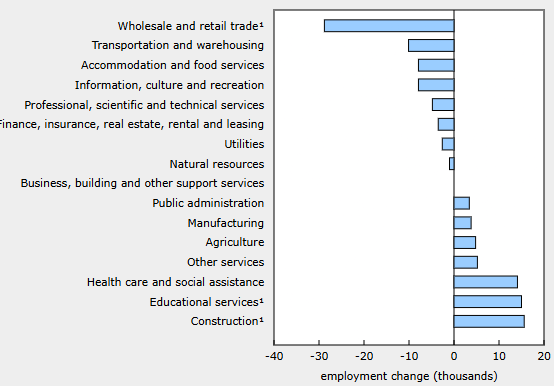
Construction added 16,000 jobs (+0.9%) after two flat months and is up 47,000 (+2.9%) from a year ago. Educational services gained 15,000 (+1.0%), recovering part of September’s 35,000 drop, though employment in the sector remains 48,000 (−3.0%) below its level of a year earlier.
Alberta loses ground, B.C. rebounds
Alberta posted the largest provincial decline, losing 24,000 jobs (−0.9%) and erasing a similar gain from September. The province’s unemployment rate jumped 0.9 points to 7.3%, though employment there is still up 41,000 (+1.6%) on the year.
In Ontario, employment was little changed for a third straight month, but the unemployment rate rose 0.3 points to 7.3% as more people searched for work. That rate is 0.3 points lower than a year ago, Statistics Canada reported.
Quebec’s employment held steady after a combined loss of 68,000 jobs (−1.5%) in August and September. The province is down 106,000 jobs (−2.3%) year over year. Its unemployment rate fell 0.3 points to 5.7% as fewer people looked for work, but remains 0.4 points higher than a year earlier.
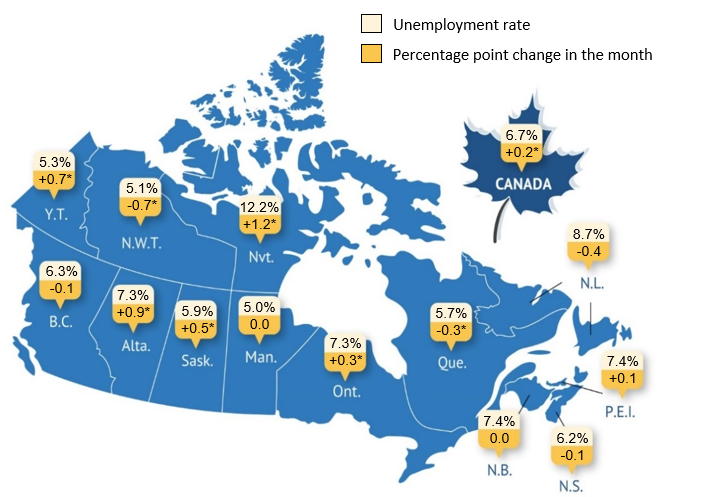
British Columbia added 12,000 jobs (+0.4%) after losing 20,000 in September, with its unemployment rate steady at 6.3%. Newfoundland and Labrador gained 2,900 jobs (+1.2%), while Prince Edward Island lost 1,300 (−1.3%).
Jobseekers waiting longer
The release points to a market where finding a job has become harder, even if layoffs have not surged. Of the people who were unemployed in September, 18.9% had found work by October. That job-finding rate is slightly below the 19.8% recorded a year earlier and well under the 24.6% average for the same months in 2017 to 2019 (not seasonally adjusted). The layoff rate, by contrast, was 0.7%, virtually unchanged from 0.6% a year ago.
Of the roughly 1.5 million Canadians unemployed in October, 23.7% were in long-term unemployment, defined as searching continuously for 27 weeks or more. That is up from 21.5% a year earlier and far above the 17.2% average seen from 2017 to 2019, before the COVID-19 pandemic, Statistics Canada reported.
Older workers are bearing the brunt. Among unemployed people aged 55 and older, 32.7% had been searching for at least 27 weeks, up from 27.9% a year earlier. The share was 25.3% for core-aged workers (25 to 54), up from 23.3%, and 15.2% for youth, little changed from 14.4%.