First monthly Labour Market Survey since latest tariffs shows 68,000 jobs lost; economists warn of weak dynamism and shrinking labour pool

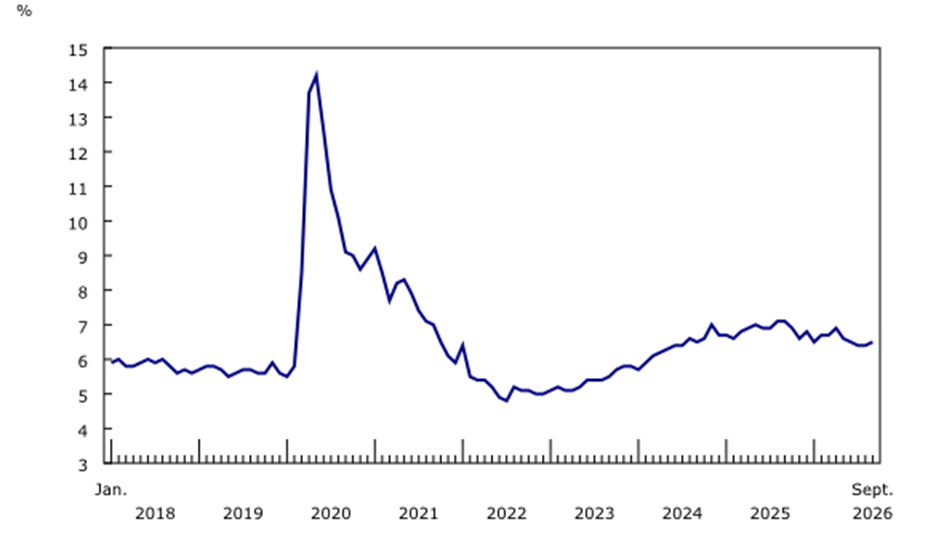
Canada’s labour market shed 68,000 jobs in September, pushing the national unemployment rate back to 6.5 per cent and erasing all net employment gains recorded so far this year, according to Statistics Canada’s latest Labour Force Survey (LFS). The losses – split almost evenly between full-time and part-time positions – follow a decline of 42,000 in August and mark the first full survey period to capture the weight of escalating United States-Canada tariffs.
Canada has now shed a net 41,200 jobs in 2026, although employment was up by 95,000 jobs year over year. The employment rate fell 0.2 percentage points to 60.6 per cent.
The headline figure conceals a pronounced sectoral divergence. Public sector employment contracted by 70,000 – a decline of 1.5 per cent – in September, its fourth consecutive monthly decrease, leaving the sector 119,000 workers below where it stood a year earlier, according to StatCan, with educational services accounting for much of the slide.
Canada's unemployment rate
Private sector jobs hold steady
The private sector told a different story. Employment was up slightly on the month – adding approximately 24,000 positions – and remains up 163,000, or 1.2 per cent, year over year. That relative private-sector resilience deserves recognition even against a difficult backdrop, according to Andrew Hencic, Director and Senior Economist at TD in Toronto.
“We've clearly seen a little more weakness in the labour market this month, and to a certain degree, that was to be expected,” says Hencic. “That being said, it was the composition of the change in work that was interesting to me, with most of the job losses in the public sector.”
Hencic points out that the manufacturing sector lost positions and there were gains in other services. “Nonetheless, in a month where trade frictions came back, you take any piece of good news you can,” he says.
Some stability in bigger picture
The StatCan report shows that September was a bad month for job numbers, but the bigger picture shows some stability, if not strength, says Robert Kavcic, Director and Senior Economist at BMO Capital Markets in Toronto.
“We came through a period in May, June, and July, where arguably the job market numbers were a lot stronger than the reality on the ground,” says Kavcic. “If you look back over a longer period, whether it's the past six months or the past year, you see average job growth running at somewhere between 5,000 and 10,000 per month, which just so happens to be about the run rate of job growth that we need to balance the job market – so from that perspective, things look pretty stable.”
Kavcic frames the public-private split as structural as much as cyclical.
“We would generally read private-sector job growth as a better reflection of economic activity than public-sector – not to discount the value of public-sector jobs, but we know the federal government’s going through a consolidation phase that’s going to probably continue into next year, where not only do we see job loss through attrition but probably just a much flatter pace of hiring.”
Average hourly earnings grew 2.3 per cent year over year in September, up from 2.0 per cent in August, according to StatCan – still a soft pace by recent standards, says Hencic.
“That’s not necessarily a really strong pace of growth in average hourly earnings, so that, to me, signals that there’s still slack in the labour market, and it’s consistent with that 6.5-per-cent unemployment rate,” he says.
Demographic fault lines widen
Youth aged 15 to 24 lost 48,000 positions – a contraction of 1.8 per cent – while women aged 25 to 54 shed 28,000 jobs. The job-finding rate fell to 30.6 per cent in September, well below its pre-pandemic average, according to StatCan.
Hencic believes the job-finding rate reveals a labour market functioning below its potential.
“When I see things like a low job-finding rate despite a layoff rate that’s in that 2017-to-2019 range, that suggests a lack of dynamism,” he says. “Although businesses are kind of finding a way, these are signals that are supportive of this notion that it’s not exactly robust out there. It’s still not easy to find a job.”
A 29-year low in labour force participation
The September report’s most consequential signal for long-term workforce planning may be the labour force participation rate. The rate fell 0.2 percentage points to 64.8 per cent – its lowest level since December 1997, excluding the pandemic, according to StatCan, which attributed the decline largely to population aging and the growing share of Canadians aged 65 and older within the working-age population.
HRD Canada has reported on how Canada’s population decline is already pressuring talent strategies at the organizational level, with employers flagging an accelerating loss of institutional knowledge as retirements rise.
Hencic describes the trend as one employers can’t afford to ignore.
“If you’re in an environment with little-to-no population growth and your labour force participation rate declines, that means the number of people ready, willing, and able to work is shrinking,” says Hencic. “Competition for workers, all else equal, will be a little tighter. Finding people and hanging on to them is something to consider.”
The long-term trajectory is a lower, one-way path for the aggregate labour force participation rate, says Kavcic.
“It's pretty clear that we're in an environment where labour force growth is slowing,” he says. “So if you're trying to drive potential economic growth, you have to do that through the productivity channel because we're not going to change that big demographic curve.”
Kavcic says that organizations will have to lean more on immigration or new cohorts to backfill employment, while also exploiting technology to make employees more productive.
Regional divergence: Alberta rises as Quebec slides
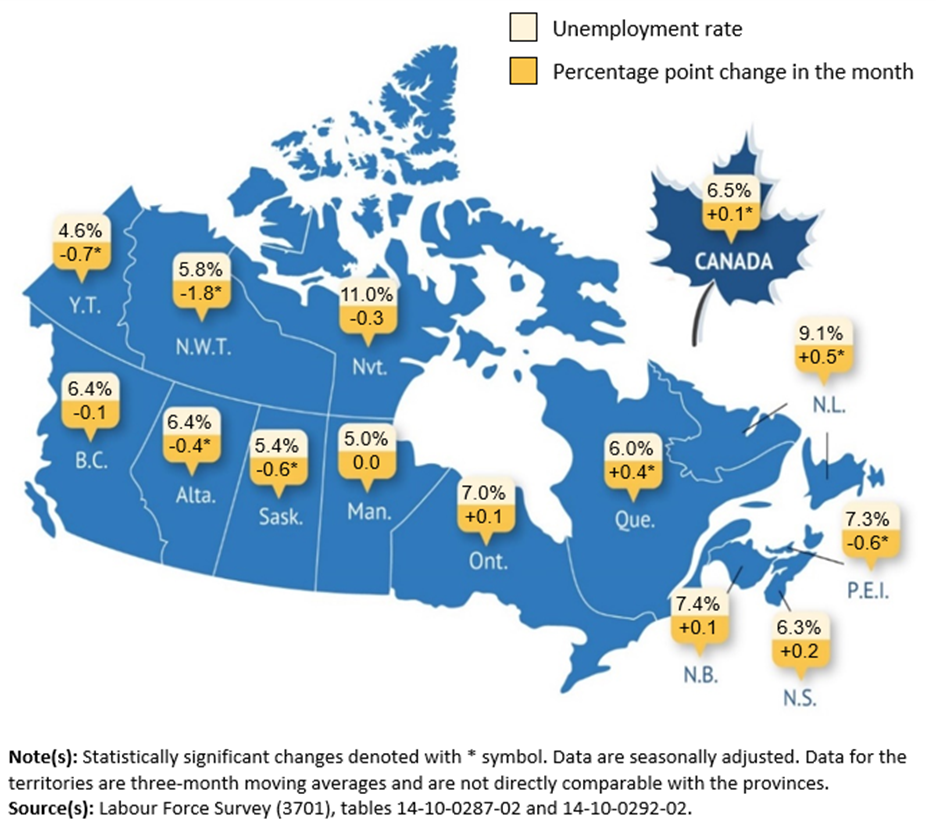
The national figures mask a pronounced provincial split. Quebec shed 49,000 jobs in September – extending a slide that has cost the province 130,000 positions since January, with its unemployment rate rising to 6.0 per cent. British Columbia lost a further 20,000 positions. Alberta moved in the opposite direction, adding 23,000 jobs and is up 76,000 positions, or 2.9 per cent, year over year, according to StatCan.
Hencic attributes the divergence to two forces working simultaneously, calling Alberta “the strongest job market, arguably, in Canada.”
“High energy prices, as a rule of thumb, are good for energy producers and good for energy-producing regions, – your Alberta, your Saskatchewan, your Newfoundland,” says Hencic. “Whereas the trade frictions with the United States in particular are hitting home harder in Quebec and Ontario, to use two big examples.”
Earlier this year, analysts mapped the Canadian labour market outlook for 2026 around stability rather than strength – a forecast that holds with the September data, though conditions have slipped further than pre-release forecasts anticipated.
“The labour market’s kind of treading water, given what the next few months might hold for the economy,” says Hencic. “It’s more of a case of hanging in rather than really showing its mettle.”
Kavcic believes the back-to-back monthly job declines and rise in the unemployment rate should be kept in context.
“If you can look through two months of bad reports and look back over the last six and 12 months, we’re creating on net basically the number of jobs we need to keep the job market stable in a world where there’s very low labour force growth,” he says. “From that perspective, things are pretty neutral still.”