Treasury Board data shows most federal workers exiting through workforce adjustment are choosing cash payouts tied to years of service

More than 2,500 federal public servants have been accepted for voluntary departures since Ottawa began issuing workforce adjustment notices, according to Treasury Board of Canada Secretariat (TBS) data current as of Oct. 14, 2026.
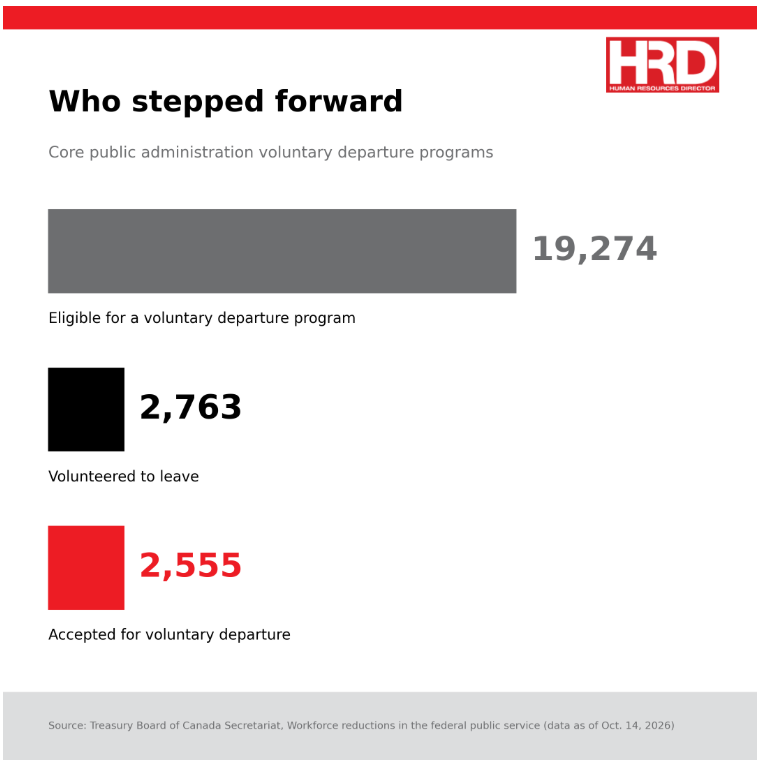
The TBS workforce reductions tracker shows 2,763 employees volunteered to leave the core public administration (CPA) through voluntary departure programs (VDPs), and 2,555 were accepted.
The departures support the Comprehensive Expenditure Review (CER) in Budget 2025. TBS says the review will cut an estimated 16,000 full-time equivalents over three years as Ottawa works toward a public service of about 330,000.
Cash payouts dominate voluntary departure choices
Departments must offer a VDP when five or more employees at the same group and level in a work unit are told their jobs may be affected, TBS states. Volunteers have 30 days to choose an option.
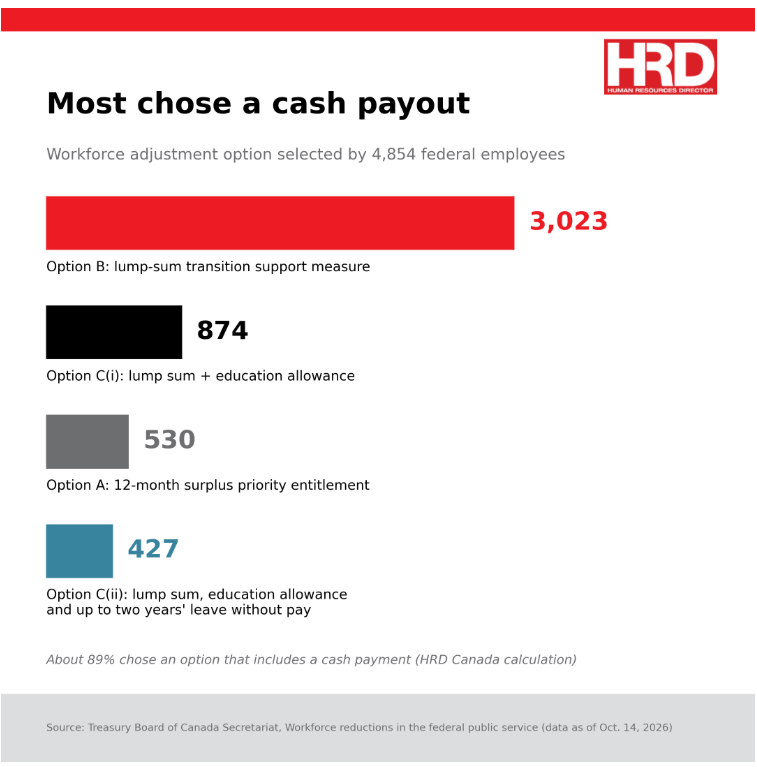
Of the 4,854 employees who have chosen, 3,023 took Option B, a transition support measure (TSM) that pays a lump sum based on years of service, TBS data shows. Another 874 paired the TSM with an education allowance, and 427 added up to two years of leave without pay. Only 530 chose a 12-month paid entitlement to seek another public service job. About 89% of those who chose opted for a cash payment.
A further 986 employees left through alternation, swapping places with willing colleagues in unaffected roles, according to TBS.
Layoff selection fills the gap
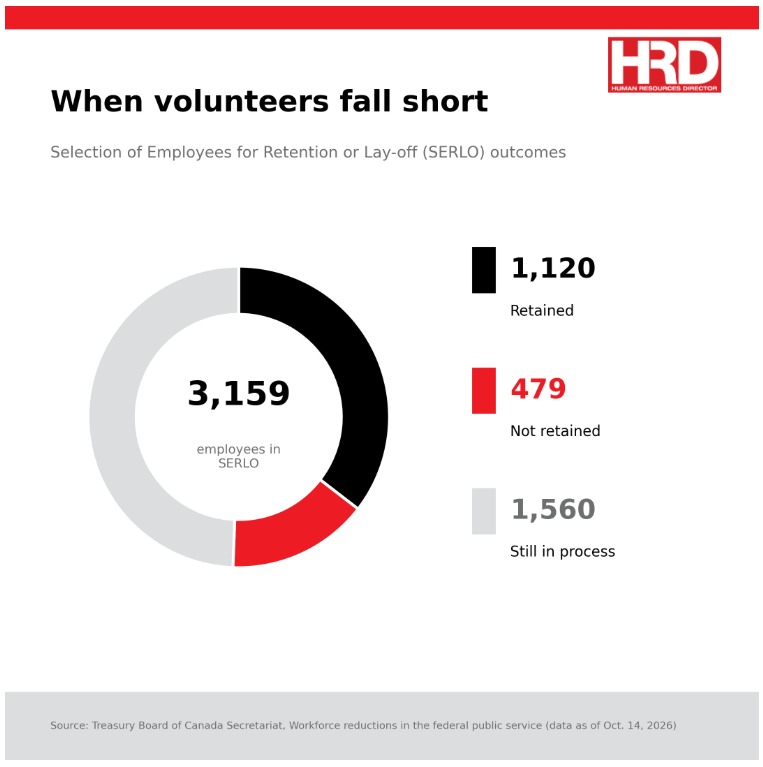
Where volunteers fall short, departments use the Selection of Employees for Retention or Lay-off (SERLO) process. Of 3,159 employees in SERLO, 1,120 were retained, 479 were not and 1,560 are still in the process, TBS reported.
Departments have also sent an estimated 25,368 affected letters to employees, against 17,977 non-executive positions identified for elimination, according to TBS. Employment and Social Development Canada (ESDC) faces the deepest reduction at 5,313 positions.
Unions say the burden is uneven. The Ottawa-based Public Service Alliance of Canada (PSAC) said in August 2026 that 71% of its 14,000 members who had received workforce adjustment letters were women. National president Sharon DeSousa said the findings show “a disproportionate impact on women workers,” CP24 reported.
Early retirement draws larger numbers
Ottawa’s other voluntary route has drawn far more takers. The Early Retirement Incentive (ERI) lets eligible employees retire with an immediate pension. It waives the roughly 5% annual reduction that normally applies, according to TBS figures reported by Benefits and Pensions Monitor.
After the early retirement offer drew more than 7,000 applications, and with nearly 9,500 public servants applying for early retirement as confirmations began, TBS received 10,006 applications by the July 24, 2026 deadline. As of Oct. 13, 2026, 9,694 had been confirmed, CTV News Ottawa reported, citing TBS. Approved employees must retire by Jan. 20, 2027.
Mohammad Kamal, a spokesperson for Treasury Board President Shafqat Ali, told CTV News Ottawa that participation is “entirely voluntary.”
Unions dispute the voluntary framing
Unions see it differently. The Professional Institute of the Public Service of Canada (PIPSC) filed a policy grievance in April 2026. It said employees were being pushed to “make irreversible career decisions without the full information or agreed safeguards,” CTV News Ottawa reported. PSAC, which filed its own grievance in March 2026, said any policy to prevent involuntary layoffs “must be negotiated, lawful, and protect workers’ rights,” CP24 reported.
For HR leaders, the data shows how strongly affected employees favour certainty. Confirmed early retirements are nearly four times the voluntary departures accepted, and most workforce adjustment choices ended in a cash settlement.
Headcount had already fallen by more than 12,600 between March 2025 and March 2026, Treasury Board data shows, even as applications for federal public service jobs fell nearly 30%.