Which provinces are seeing the biggest loss of private sector jobs?

Canada’s private employers created far fewer jobs than their U.S. counterparts between 2019 and 2024 once population growth is factored in – leaving fewer private-sector roles for a fast-growing workforce and more pressure on output per hour, according to a study.
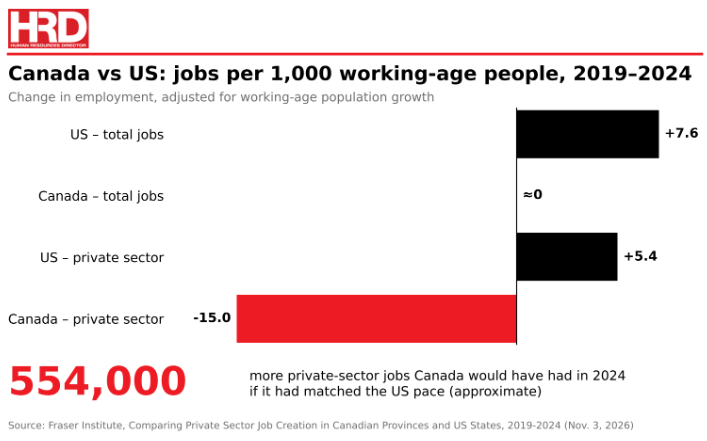
The Fraser Institute report found U.S. private-sector employment rose by about 5.4 jobs per 1,000 working-age people over the period. In Canada, it fell by roughly 15.
That decline carries a real economic cost. It represents a 1.5-percentage-point drop in Canada’s private-sector employment rate – roughly 407,000 fewer private-sector jobs in 2024 than if the 2019 rate had held, the authors calculated. They argue the private sector is the main engine of the investment, production and productivity growth that lifts incomes and living standards.
“Despite political rhetoric, Canada has performed poorly compared to America in creating private-sector jobs,” said Ben Eisen, senior fellow at the Fraser Institute and co-author of the report with senior economist Nathaniel Li.
Stronger employment growth among G7
Ottawa’s 2024 Fall Economic Statement touted 7.4% employment growth since 2019, the strongest in the Group of Seven (G7). Adjusted for population growth, the Fraser authors found that per 1,000 working-age residents, total Canadian employment was essentially flat, while the U.S. added 7.6 jobs.
Excluding public-sector hiring widens the gap. Government jobs grew far faster than private-sector jobs in most provinces. Had Canada matched the U.S. pace, it would have had approximately 554,000 more private-sector jobs in 2024, the study estimated.
Small employers say the weakness persists. In October 2026, 22% of small firms planned to lay off staff and only 11% planned to hire – the weakest net staffing intentions since the pandemic, according to the Canadian Federation of Independent Business (CFIB). Average planned wage increases sat at 2.2%. Monthly data has been mixed, from Canada adding 75,000 jobs in July 2026 to economists’ view that Canada’s labour market is hanging in.
Provinces lag their US neighbours
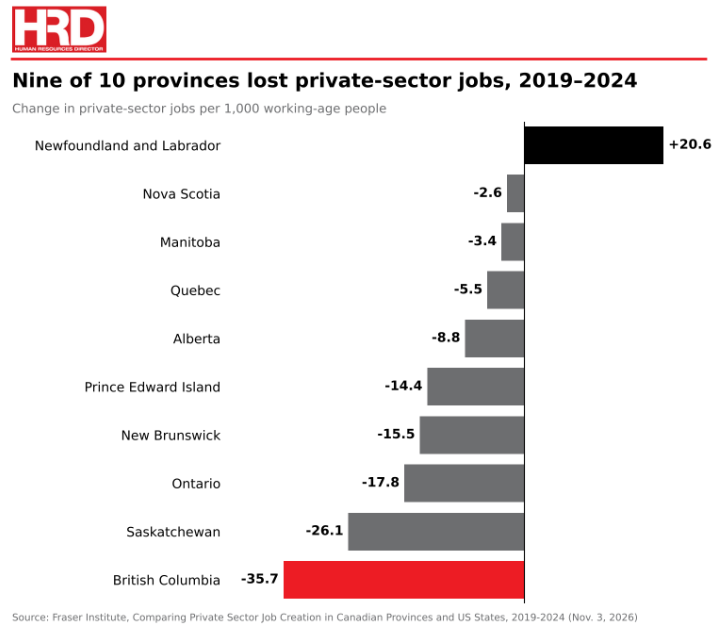
The national shortfall shows up in almost every province. Nine of 10 lost private-sector jobs per 1,000 working-age people over the five years, the report found. British Columbia fared worst at 35.7, followed by Saskatchewan (26.1) and Ontario (17.8).
Newfoundland and Labrador was the lone exception, adding 20.6.
Ontario ranked last among 10 Great Lakes jurisdictions, and British Columbia’s decline was more than double that of Washington, the next-weakest of its western U.S. peers.
How productivity compares in Canada and US
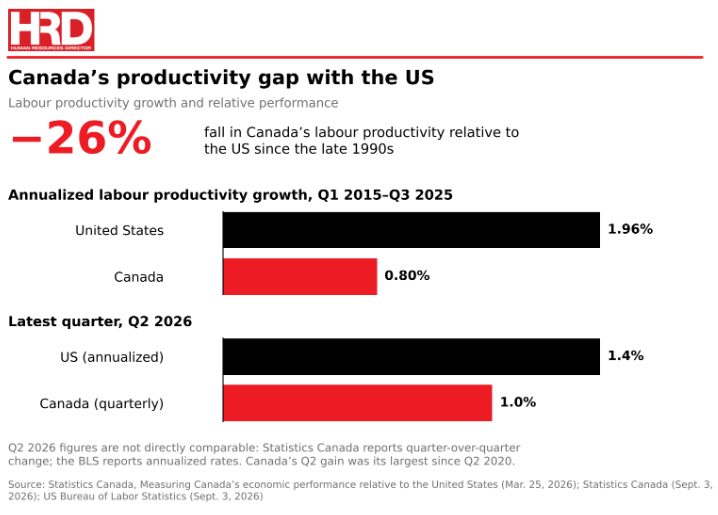
Weak private hiring mirrors a deeper productivity problem. Labour productivity – the value of goods and services produced per hour worked – has fallen 26% in Canada relative to the U.S. since the late 1990s, according to a March 2026 Statistics Canada report. Between early 2015 and late 2025, Canadian output per hour grew at an annualized 0.80%, compared with 1.96% in the U.S.
Report authors Carter McCormack and Ryan Macdonald concluded that “the relative decline in productivity growth is the principal reason why Canada is falling behind, regardless of how economic performance is measured.” They also warned that without productivity growth, real wages and living standards can stagnate.
Firm size helps explain why. Statistics Canada’s December 2025 research found slower productivity growth among Canada’s large firms contributed most to the widening gap. “Small firms may be where the ideas come from, but until they scale into big firms we won’t get the productivity gains we desire,” Jeremy Kronick, president and CEO of the C.D. Howe Institute in Toronto, told The Hub.
The latest quarter brought improvement. Canadian business-sector productivity rose 1.0% in the second quarter of 2026, Statistics Canada reported, reversing declines outlined in our report on Canadian productivity falling again as labour costs rise. In the U.S., nonfarm business productivity grew at an annualized 1.4% in the same quarter, according to the U.S. Bureau of Labor Statistics (BLS) – an annualized rate not directly comparable with Canada’s quarterly figure.
What can employers do to close the gap?
Much of the fix lies inside the workplace. Canada’s high levels of education have not fully translated into productivity gains, according to Reviving Productivity Growth in Canada, a review by the Organisation for Economic Co-operation and Development (OECD). Canada has one of the highest rates of over-qualification in the OECD, with many workers in jobs that do not require their level of education. The OECD estimates that labour market mismatch explains about 15% of the productivity gap between Canada and the best-matched countries.
Training is a second lever. In 2023, only 19% of Canadian businesses provided information and communications technology (ICT) training to staff, compared with more than 35% in top-performing countries, the OECD found. Canada also has the largest training gap between older and younger workers among OECD countries, and employees of small firms are far less likely to receive training.
For smaller employers with limited budgets, the OECD points to partnerships with larger firms and training providers, along with subsidies or tax credits to lower costs. It also flags investment as a weak point: too much Canadian capital has flowed into real estate rather than machinery, intellectual property and other assets that raise worker productivity.