Is AI uptake slowing down in Canada?

Business optimism among Canadian employers held steady through summer 2026, but new national survey data suggest human resources (HR) leaders should not read that stability as a signal to add staff.
Nearly three-quarters (72.6%) of businesses were very or somewhat optimistic about the next 12 months in the third quarter, according to Statistics Canada's Canadian Survey on Business Conditions. The Bank of Canada's Business Outlook Survey, released Oct. 19, 2026, also found sentiment improved, yet "firms' hiring intentions remain soft, and most firms plan to keep headcounts unchanged."
The third-quarter reading compares with 72.3% in the first quarter and 66.8% in the second, which Statistics Canada described as similar. The July 2 to Aug. 6, 2026, survey is the final edition of one businesses have answered since 2020.
Sales expectations cooled: only 14.5% expected higher sales over the next three months, down from 19.4%.
Bank of Canada interviews with about 100 firms put employment intentions below their historical average.
Fewer firms expect cost obstacles
The share of businesses anticipating cost-related obstacles fell to 59.8% from 64.3% in the second quarter, Statistics Canada said. Inflation topped the list at 41.6%.
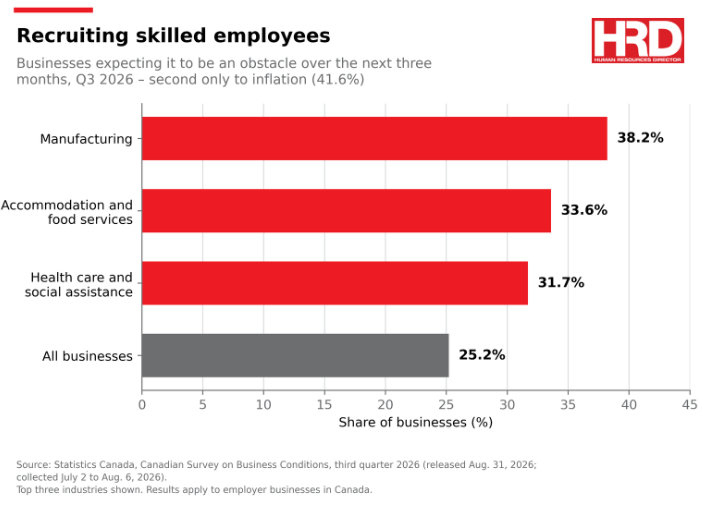
Recruiting skilled employees ranked second at 25.2%, led by manufacturing (38.2%) and accommodation and food services (33.6%) – mirroring how Canadian small business hiring lags as larger employers eye growth.
The Bank of Canada found shortages concentrated in skilled trades and specialized technical roles, while one-tenth of firms said attracting and retaining workers was lifting expected wage growth.
Tariffs weigh on one-third of businesses
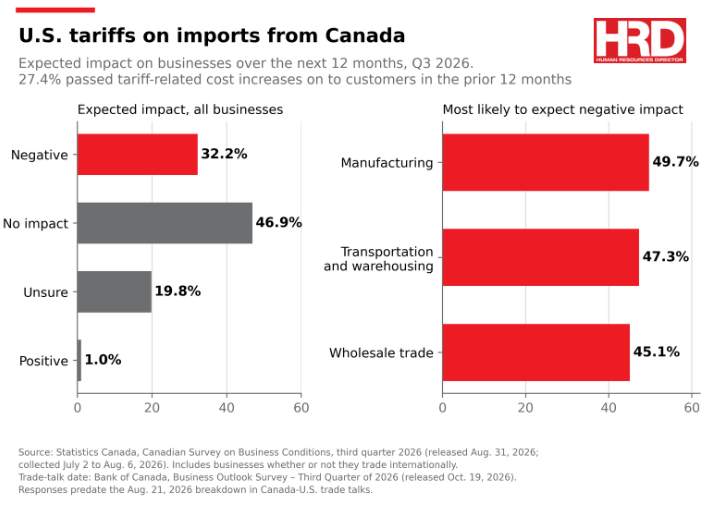
Nearly one-third of businesses (32.2%) expected U.S. tariffs on Canadian goods to hurt them over the next 12 months, led by manufacturing (49.7%) and transportation and warehousing (47.3%). Over the prior year, 27.4% had passed tariff costs on to customers.
Those responses predate the Aug. 21, 2026, collapse of Canada-U.S. trade talks; later responses show "a moderation rather than a fundamental shift in firms' outlooks," the Bank of Canada said, though new tariffs are "putting upward pressure on costs and prices."
HRD Canada has reported how tariffs pressure slows Canada's 2027 growth forecast.
Most businesses have no plans to use AI
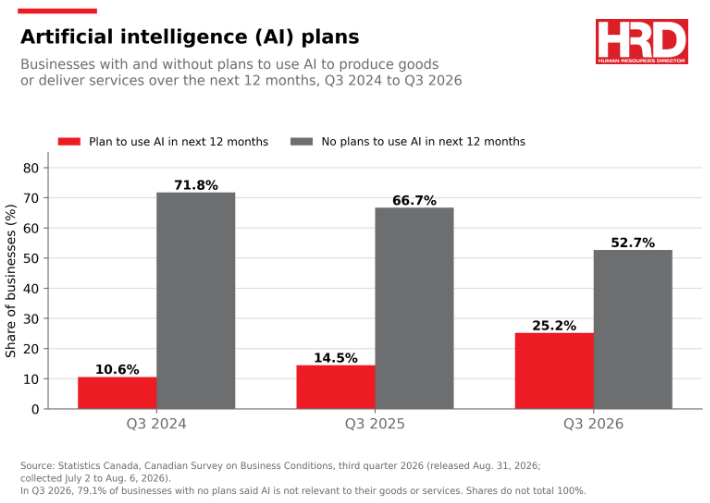
One-quarter of businesses (25.2%) plan to use artificial intelligence (AI) over the next 12 months, up from 14.5% a year earlier, Statistics Canada said. But 52.7% have no plans, and 79.1% of those said AI was not relevant to their work.
Claire Fan, senior economist at Royal Bank of Canada (RBC), wrote Oct. 19, 2026, that firms "are increasingly investing in AI-embedded automation to improve efficiency and offset higher costs, enabling them to meet demand increases without expanding headcounts."
An April 22, 2026, Statistics Canada study by Jiang Li of Innovation, Science and Economic Development Canada and Huju Liu of Statistics Canada, using 2019 and 2021 data, found adopters' 16.8% productivity advantage fell to an insignificant 5.1% once prior productivity and complementary investments, including employee technology training, were factored in.
For HR, that makes training budgets part of AI workforce planning, not an afterthought. "The objective isn't to turn every employee into a data scientist. It's to ensure every employee can be an informed, ethical, and effective user of AI in their role," Erin Polcyn Sailer, board chair of Chartered Professionals in Human Resources (CPHR) Canada, told HRD Canada in a June 2026 report on why the people side is the real barrier to AI adoption.