TD report looks at issues of capability, cost and speed in evaluating prospect of job apocalypse

HR leaders bracing for an AI job apocalypse should be watching their hiring pipelines more closely than their layoff lists, according to a TD Economics analysis.
"A large-scale, AI-driven 'job apocalypse' requires several conditions to align simultaneously, and current evidence suggests those conditions have yet to materialize," write Rannella Billy-Ochieng', senior economist, and Thomas Feltmate, director and senior economist, at TD Economics in Toronto.
The report focuses on the United States, which TD calls a frontier for artificial intelligence (AI) adoption and a signal of what lies ahead for lower-adoption countries.
AI job apocalypse requirements
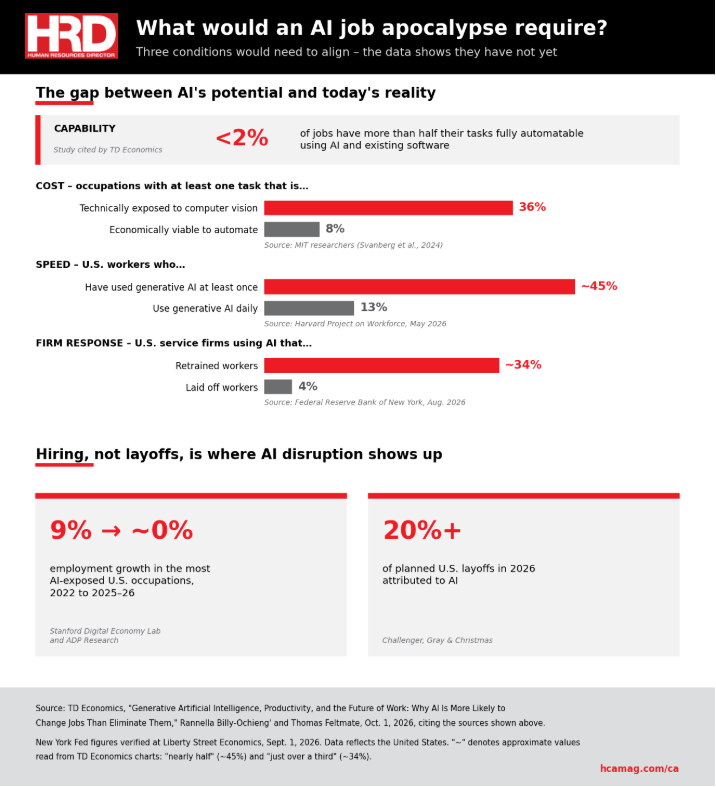
The first condition is capability. Data from Model Evaluation and Threat Research (METR) shows leading AI models completing longer software tasks reliably, but TD cautions that coding gains do not carry over easily to work involving judgment, tacit knowledge and interpersonal skills. One study cited by TD estimates fewer than 2% of jobs have more than half their tasks fully automatable.
The second is cost. Researchers at the Massachusetts Institute of Technology (MIT) found 36% of occupations had at least one task technically exposed to computer vision, but only 8% had a task economically viable to automate at scale.
The third is speed. The Harvard Project on Workforce's generative AI adoption tracker found nearly half of U.S. workers had used the technology at least once, but only 13% used it daily as of May 2026.
Hiring, not layoffs, is where AI disruption shows up
TD finds little aggregate disruption, but in the most exposed U.S. occupations, employment growth has slowed from nearly 9% in 2022 to close to zero, based on Stanford Digital Economy Lab and ADP Research data.
AI was cited in about 24% of U.S. job cuts announced through July 2026, according to Challenger, Gray & Christmas. "Hiring has also increased over last year by 25%, so while AI is shifting the labor market, it is not dismantling it," says Andy Challenger, workplace expert and chief revenue officer at the Chicago-based firm.
In August 2026 regional surveys, the Federal Reserve Bank of New York found just over a third of service firms using AI had retrained workers, while 4% had laid staff off.
What the AI job outlook means for Canadian employers
Among Canadian businesses using AI, 89.4% reported no change in employment after implementation and 38.9% trained staff to use it, according to a Statistics Canada survey from the second quarter of 2025.
Michelle Alexopoulos, external deputy governor at the Bank of Canada in Ottawa, said in May 2026 it had seen no widespread evidence of AI replacing workers, as covered in HRD Canada's report that the Bank of Canada sees limited AI-related job losses. "This reinforces the view that AI will mostly transform jobs – not eliminate them," she said, according to The Canadian Press.
The Conference Board of Canada is less optimistic, projecting AI could cost Canada 555,000 jobs by 2030 before rebounding. Yet a Mercer survey of 462 organizations found just 1% cited AI for reduced hiring, as detailed in our coverage of how AI is affecting hiring plans in Canada.
"While AI is changing the way many employees and companies work, there is still a critical need for human beings to use the tools and provide their judgment," says Teresa Palandra, president of Mercer.