Employees can’t find a clear standard to measure fluency in technology, finds Canadian survey

Hiring decisions in Canada may be resting on inflated signals of job applicants’ artificial intelligence fluency, according to a recent report.
Most Canadian workers rate their AI fluency highly, yet far fewer can show they use AI well – and employers increasingly want proof, reports Indeed.
The job board defines AI fluency as the practical ability to use AI tools well and judge what they produce.
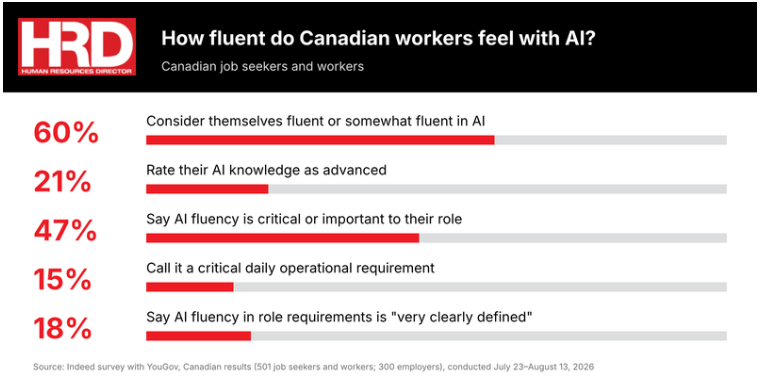
In an Indeed-commissioned YouGov survey of 501 Canadian job seekers and 300 employers, 60% of workers said they were fluent or somewhat fluent, and 21% rated their knowledge as advanced. That was the highest of the four countries studied, which also included the United States, the United Kingdom and France.
Confidence is high, depth of use is not
Other national data show confidence is not competence. Ipsos research for TD Bank Group’s 2026 AI Insights Report found 32% of Canadians admitted overstating their AI abilities at work, while 75% graded their own skills a “C” or lower. Only 37% said their employer provided adequate AI training.
Use is shallower too. Statistics Canada found 35.9% of workers aged 15 to 69 used generative AI tools in their main job in the 12 months to March 2026, but most applied them to only some tasks.
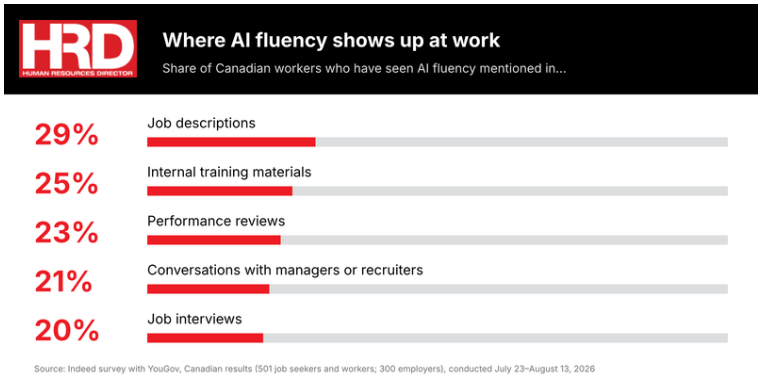
Nor are expectations clear. Among Indeed respondents who see AI fluency in their role requirements, only 18% said it is “very clearly defined,” with specific tools or tasks named – even as 23% of all respondents have seen it raised in performance reviews. The result is a widening AI skills gap in Canada as worker confidence fails to keep pace.
Effective AI use starts with checking the output
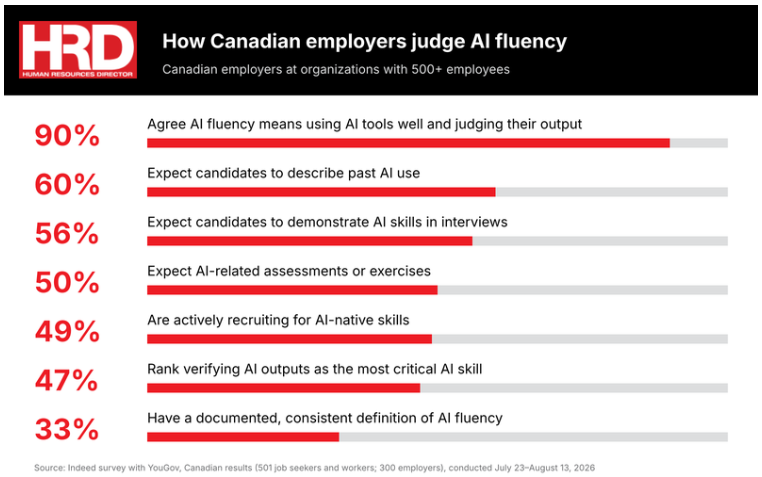
If definitions are vague, employers are clear about one thing: effectiveness depends on judgment. Indeed found 47% of Canadian employers named reviewing and verifying AI outputs for accuracy, quality or bias as the most critical AI skill, the most of any market surveyed.
Nine in 10 employers (90%) backed Indeed’s definition, yet only 33% have documented one consistently across the roles they hire for.
“There’s actually a lot of agreement on what AI fluency means,” said Stepan Arman, Senior Director of Sales, Quebec, at Indeed Canada. “Nine in 10 employers describe it as using AI tools well and judging what they produce. The next step is putting that into writing, since about a third have a consistent definition today. When expectations are clear, it’s easier for both employers and job seekers to know what to aim for.”
Until then, many employees are left to work it out themselves, as workers train AI colleagues without HR support.
What should HR leaders do about AI fluency?
Hiring is the first test. Indeed reported that 49% of Canadian employers are actively recruiting for AI-native skills, 60% expect candidates to explain how they have used AI in past roles, 56% want skills demonstrated in interviews and 50% expect AI-related assessments.
“Canadians feel good about their AI skills, and that’s a great place to start,” Arman said. “What we’re hearing from employers is that they’d like to see those skills in action. Many are asking candidates to talk through how they’ve used AI in past roles or show it in an interview, so it helps to come prepared with a real example or two.”
The same discipline can extend beyond recruitment: define effective AI use for each role, put it in writing and assess it consistently in training and reviews. Asking employees how they use AI is a practical start, as the organizations in HRD Canada’s Best Places to Work in Canada: The Listening Advantage special report.