Federal $700-million top-up opens a health and life sciences call for small and mid-sized firms

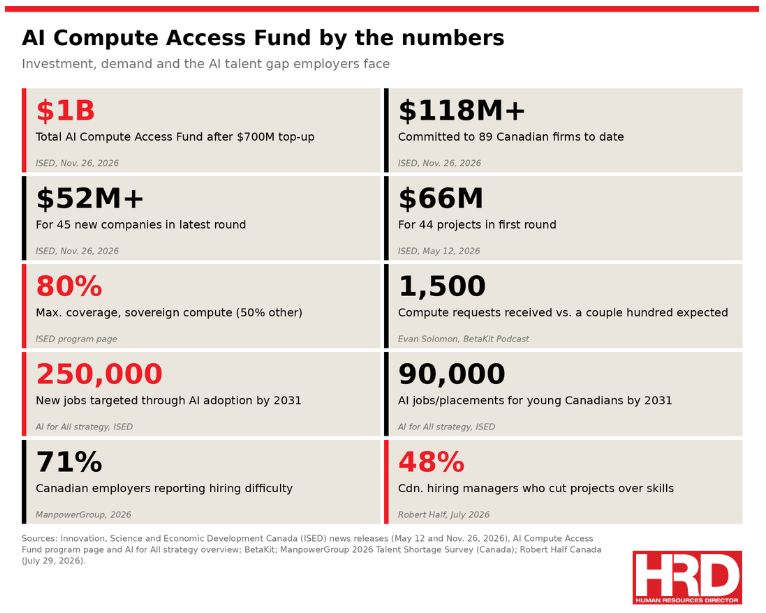
Ottawa has added $700 million to the AI Compute Access Fund, lifting the program to $1 billion and opening a new round of support for Canadian companies building artificial intelligence products at home.
Evan Solomon, Minister of Artificial Intelligence and Digital Innovation, announced the expansion on Nov. 26, along with more than $52 million for 45 additional companies, according to Innovation, Science and Economic Development Canada (ISED). The awards bring total commitments to more than $118 million across 89 Canadian firms.
"Canadian companies are developing AI that can help detect disease earlier, improve access to home care, and keep critical networks running," Solomon said in a statement quoted by BetaKit. "By encouraging more companies to use Canadian computing providers, we are also helping create the demand that supports investment in infrastructure owned, operated, and governed in Canada."
The expansion also launches the fund's first targeted call, aimed at health and life sciences, which ISED said backs AI that can speed research, improve patient outcomes and strengthen health system performance.
What changes under the expanded AI Compute Access Fund?
The bigger budget brings richer terms for companies that buy Canadian. The fund now covers up to 80% of eligible costs when small and medium-sized enterprises (SMEs) use a sovereign compute provider – one that is Canadian-owned and governed in Canada – up from two-thirds previously, according to ISED's AI Compute Access Fund program page.
By contrast, providers that operate in Canada but are not Canadian-owned qualify for up to 50%. Funding may be non-repayable, conditionally repayable or repayable, decided during assessment, ISED said.
Projects must involve compute costs between $100,000 and $5 million. Applicants have until Dec. 17, 2026, to file a statement of interest, with full applications due Jan. 4, 2027.
Demand outran the original $300 million
Those terms follow a budget that ran out fast. The fund launched in March 2025 with $300 million under Canada's Sovereign AI Compute Strategy.
Its first major round came on May 12, 2026, when Solomon announced $66 million for 44 projects, assessed on technical feasibility, commercialization potential, risk and benefits to Canada, according to ISED.
"We thought … we'll get a couple hundred people who need compute; [we got] 1,500 asks," Solomon said on The BetaKit Podcast, explaining the top-up.
Where the AI jobs and talent will come from
That demand raises a question for employers: who will do the work? ISED has not estimated how many jobs the fund itself will create. The fund now sits under Canada's National Artificial Intelligence Strategy: AI for All, which aims to help create up to 250,000 new jobs through AI adoption by 2031, including up to 90,000 AI-related jobs and work placements for young Canadians.
Filling those roles will be hard. ManpowerGroup's 2026 Talent Shortage Survey of 39,000-plus employers in 41 countries ranked AI skills hardest to find; 71% of Canadian employers reported hiring difficulty.
Robert Half's results point the same way: 48% of more than 1,360 Canadian hiring managers said they had cancelled projects for lack of skills, according to findings released in July 2026.
"Finding professionals with specialized, in-demand skills remains a challenge for many organizations, and employers are increasingly seeking flexible ways to address talent gaps," said Koula Vasilopoulos, senior managing director at Robert Half Canada in Toronto.
The funding adds to existing pressure on employers hiring for AI roles. HRD Canada has reported that employers are offering up to 15% salary premiums for AI-skilled staff, and that AI tools are slowing hiring and adding pressure on HR teams. The Compute Access Fund is one of several federal compute measures, alongside the recent opening of applications for Ottawa's AI supercomputing program.