Canada’s falling on the global innovation index. The answer may lie in how organizations move their people

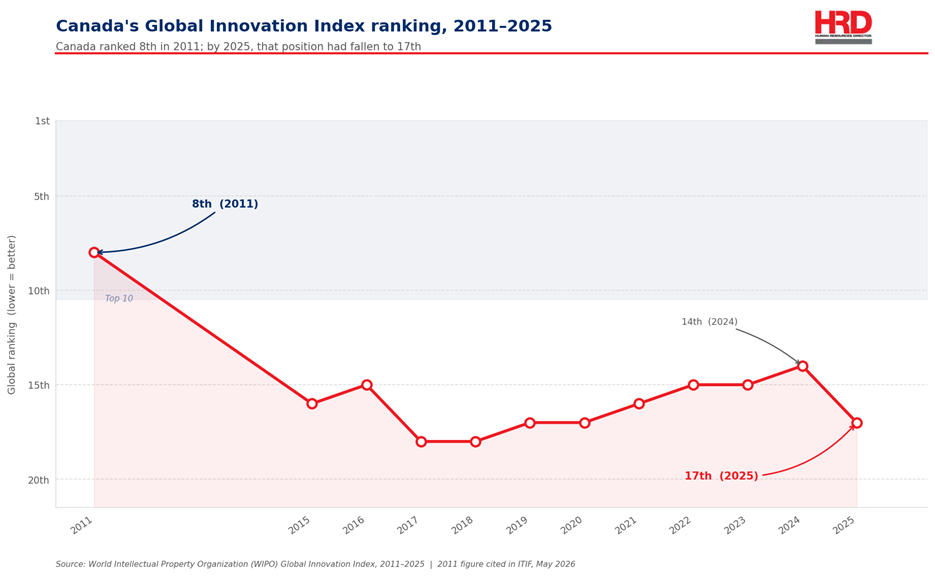
Canada’s innovation trajectory has been moving in the wrong direction. The Organization for Economic Co-operation and Development’s (OECD) June 2026 review, Reviving Productivity Growth in Canada, found that the country’s productivity growth has fallen to one of the lowest levels in the developed world. The World Intellectual Property Organization (WIPO) Global Innovation Index, meanwhile, ranked Canada eighth among the most innovative nations in 2011; by 2025, that ranking had slipped to 17th, according to a May 2026 analysis by the Information Technology and Innovation Foundation (ITIF). Global mobility is part of the solution – and the opportunity may be more accessible than most organizations assume, according to Vanessa Ribreau, Chief People Officer at Safe Software in Vancouver.
The connection between international exposure and innovation is personal before it’s strategic, says Ribreau. Originally from France, she has lived and worked in the U.K., relocated to Canada, and moved between coasts – each transition broadening the way she sees and solves problems.
“When you expand your horizon, when you expand into new markets, you see things being done differently, and you’re just better at the end of the day,” says Ribreau. “You make better decisions because you have different perspectives, different inputs, and you’re exposed to different ways of doing things.”
International exposure narrows Canada’s productivity and innovation gap
The evidence at an organizational level supports that instinct. The OECD’s 2024 report FDI Qualities Review of Canada: Accelerating Inclusive and Sustainable Growth found that Canadian multinationals exhibit narrower productivity and innovation performance gaps than their domestic counterparts, attributing the advantage to greater access to trade networks, advanced technologies, and innovation exposure. International integration through global value chains, the review noted, leads to productivity enhancements and access to knowledge, technology and skills that domestically focused firms can’t match, leaving Canada’s productivity lagging behind many other countries.
Ribreau’s organization is expanding operations into new markets after decades in Canada and Ribreau believes the most common failure of international expansion is treating new markets as either carbon copies of headquarters or entirely separate operations.
“What you don’t want is a completely different operation, but you don’t want the same way of operating either,” she says. “People who have been closer to the product or the headquarters know it really well, but they don’t have all the answers because it’s a new market and there are new things to discover. Having global mobility is when you can actually bridge that gap.”
Moving from transactional to strategic mobility
The challenge in Canadian organizations is that global mobility programs have rarely been positioned to do that bridging work. The 2026 Global Mobility Survey, published by the Canadian Employee Relocation Council (CERC) and drawing on responses from 28 organizations across finance, natural resources, and transportation, found that while HR manages 50 per cent of corporate mobility programs, the majority of those teams’ time remains concentrated on operational tasks and compliance management rather than strategic workforce planning and talent development in Canada. The OECD’s June 2026 review made the case for change directly, identifying worker-oriented policies – specifically skills development, job mobility and structural adaptability – as central to reversing Canada’s productivity decline.
Stephen Cryne, President and Chief Executive Officer of CERC in Toronto, has a name for the structural problem: mobility managed off the side of somebody’s desk.
“Small teams are stretched – they’re supporting complex multi-regional programs, and the value of that is not often seen inside the organization,” says Cryne. “It’s a challenge. It’s going to take some time. But that shift is already underway.”
The cost of that invisibility extends well beyond internal influence. International assignments can run to tens of thousands of dollars per employee when relocation, housing, and support costs are factored in. A failed assignment – one where the employee has a poor experience and leaves – doesn’t simply waste that investment, according to Cryne.
“They take that knowledge and that skill set often to a competitor,” he says.
Making the case to the C-suite
The formula for avoiding that outcome starts with how HR frames the internal conversation, says Cryne, who believes the return-on-investment case for global mobility can’t be built on cost containment alone.
“If it’s focused just on money, it doesn’t go very well – they really have to show that the purpose of the assignment or the relocation is going to drive the mission of the company. They have to be aligned,” he says. “One of the things we talk a lot about is stories – telling the story about how you had a successful assignment and what the outcome of that was, and then showcasing that against how a poor assignment was run and what were the implications of that.”
Ribreau’s experience of that conversation reflects a different kind of institutional culture – one where the value of mobility is assumed at the leadership level, shifting the conversation from justification to execution.
“The CEOs I work with value people being mobile,” she says. “As we expand into those new markets, we would welcome people based in Vancouver if they want to relocate to those new regions.”
In practice, she has found that short-term trial assignments reduce friction on both sides. “What I did in the past is often assignments for both parties to be able to assess, how is it working for you? How is it working for us? Is it a long-term thing? You go with more of a trial approach,” she says.
What the data says about where mobility is headed
The CERC survey points to a directional shift away from compliance and employee support and toward providing strategic support to leaders and greater involvement in workforce planning, with increased investment in measuring return on investment through data analytics. The shift in capability expectations is substantial: 79 per cent of surveyed organizations identified technology and AI as essential future skills for mobility professionals.
Cryne draws on a macro-level figure to anchor the longer case. He points to a widely referenced 2011 analysis by the Partnership for a New American Economy that found 40 per cent of Fortune 500 companies at the time were founded by immigrants or children of immigrants. The OECD’s June 2026 review reinforces the argument, finding that the productivity slowdown is concentrated in Canada’s frontier firms and raising explicit concerns about the international diffusion of new technologies – the very transfer of knowledge that mobile talent makes possible.
“It’s a capability shift, and mobility teams are being asked to influence where, why, and who decisions – not just managing the how,” he says. “Mobility is shifting to becoming a strategic business imperative, and that’s expected to nearly double in the next two years.”
Ribreau frames the human version of that same argument. The employee who has lived and worked across borders already understands, at a level no onboarding program can replicate, what will resonate in a new market and what won’t, and can bring knowledge from abroad into the organization. For Canadian HR professionals navigating a shifting global talent landscape and figuring out what they can do about Canada’s productivity crisis, that understanding may be among the most valuable assets an organization can build.
“It brings you more agility,” she said. “You know what will land in those markets and what won’t land, because you went through it.”
Cryne believes that for Canadian organizations, the key to driving innovation through global mobility is awareness. “It's identifying and understanding that diversity brings new ideas and innovation that make a valuable contribution to organizational success and, frankly, our country's future productivity,” he says. “We want to bring the brightest and the best that can share their knowledge and ideas and drive our economy forward.”