Ontario employment rates lag pre-COVID levels in four of five regions, finds study

Human resources (HR) leaders hiring in Eastern and Northern Ontario are recruiting from the province’s oldest and least active labour pools, where fewer working-age residents are either employed or looking for work, according to a Fraser Institute study released Oct. 14, 2026.
Ontario employment rates in four of the province’s five regions remained below 2019 levels in 2025, the Vancouver-based public policy think-tank found. Only Southwestern Ontario finished higher, at 0.6 percentage points above its pre-pandemic mark.
“In almost every corner of the province of Ontario, economic pain persists with the employment rate – a key measure of an economy’s strength – still not having recovered to pre-pandemic levels,” said Jake Fuss, director of Ontario prosperity studies at the Fraser Institute and co-author of The Five Solitudes of Ontario: A Regional Analysis of Labour Market Performance Since 2015.
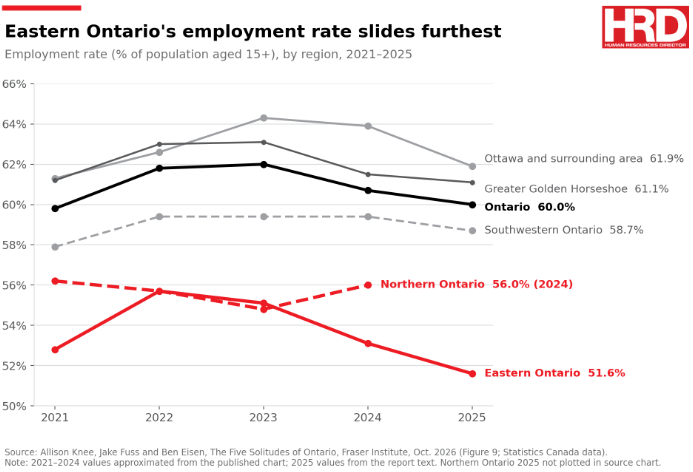
Regional gaps in Ontario employment rates
Eastern Ontario’s employment rate fell from 53.6% in 2019 to 51.6% in 2025, the steepest drop. Ottawa and the surrounding area declined from 63.8% to 61.9%, and the Greater Golden Horseshoe (GGH) from 63.0% to 61.1%. Northern Ontario was 0.1 points below its 2019 level. The provincial rate slipped from 61.6% to 60.0%, the report found.
“Ontario is an enormous jurisdiction and given the economic and demographic dominance of the Greater Golden Horseshoe area, provincial-level statistics often mask what’s really going on in each of Ontario’s distinct regions,” Fuss said.
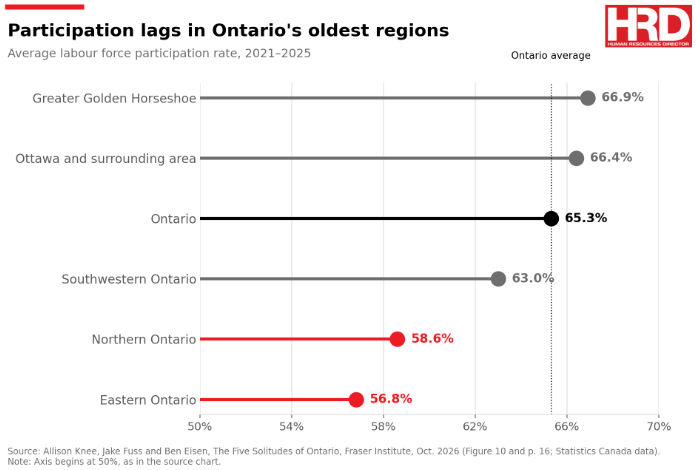
The study, co-written with Allison Knee and Ben Eisen, points to aging as one factor behind weaker results. In 2025, 26.6% of Eastern Ontario residents and 23.0% of Northern Ontario residents were 65 or older, compared with 17.4% in the GGH. Average labour force participation from 2021 to 2025 was 56.8% in Eastern Ontario and 58.6% in Northern Ontario, against 66.9% in the GGH. The authors also cited discouraged workers, skills mismatches and health.
Employers report too few workers
“While local recruitment remains a priority, there are not enough available workers to meet current and projected demand across key sectors,” Jamie Taylor, chief executive officer of the Thunder Bay Community Economic Development Commission, told The Chronicle-Journal in February 2026.
The federal government’s Prosperity and Growth Strategy for Northern Ontario 2025–2030 reports that 68.3% of small and medium-sized enterprises in the region cite a shortage of skilled labour as an obstacle to growth.
Provincial data show Northern Ontario’s unemployment rate rose 0.9 points to 6.3% between the second quarters of 2025 and 2026, while employment was essentially unchanged, according to the province’s April–June 2026 Ontario Employment Report, which uses its own regional groupings.
Federal data point to demographics
Statistics Canada data released Oct. 9, 2026, suggest aging, rather than weaker attachment to work, explains much of the recent national decline. Canada’s participation rate fell to 64.8% in September 2026, its lowest since December 1997 outside of 2020, with the year-over-year decline largely attributed to population aging.
Holding the population’s 2019 age mix constant, the agency calculated participation would be 0.2 points higher than in September 2019.
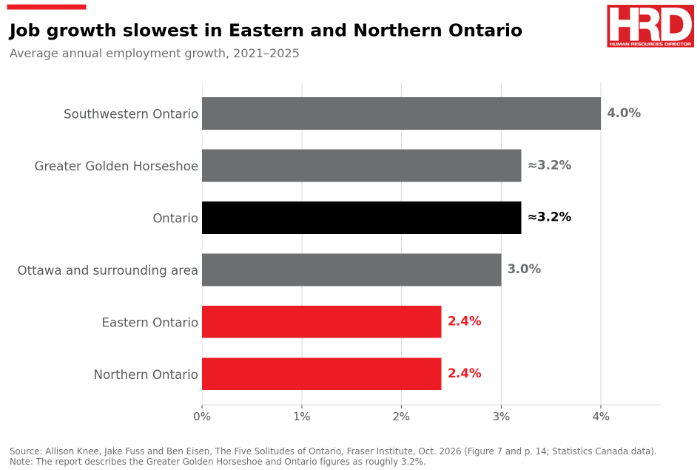
Ontario added 86,000 jobs in the year to September 2026, the agency reported. HRD Canada has previously covered a Statistics Canada study showing the share of older workers in Canada has doubled over two decades.
Sector exposure differs by region
Southwestern Ontario remains the most manufacturing-dependent region, with the sector accounting for 15.0% of jobs in 2024 compared with 10.0% provincially, according to the Fraser Institute. Its employers are operating amid new U.S. tariffs and the federal government’s pledge to defend Canadian workers.
In Ottawa, public administration made up 20.5% of employment in 2024, up from 16.3% in 2015, the study found. HRD Canada has reported on the federal public service shedding more than 12,000 jobs in a single year.
The Fraser Institute authors concluded that policies designed around provincial averages may not suit regions with low participation, older populations or heavy reliance on manufacturing or resource industries.
Holding on to older workers could be the key to addressing organizations’ staffing needs. Phasing out older workers costs “experience, mentorship capacity and practical knowledge,” Myron Liew wrote in Policy Options in July 2026.
Diane-Gabrielle Tremblay’s 2022 Québec surveys found phased retirement would motivate 54% of older workers to stay.