With Canada’s talent pool tightening and immigration in flux, a transactional approach to global mobility is no longer enough

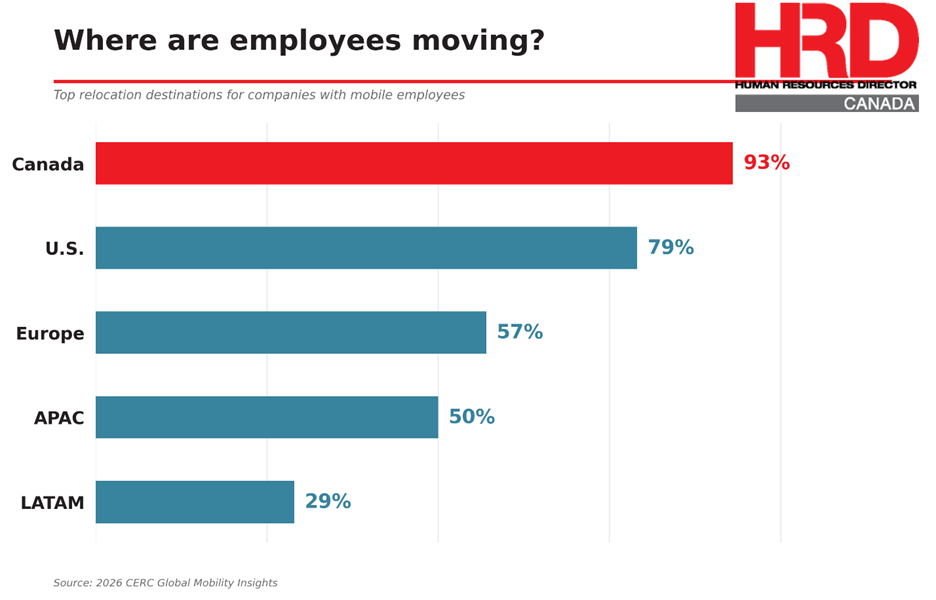
Canada’s mobility professionals spend most of their working time on operational tasks and employee support, according to a recent survey. The 2026 CERC Global Mobility Survey Insights by the Canadian Employee Relocation Council (CERC), which captured input from 28 organizations spanning finance, natural resources, and transportation, found a significant distance between current practice – 50 per cent operate it as a transactional process – and where leaders want their programs to be: a strong desired shift toward strategic involvement in workforce planning, leadership support, and return-on-investment measurement.
As the country confronts a structural talent shortage with few domestic remedies, the window for treating global mobility as a back-office function is closing, according to Stephen Cryne, President and Chief Executive Officer of CERC in Burlington, Ont.
“[Global mobility has] been transactional, but there's this aspiration to develop it into a more strategic business partnership, providing strategic input in the talent management process,” says Cryne.
Canada’s population fell for a third consecutive quarter to start 2026, according to Statistics Canada’s initial estimates, driven by a 20.2 per cent year-over-year drop in permanent immigration, a reduced intake of non-permanent residents, and a birth rate below replacement level. StatCan later revised the numbers to a statistically break-even figure, but Canada recorded its first-ever annual population decline since Confederation in 2025. For 2025/2026, the country experienced its lowest annual total July-to-July population increase since the Second World War and the lowest percentage growth since the First World War.
Global mobility a strategic engine
With demographic changes shrinking Canada’s workforce, immigration and global mobility must be the economic and strategic engine for Canadian organizations, says Cryne. “It’s going to be the only source of population labour force growth that we have for the foreseeable future,” he says.
Canada’s federal investment agenda – infrastructure rebuilding, pipeline expansion, and the green energy transition – is generating demand for workers that the domestic labour market can’t supply, says Cryne, and companies will need immigration and mobility programs – such as the federal government’s Global Talent Stream – to close those gaps.
“If you look at trade and what Canada is trying to do in terms of building trade partnerships with other regions, mobility is critically important to that process,” he says. “You need to have people on the ground making contacts, opening new offices, and making the relationships that are really important in order to get those things off the ground, and that takes people – you can't do it with artificial intelligence and you can't do it remotely.”
Lara Dyer, Chief Executive Officer of Talent Beyond Boundaries Canada, the Ottawa branch of a global organization that helps employers hire skilled workers from the global refugee population, works with employers who have already exhausted domestic options.
“The question isn’t, ‘Do we need immigration?’ but rather, ‘What does that look like and how can companies take advantage of that?’” Dyer says.
Dyer says her organization focuses primarily on regulated professions – healthcare and skilled trades – where labour shortages are most severe. She cautions that international recruitment carries inherent risks: fraud in immigration systems, credential misrepresentation, and retention risk. With qualified partners and planning, most of these can be mitigated, she says.
From cost centre to competitive advantage
The 2026 CERC survey found a clear appetite among mobility professionals to move beyond transactional work. Most teams currently spend the bulk of their time on operational tasks and compliance management. Their desired future focus points elsewhere: strategic support for business leaders, deeper involvement in talent strategy, and data analytics to demonstrate impact. Nearly half of survey respondents see their mobility program developing into a strategic business imperative within two years, and four-in-10 see it as being a strategic management tool by then.
“Companies that just see it as a cost, a transaction, moving somebody from point A to point B, they’re not reaping the real benefits of what mobility can deliver, frankly,” says Cryne. “Companies that take the view that relocation and mobility is a strategic part of their growth, I think that they're further ahead of the game – they're developing their talent and they're using these opportunities to grow their talent pipeline.”
Those benefits run deeper than filling vacancies. Organizations that embed mobility into their leadership development frameworks see returns that transactional relocation can’t replicate, says Cryne. “Global mobility is used to develop future leaders. Companies look for leaders that have global savvy, global experience that they’ve built up over the years,” he says. “So it really does build a better talent pipeline.”
Cryne estimates that roughly half of Canadian organizations still approach mobility as a transaction, consistent with the 2026 CERC survey’s findings. About 50 per cent of mobility programs are managed within HR functions, with 39 per cent overseen by total rewards teams, according to the survey. However, there’s growing interest in measuring ROI across CERC’s membership, according to Cryne – spanning financial returns, leadership development metrics, and retention outcomes.
The appetite for change differs by organizational size. Large multinationals tend to manage international mobility well, often driven by necessity, while small owner-operated businesses rarely have the labour shortages or HR infrastructure to look internationally, according to Dyer. “It’s really those in the middle that know they need to grow or want to grow, and probably don’t have a large HR team to help them figure that out,” she says.
Navigating policy and geopolitical risk
For organizations moving talent across the Canada-U.S. border in particular, structural obstacles compound the challenge. The Canada-United States-Mexico Agreement (CUSMA) governs cross-border professional movement through the Trade National (TN) visa in Chapter 16 – a list CERC has been pushing to have rewritten. “The occupations that are included in that visa are woefully outdated,” Cryne says, pointing to a CERC survey conducted in June on Canada-U.S. labour mobility, which found persistent operational difficulty.
Cryne believes that the trade tensions between the two countries hasn’t significantly reduced the desire for worker mobility, but it’s becoming more difficult to actually cross the border. “Some of the business that has been lost because of the tariffs, that's probably reduced [mobility] in certain industries, but there's no reluctance, I would say, on the part of Canadian or U.S. companies to keep that pipeline open,” he says. “You cannot have trade without the movement of talent, but the challenge is getting people across the border – there’s a lot of ambiguity in the decision-making, particularly on the U.S. side, and we found challenges there.”
Geopolitical unrest has added further complexity. Instability in parts of Europe and the Middle East has elevated duty of care to a frontline HR responsibility and a potential compliance blind spot with mobility – a lesson reinforced during the COVID-19 pandemic, when many organizations had no reliable picture of where their mobile employees were. “That’s a big part of this professional management of where your people are that are mobile,” Cryne says.
The 2026 CERC survey found that 79 per cent of organizations now regard technology and AI as essential future skills for mobility professionals. Fragmented systems, data quality issues, and budget constraints remain the primary barriers to adoption.
As Canadian organizations build their global workforce strategy, those that invest in professional mobility programs – grounded in qualified immigration support, diversified pathway strategies, and measurable ROI frameworks – will be better positioned to access the talent Canada’s economy requires.
This article is part of our Monthly Spotlight series, which in October focuses on global mobility. Full coverage can be found here.