Just 18.1% of organizations have confirmed a promotion budget for 2027
Canadian employers are holding 2027 salary budgets at an average base increase of 3.3%, barely above the 3.2% delivered in 2026, according to Eckler Ltd.
Behind that steady figure, however, promotion funding is scarce.
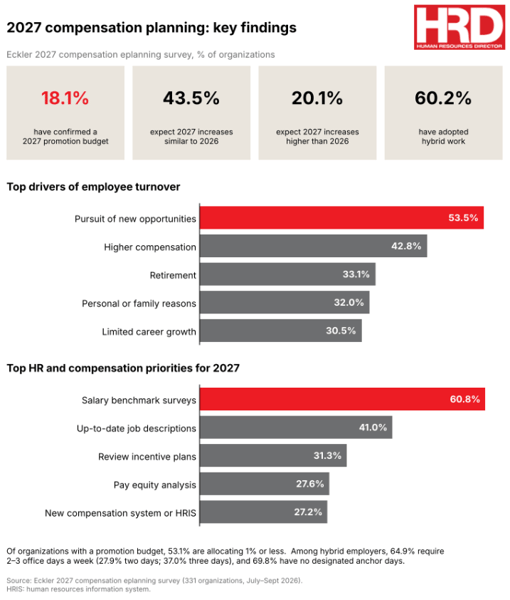
Just 18.1% of organizations have confirmed a promotion budget for 2027, and most of those budgets are modest, according to the survey of 331 organizations. The salary figures cover non-unionized employees and exclude freezes, which remain rare.
That combination puts HR leaders in a difficult position. Eckler links employers’ caution to trade tensions and economic uncertainty, while employees’ inflation catch-up demands and talent shortages in specialized fields keep pressure on pay.
Thin promotion funding raises retention stakes
The promotion gap matters because career growth is one of the main reasons employees leave. Employers in Eckler’s survey cited new opportunities (53.5%), higher compensation (42.8%) and limited career growth (30.5%) among the leading drivers of turnover.
Darcy Clark, senior principal of compensation at Normandin Beaudry, told Benefits and Pensions Monitor (BPM) that base increases compound into bonuses, benefits premiums and pension contributions, which is why many employers fund targeted retention programs separately. “There’s certain skill sets and levels of talent that’s always going to have retention risks,” he said.
For HR leaders, that means promotion and retention dollars must be aimed carefully. Eckler respondents are prioritizing fundamentals for 2027, led by salary benchmark surveys (60.8%), current job descriptions (41.0%), incentive plan reviews (31.3%) and pay equity analysis (27.6%).
Other surveys confirm 2027 salary budgets are holding
Those benchmarking efforts will show a consistent market. Normandin Beaudry’s 2027 Salary Increase Survey of more than 800 organizations found employers expect a 3.1% average increase in 2027, excluding freezes, matching 2026. Including additional budgets, total increases reach 3.3%.
“The story here is there is no big story, which is a story in itself given what’s going on in the external markets,” Clark told BPM. “The quantum hasn’t changed, but I think everything around that number has changed.”
Mercer Canada’s July 2026 QuickPulse Canada Compensation Planning Survey of more than 470 organizations points the same way, with planned total increases of 3.2%. HRD Canada has reported on how Canadian employers are holding salary budgets at 3.1% for 2027, and on how starting salary increases for HR roles lag behind other in-demand jobs.
Regional and sector gaps HR leaders should watch
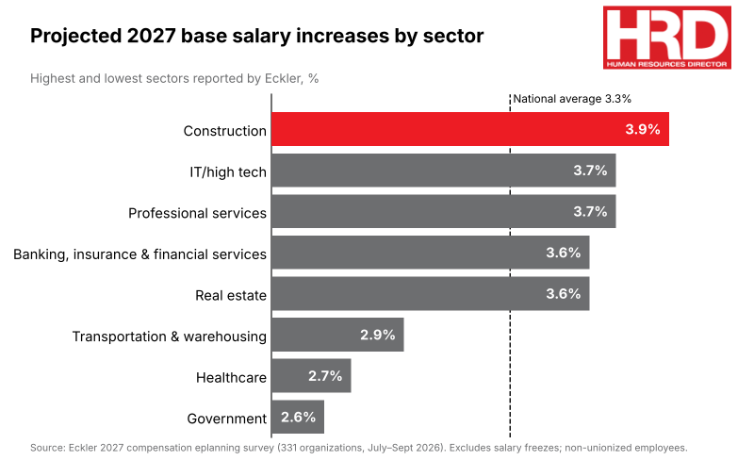
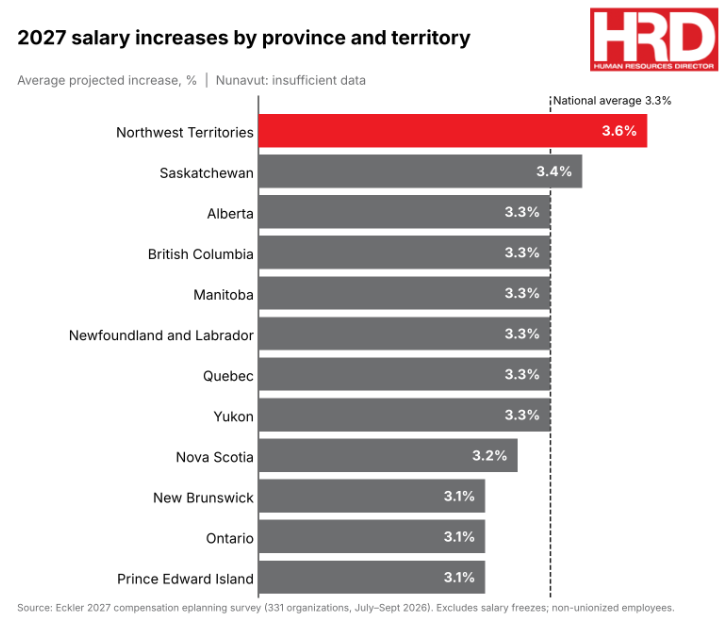
Beneath that national consensus, Eckler’s data shows meaningful variation. The Northwest Territories leads at 3.6%, followed by Saskatchewan at 3.4%, while Ontario, New Brunswick and Prince Edward Island trail at 3.1%. Construction tops the sectors at 3.9%, while government (2.6%) and healthcare (2.7%) sit lowest.
Those gaps matter more when inflation runs close to pay budgets. Statistics Canada reported the Consumer Price Index (CPI) rose 3.1% year over year in September 2026, so employers in lower-budget sectors with little promotion funding may struggle to retain staff.
Non-pay levers can help close that gap, as organizations named among the Best Places to Work in Canada for listening to employees demonstrate. With more than a quarter of Eckler respondents still finalizing budgets, HR leaders have time to make that case before 2027 plans are locked in.